Analysts See Marathon Petroleum Earning $55 a Share in 2027 and Half That in 2028. I Think Both Years Are Wrong
October 16, 2026 · Marathon Petroleum Corporation (MPC)
profitmonk
Summary
- The war knocked out the world's refineries faster than its oil supply. Crude is moving through Hormuz at pre-war levels again, but refined fuel is moving at under a fifth of its old rate.
- Marathon Petroleum earned $24.84 of refining EBITDA per barrel in the June quarter, up from $6.79 a year earlier, and beat consensus earnings by 24%.
- For 2027 my model is below the street. If I apply the EIA's own forecast of a 20% lower diesel margin, I get about $43 a share. Consensus is $55.09.
- For 2028 it is well above the street, on one assumption. If 2027's margin holds for one more year, earnings reach about $46 a share, 67% above the $27.61 consensus.
- The bet is on how long this lasts. At $478.07 the stock trades at 17.3 times 2028 consensus and about 10 times my 2028 case. My case needs the broken refineries to stay broken longer than analysts expect.
Wolfe's Doug Leggate Asked How Long This Lasts
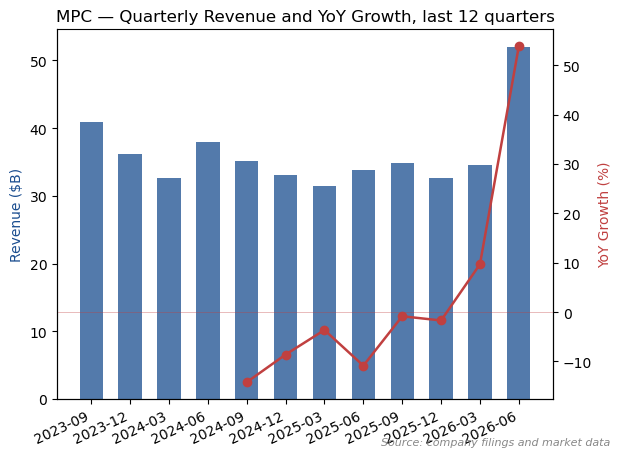
Refiners rarely get a quarter like Marathon Petroleum's June quarter, and the best question on the call was how long it could last. On 4 August the company reported adjusted earnings of $17.73 a share, 24% above consensus. It returned $2.8B to shareholders and still built cash.
"Those of us who have been doing this for 30 years are looking at it going, 'Well, how long is this going to last?'" said Doug Leggate of Wolfe Research. He wanted to know whether the cash build meant management doubted the margin. Chief executive Maryann Mannen said it did not: "No, our capital allocation priorities are consistent."
Since then the margin has hit a 20-year high. The crack spread is the gap between the price of crude and the price of the fuel made from it. A calculation from EIA spot data shows the 3-2-1 version of it averaging $68.23 a barrel in September, the highest monthly value since June 2006. Brokers spent the first half of October catching up, and Wells Fargo raised its target to $560 from $400.
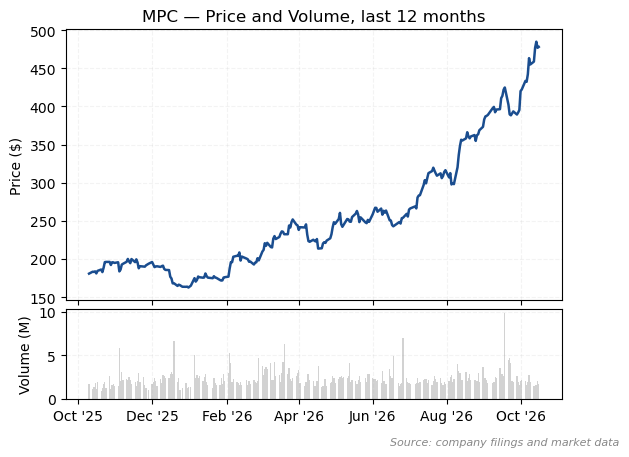
The stock closed on 16 October at $478.07, 195% above its 52-week low. Leggate's question is now the whole investment case.
The Refiner From Findlay, Ohio
Marathon Petroleum owns no oil fields. It buys crude, turns it into gasoline, diesel and jet fuel, and sells the fuel. It is based in Findlay, Ohio, and was spun off from Marathon Oil in 2011.
It is big. The 2025 annual report lists 13 refineries with about 3 million barrels a day of capacity. Two Gulf Coast plants, Galveston Bay and Garyville, account for 42% of that, and Los Angeles is the largest of its three West Coast plants. The fuel goes out through Marathon-branded outlets, ARCO stations in Southern California and export markets.
Two deals made the present company: the 2018 purchase of Andeavor and the 2021 sale of its Speedway gas stations to 7-Eleven for $21.38B. Marathon also owns the general partner and about 64% of the common units of MPLX, a listed pipeline and gas-processing partnership. MPLX turns out to be the steadier half of the business.
Refining Earns the Swings, and MPLX Pays the Bills
Marathon's three segments behave very differently. The company reports each one on adjusted EBITDA, which is earnings before interest, tax, depreciation and one-off items.
| Segment adjusted EBITDA | FY2024 | FY2025 | Change | Q2 2025 | Q2 2026 | Change |
|---|---|---|---|---|---|---|
| Refining & Marketing | $5.70B | $6.14B | +8% | $1.89B | $6.66B | +252% |
| Midstream | $6.54B | $6.75B | +3% | $1.64B | $1.78B | +8% |
| Renewable Diesel | $(150)M | $(110)M | $(19)M | $258M | ||
| Corporate | $(774)M | $(822)M | ||||
| Total | $11.32B | $11.96B | +6% | $3.29B | $8.46B | +157% |
The cycle shows up in Refining & Marketing. As the table shows, its EBITDA more than tripled in the June quarter, and chief financial officer Maria Khoury said "all regions contributed," mainly through "a stronger margin environment." Capture is the share of the benchmark crack spread that a refiner actually banks. Marathon's was 112%, so it earned more than the benchmark said it should.
Midstream is the ballast. MPLX gathers, moves, stores and processes crude, fuel and natural gas. It earns fees on contracted capacity, and in 2025 it earned more than Refining & Marketing did. Management credited that year's growth to its Permian-to-Gulf Coast gas chain and two acquisitions.
Renewable Diesel is small: a plant at Dickinson, North Dakota and half of a venture with Neste at Martinez. It lost money until this year. In the June quarter it turned a profit, helped by "improved regulatory credit values."
What Changed Is That a War Took Refineries Offline
Management thought the market was tight before any fighting started. Its risk factors rank long-run demand erosion second, behind margin volatility. Even so, the 2025 annual report expected "global demand growth to outpace the net effect of refining capacity additions and rationalizations through the end of the decade." It also described "stable demand and U.S. gasoline and distillate inventories at or below five-year averages."
Then the 2026 war in the Persian Gulf changed the arithmetic. The Congressional Research Service describes an April ceasefire, a June memorandum and renewed fighting in July. On the call, Mannen added that Ukraine had stepped up its attacks on Russian refineries. The Dallas Fed wrote on 8 October that since late spring the world had lost as much as 6 to 8 million barrels a day of refining. That is up to about 10% of world capacity, gone from a market that was already tight.
Demand Is Setting Records While Inventories Run Dry
Demand for American fuel is setting records. Management told analysts that "U.S. jet was at an all-time high in June," and chief commercial officer Rick Hessling added: "We hit distillate records on exports in the quarter." The EIA confirmed record second-quarter exports, and Hessling said they were flowing from Garyville and Galveston Bay to Latin America and Europe.
US fuel stocks are near the bottom of their range. Mannen said gasoline was "well below the five-year range" and distillate sat "at the bottom of its five-year range." Washington has been drawing down its emergency stockpile too. The Dallas Fed puts the Strategic Petroleum Reserve at 284 million barrels in September, its lowest since 1982, after about 110 million barrels of releases this year.
Marathon took some of those barrels itself. "We bought directly from the SPR. We avoided the middleman," Hessling said. The company has to repay them, an obligation that sits in working capital.
Forecasters see the near term the same way. OilPrice.com reported that Goldman Sachs expects a US diesel margin of $50 a barrel in the fourth quarter. The EIA's October outlook keeps distillate inventories below their 2021 to 2025 average through 2027.
The question that matters for 2028 came from UBS analyst Manav Gupta: "Is there a possibility here that for the next 10 years or so, even the mid-cycle is higher?" Mannen would not give a number. "We remain constructive well into 2027," she said.
The Constraint Is Refining Capacity, and It Is Slow to Rebuild
What limits supply is the number of working refineries in the world. Crude oil came back first and refined products have not followed. Marathon's margin comes from that gap.
The Strait of Hormuz shows it most clearly. On 30 September CNBC, citing Kpler data, reported that crude flows through the strait were back to pre-war levels. Refined products averaged 677 thousand barrels a day, compared with 3.6 million before the war.
Mannen put the global shortfall at "over 9 million bpd of planned and unplanned refined capacity downtime, approximately 4 million bpd above historical norms." She said Russia alone has a third of its capacity offline and has "fully banned diesel export." The Dallas Fed thinks the shortage can outlast the fighting for this reason. It wrote that product prices "could stay unusually high even after crude-oil flows normalize."
California is losing capacity for reasons of its own. Phillips 66 closed its Los Angeles refinery by the end of 2025, partly because of state policy. Valero planned to stop refining at Benicia in April 2026. Industrial Info Resources expects California capacity to fall to at most 1.3 million barrels a day this year. Marathon's Los Angeles plant sits inside that shrinking market. Hessling said the waivers that let Gulf Coast cargoes sail west "aren't enough to overcome the lack of Asian imports."
Marathon itself is adding no refining capacity. Its $1.5B standalone capital budget for 2026 goes to existing plants. Mannen said the plan does not rely "on any particular specific market environment."
New supply is coming, mostly in Asia and Africa. BNEF expects about 4.2 million barrels a day of net global additions from 2026 to 2030, with China and India taking about 71% of the 2026 to 2027 additions. About half of the total is running or under construction. BNEF describes the later projects, due in 2028 to 2030, as "mostly at earlier stages." My 2028 case turns on that timing.
What It Is Worth: Less Than the Street in 2027, Far More in 2028
My model turns on one number: refining EBITDA per barrel, which is what Refining & Marketing earns on each barrel it processes. In the last quarter of 2025, before the war, it was $7.15. In the record June quarter it was $24.84. Capacity is fixed, so volume barely moves. Across about 1.06 billion barrels a year, each extra dollar per barrel adds roughly a billion dollars of EBITDA.
I hold everything else at 2025 levels: Midstream, Renewable Diesel, corporate costs and turnarounds. That is conservative for Midstream, because management has guided to growth at MPLX. I assume shares fall at the 2025 buyback pace of about 6.5% a year, to about 247 million by 2028. The full walk is in the published research brief.
For 2027 I use the EIA's September Short-Term Energy Outlook. It forecasts the distillate crack, the refining margin on diesel, falling about a fifth to $1.25 a gallon in 2027. If I cut Marathon's record June-quarter margin by the same fraction, it earns $17.44 a barrel. That is more than double the pre-war level and gives 2027 earnings of about $43 a share.
That puts me more than a fifth below the $55.09 consensus. To earn $55, Marathon would need about $21 a barrel for a full year, 86% of its record quarter, in a year when the EIA expects the margin to fall.
I think the street's real mistake is 2028. Consensus of $27.61 a share implies $11.69 a barrel. In other words, analysts have Marathon giving back more than half of its margin above pre-war levels in a single year.
| What 2028 looks like | Refining EBITDA per barrel | 2028 earnings per share |
|---|---|---|
| Back to the last quarter of 2025, before the war | $7.15 | $12.89 |
| What the 2028 consensus implies | $11.69 | $27.61 |
| The EIA's 2027 margin holds one more year | $17.44 | $46.25 |
| The June 2026 quarter as a run rate | $24.84 | $70.23 |
My case is the third row. If the EIA's 2027 margin carries into 2028, Marathon earns about $46 a share, two-thirds above consensus. Three things have to happen: the damaged capacity in the Gulf and Russia stays partly offline, the reserve gets refilled, and BNEF's later projects run late. None of them requires a repeat of the June quarter.
Three assumptions carry the result:
- The 2028 margin. This matters most, because every $2.34 a barrel moves 2028 earnings by about $7 a share.
- The bridge. This is how I turn EBITDA into earnings per share, after depreciation, interest, tax and the part of MPLX that other investors own. When I tested it against two past quarters, it understated actual profit both times.
- Buybacks. Without further buybacks, earnings per share are about 13% lower in every case. Buybacks also shrink when margins do, so this risk adds to the first one.
What the Market Is Paying: Fair on 2028 Consensus, Cheap If Margins Last
I value Marathon on 2028 earnings, because 2028 is the year this argument is about. At $478.07 the stock trades at 17.3 times 2028 consensus, a full multiple for what analysts treat as the low year. On my case it trades at 10.3 times 2028 earnings. It only looks expensive, at 37.1 times, if margins go all the way back to pre-war levels. So the price is fair if consensus is right, and cheap if the EIA's 2027 margin lasts one more year.
Trailing multiples are only a cross-check, and they show Marathon no more stretched than its two closest rivals. That holds for earnings and for enterprise value to EBITDA, which prices the whole business, debt included, against its operating earnings.
| Trailing multiples | P/E | EV/EBITDA |
|---|---|---|
| Marathon Petroleum | 16.5x | 9.2x |
| Phillips 66 | 16.6x | 10.4x |
| Valero | 18.4x | 9.8x |
Against its own history the stock looks dearer. Over its last nine profitable years its earnings multiple has ranged from 4 to 24 times, and today's multiple sits in the 78th percentile.
The street is less sure than I am. The average analyst target of $474.17 is just below the price. Buy ratings fell from 53% of the total in July to 45% in October, and Citi and Bank of America both raised their targets while keeping Neutral ratings.
Shareholders get paid while they wait, mostly through buybacks. The dividend yields 0.84%. Repurchases at the second-quarter pace would retire about 7.4% of the company a year, and $6.1B of authorization remains.
The Competition Runs Cheaper, but Marathon Runs More Crudes
Marathon's two closest rivals also had a huge quarter, so the useful question is which of the three is best placed for 2028. Valero's second-quarter refining operating income more than tripled to $4.5B. Chief executive Lane Riggs credited "exceptional operational and commercial performance." Phillips 66's realized refining margin more than doubled. The three companies define per-barrel margins differently, so capture is the cleaner comparison, and Marathon's was 108% for the half.
Valero's advantage is cost. Its cash operating cost was $4.70 a barrel, against Marathon's third-quarter guide of $5.60, and in a downturn cost per barrel matters more than capture.
Marathon's advantage is the range of crudes it can buy. Planning executive Julian Stoll said its system can run "over 100 different types of crudes," and that lets it lean on cheaper grades, which lifts its margin. Canadian heavy crude trades about $14 a barrel below WTI, the US benchmark. Hessling says Marathon has "the largest appetite for Canadian barrels of anyone in the U.S.," and he expects the discount to widen by "about $2 a barrel" into the fourth quarter. Marathon also more than doubled its Venezuelan runs from the first quarter to the second. Mannen said its pipeline access limits its exposure to crudes priced off Brent, the international benchmark, which the war affected most.
MPLX settles it for me. Mannen said its distributions to Marathon are "$2.8 billion and growing," enough to cover the dividend and capital spending, and MPLX plans 12.5% distribution growth in both 2026 and 2027. That frees the whole refining windfall for buybacks. My sources do not size Valero's or Phillips 66's midstream holdings, so I cannot compare them directly. Even so, I think Marathon is the best placed of the three for 2028, as long as margins stay high enough that crude choice and MPLX cash outweigh Valero's lower costs.
The competitor that worries me most is the new Asian refinery. Large integrated plants in China and India compete for the Latin American and European export markets where Marathon set records this year. Most of BNEF's additions land in 2026 and 2027, and my 2028 case assumes the war damage absorbs them. I leave the later wave out of my 2028 numbers because BNEF itself puts those projects at early stages.
What Could Go Wrong Is Written in the First Risk Factor
Marathon's own list of risks opens with the whole thesis. The first risk factor in its 2025 annual report reads: "Our financial results are affected by volatile refining margins, which are dependent on factors beyond our control." The second covers long-term demand under "industry, market, technological and regulatory developments regarding emissions, fuel efficiency" and related rules.
Another disclosed risk is already costing money: the availability and cost of renewable identification numbers and of credits related to low carbon fuel programs. The price of one main type of these credits nearly doubled between the start of the year and early June. Executive John Quaid said of Marathon's banked credits: "we are pulling on the bank, and that is not sustainable." Hurricanes are a further disclosed risk, given how much capacity sits at Galveston Bay and Garyville.
Part of the second quarter's 112% capture will not repeat, so the third quarter will probably come in lower. Khoury said the figure included "the physical offset related to the derivative losses in the first quarter," a one-off unwind. Advantaged barrels bought from the reserve also helped. That benefit could recur, because Hessling sees "potentially another 38 million" barrels of releases. Khoury also flagged third-quarter maintenance at Gulf Coast and Mid-Continent units that will be "a headwind to capture." Mannen said third-quarter capture averaged 95% over 2023 to 2025.
Washington wants lower fuel prices. Kevin Hassett at the White House has promised "fast" relief "as refineries restart," and Energy Secretary Chris Wright has pointed out that diesel is already 20 to 25 cents below its peak. Reserve releases and shipping waivers both push down the same crack spread Marathon earns.
The strongest case against me is a fast return to normal. The EIA expects diesel margins to ease through mid-2027 if Hormuz traffic returns to normal. An S&P Global outlook puts the refining low point in 2027 to 2028, though I could not confirm when it was written, and it may predate the war. If the Middle East and Russia repair faster than expected, Mannen's 4 million barrels a day of excess downtime disappears into a market that is also adding capacity.
My answer is that the bull case already gives up 2027. I model that year below the street, on the EIA's own forecast, and ask only that the EIA's 2027 margin survive one more year. The assumption most likely to be wrong is that 2028 margin, followed by my bridge from EBITDA to profit.
What I Am Watching
The first test is the third-quarter report on 3 November. Consensus implies refining EBITDA of roughly $28 a barrel, above the record second quarter, and capture has to beat its usual third-quarter average despite the maintenance work. The second test is the EIA's November and December outlooks. If they cut the 2027 distillate crack below $1.25 a gallon, my 2028 case loses the forecast it is built on.
Takeaway
Analysts expect Marathon Petroleum to earn $55 a share in 2027 and then lose half of it within a year. I think they have both ends wrong. The EIA's own forecast puts 2027 below consensus, and given the state of the world's refineries I find a fast collapse in 2028 hard to believe. If the margin the EIA forecasts for 2027 lasts one more year, Marathon earns about $46 a share in 2028, and the stock trades at about 10 times that.
Sources
- Marathon Petroleum Q2 2026 earnings release, Form 8-K, 4 August 2026
- Marathon Petroleum Q2 2026 earnings call, 4 August 2026 (Maryann Mannen, Maria Khoury, Rick Hessling, Julian Stoll, John Quaid; questions from Doug Leggate of Wolfe Research and Manav Gupta of UBS)
- Marathon Petroleum Q4 2025 earnings release, 3 February 2026
- Marathon Petroleum Form 10-K for 2025, Items 1, 1A and 7, filed 26 February 2026
- MPLX Q2 2026 earnings release, August 2026
- US Energy Information Administration, Short-Term Energy Outlook, September and October 2026, and Today in Energy on Q2 2026 petroleum markets
- Federal Reserve Bank of Dallas on global refining capacity, 8 October 2026
- CNBC on Hormuz product flows, citing Kpler, 30 September 2026
- International Energy Agency, Oil Market Report, March 2026
- BNEF Global Oil Refining Outlook, as reported by Anadolu Agency and Semafor, 29 September 2026
- Industrial Info Resources on global and California refining capacity, September 2026
- Congressional Research Service, report R45281, 2026
- OilPrice.com reporting Goldman Sachs fuel-margin forecasts, 2026
- Oil & Gas Journal and Argus on the Phillips 66 Los Angeles closure; Pipeline & Gas Journal on Valero Benicia, April 2025
- Valero and Phillips 66 Q2 2026 earnings releases and coverage, including Reuters
- Biofuels Digest citing EIA on D4 credit prices, 10 August 2026; RBN Energy, 25 June 2026
- KVIA on the El Paso refinery release, 2 October 2026
- MarketBeat and Investing.com on broker target changes, October 2026
- A calculation of the September 2026 3-2-1 crack spread from EIA spot data
- Company filings, reported results, analyst consensus and market price data
- Full working, including the per-barrel model, the earnings bridge and the anchor:
research/2026-10-16_MPC.md
Research, not a recommendation. Figures are sourced as cited and were current at publication; nothing here is personalized investment advice.