Okta Fell 9.2% on an Anthropic Launch. Six Months Later, Anthropic Picked Okta
Oct 10, 2026 · Okta, Inc. (OKTA) profitmonk
Summary
- The February sell-off was wrong about Anthropic. Okta fell 9.2% in one day when Anthropic launched a security product. By August, Anthropic had named Okta the first identity provider for its new enterprise login standard.
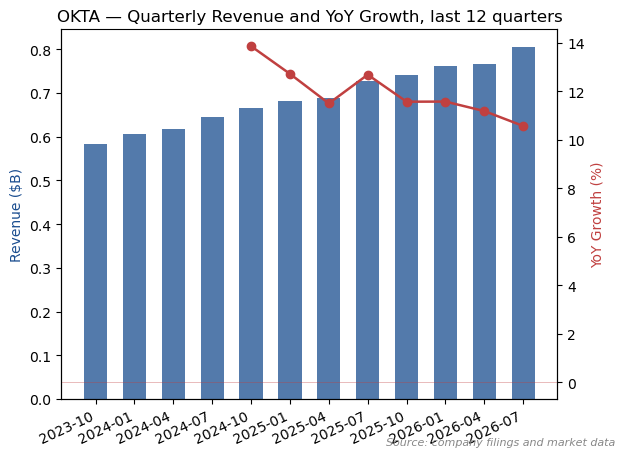
- The backlog is speeding up. Contracted revenue due in the next twelve months (cRPO) grew 14% in the quarter to July, up from 12% the quarter before, and new products drove about 30% of bookings.
- My edge over consensus, the analysts' average forecast, is small and rests on one assumption. If backlog growth holds near 12% against the 10.3% consensus implies, my fiscal 2029 revenue comes out about 3% higher. My earnings match theirs because I hold margins flat.
- The price already pays for my base case. At $232.13 the stock trades at 47.5 times analysts' fiscal 2029 earnings and 3% above their average price target.
- I would hold, and buy more only on proof. That proof is December's backlog report showing growth of 13% or better.
The Market Sold Okta on an Anthropic Launch, Then Anthropic Chose It
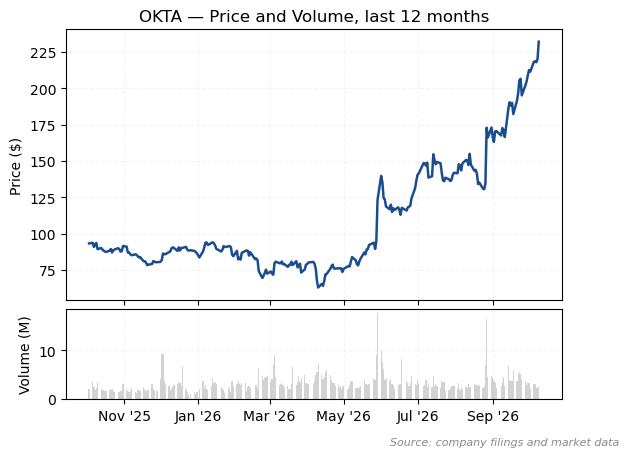
The sell-off that defined Okta's year hit the wrong target. On 20 February Anthropic launched Claude Code Security, and Bloomberg reported that Okta fell 9.2% that day. Investors were betting that AI labs would build security into their own products and leave the specialists less to sell, and the stock kept sliding to a 52-week low of $62.66.
Six months later the lab the market had feared was a partner. On the 26 August earnings call, co-founder and chief executive Todd McKinnon said Anthropic had shipped Okta's open protocol for agent logins inside Claude, in a feature Anthropic calls Enterprise Managed Auth. Okta is the first identity provider to support it.
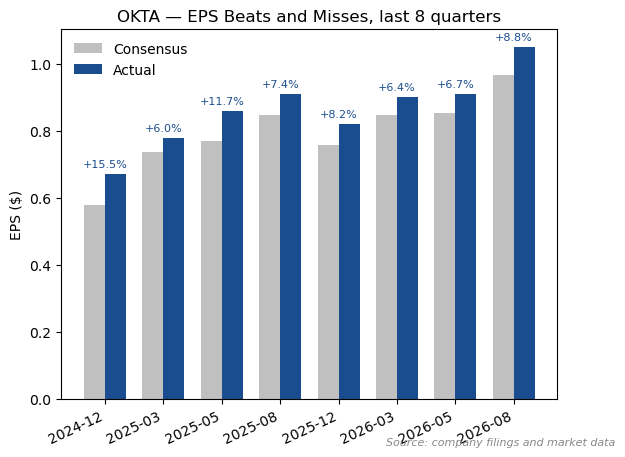
The quarter behind the announcement was strong too. Revenue rose 11%, and non-GAAP earnings of $1.05 a share beat consensus by 8.8%, Okta's eighth beat in a row. Non-GAAP is Okta's adjusted measure, and I use it for earnings throughout because guidance and analysts use it too.
By 10 October the stock had nearly quadrupled from that low, closing at $232.13, a whisker below its 52-week high.
The Company That Sells the Login
Okta decides who gets into what. Its software checks which employees, customers and now software agents may open which applications. Its fiscal 2026 annual report counts more than 20,000 customers, and McKinnon told analysts in August that Okta prices per user.
The business grew by stacking products on single sign-on, which lets a worker log in once and reach every approved app. Okta bought Auth0, a developer-led login service for consumer apps, in 2021, and has since added identity governance, privileged access and threat protection. Large buyers pay for that breadth: the annual report counted 5,100 customers spending more than $100,000 a year.
At $232.13 Okta is worth $38.56B. It holds $2.3B of cash and short-term investments, and it has carried no convertible debt since settling its last notes in cash in June.
Subscriptions Are Nearly All of Revenue, and Operating Leverage Has Arrived
Subscriptions make up nearly all of Okta's revenue. They are sold to employers for their staff and, through Auth0, to companies running logins for their customers. The small services line, which ran at a negative 29% margin, is moving to outside consulting partners, and the handoff costs about a point of revenue growth this year and nothing after.
The bigger story is fiscal 2026, the year to 31 January 2026, when operating leverage arrived. Sales and engineering costs fell as a share of revenue, so Okta swung from an operating loss to a GAAP operating profit.
| Fiscal year | FY2026 | FY2025 | Change |
|---|---|---|---|
| Subscription revenue | $2.86B | $2.56B | +12% |
| Total revenue | $2.92B | $2.61B | +12% |
| GAAP operating income | $149M | $(74)M | |
| Sales and marketing, % of revenue | 35% | 37% | −2 pts |
| Research and development, % of revenue | 22% | 25% | −3 pts |
Okta Is Now Profitable, and It Has a New Kind of User
Okta has turned from a loss-making growth stock with a security problem into a cash generator. In October 2023 an attacker stole data from its third-party-hosted support system. Fiscal 2026 was its first full year of GAAP operating profit, and in the July quarter Okta generated $227M of free cash flow, 28% of revenue.
There was a soft patch. Dollar-based net retention, which measures how much last year's customers spend this year, eased a point to 106% at January 2026, and management blamed a weaker economy.
What has changed since is the software agent. Companies are deploying AI programs that act for employees, and each one needs an identity, a permission set and an off switch. McKinnon described a customer where Okta's scanner found 50 instances of a Claude agent, and "we came back a few weeks and there was 1,500 Claude agents." That is a thirtyfold jump in a few weeks.
Big Customers Are Signing Longer and Larger
The backlog is my best evidence of demand, and it is speeding up. Total backlog (remaining performance obligations, or RPO) is signed revenue not yet recognised, and cRPO is the slice due within twelve months. cRPO growth has gone from about 12% to 14% over two quarters.
| Backlog at 31 July 2026 | Value | Growth on the year |
|---|---|---|
| Due within 12 months (cRPO) | $2.59B | 14% |
| Due after 12 months | $2.27B | about 21% |
| Total backlog (RPO) | $4.86B | 17% |
The fastest-growing piece is the part due after twelve months, which tells me customers are committing for more years as well as more dollars. Chief financial officer Brett Tighe called July "a record bookings quarter for a non-Q4," and McKinnon said the pipeline is bigger than last quarter's record.
Big customers buying more of the platform are driving it. McKinnon says the group of more than 600 customers paying over $1 million a year is growing 22%. Adding any new product to a deal lifts contract value by about 40% on average, and Okta Identity Governance, which decides and audits who should have access to what, leads those products.
So far AI mostly opens the conversation. A Fortune 50 healthcare company signed a multimillion-dollar Okta for AI Agents deal to meet strict HIPAA compliance requirements. The more telling deals are the ones AI started and other products finished. A Pennsylvania retailer began with an agent conversation that McKinnon said "helped us win the consolidation business" at an acquired subsidiary on older identity software. A Fortune 25 company running "200 identity vendors" could save "tens of millions of dollars" by standardising on Okta, though that one is still pipeline.
Tighe was frank about scale. "Still immaterial. Still very small," he said of AI revenue, before adding that for fiscal 2028 and beyond "there is a real possibility for this to be material." Fiscal 2028 ends on 31 January 2028, inside my horizon.
Sellers and Standards Are the Constraints to Watch, and Neither Binds Yet
Okta's software has no capacity bottleneck. What could slow it is the number of specialist sellers it can field and whether other vendors adopt its agent standard.
Demand for Okta's AI specialists already exceeds the team. However many people Okta adds, McKinnon said, "we fill up their calendar," so the pace of hiring caps how fast the pipeline converts. Implementation now runs through partners, and the annual report lists a shortage of qualified partners as a risk.
Standards matter because an agent protocol only works when the app on the other side accepts it. Cross-App Access (XAA) is Okta's open protocol that lets an AI agent request access to an application on a user's behalf. Anthropic has shipped it in Claude, and 26 top software-as-a-service vendors support it on the application side.
Okta is paying to speed adoption. The week of the call it put agent single sign-on into its base product at no extra charge, because the first question any app vendor asks is "how many customers can do it? And now the answer is 20,000." In the federal market Okta has earned IL5 from the Department of Defense, which McKinnon called "the highest level unclassified cloud authorization."
Neither constraint bites today, because Okta keeps adding specialists and the standard already has Anthropic and 26 application vendors behind it.
What It Is Worth: Consensus Assumes the Backlog Slows
My fiscal 2029 revenue is above consensus. My earnings are not, because I hold margins flat. The whole disagreement is about how long growth lasts: consensus implies 10.3% a year, roughly this year's guided pace rolled forward, and I assume 12%, closer to the pace of the signed backlog.
The model compounds revenue for two years, to fiscal 2029 (the year ending January 2029), from Okta's August guidance of $3.22B for fiscal 2027, at a rate taken from backlog growth. Backlog is the right guide because cRPO is next year's subscription revenue already signed, and last year it grew about 12%, in step with revenue.
| Case | What it assumes | Growth a year | FY2029 revenue | FY2029 non-GAAP EPS |
|---|---|---|---|---|
| Bear | Okta's May guided pace | 9% | $3.83B | $4.67 |
| Base | Last year's growth | 12% | $4.04B | $4.93 |
| Bull | Latest quarter's backlog growth | 14% | $4.19B | $5.11 |
| Consensus | This year's guide rolled forward | 10.3% | $3.92B | $4.89 |
For earnings I hold this year's guided 26% non-GAAP operating margin flat on 184.4M diluted shares. Analysts' fiscal 2029 revenue estimates run from $3.83B to $4.16B, so my bear case sits exactly at their floor and my bull case above their ceiling. I think the backlog points to the upper end.
An outside anchor supports the base case. Gartner expects the identity market to grow about 9% a year. My base case has Okta lifting its share of that market from about 14% to about 15% in 2028, while consensus roughly holds share, and a company with record bookings and a fast-growing long-dated backlog should take some share.
Three assumptions carry the model:
- cRPO growth of at least 12% through fiscal 2028. It drives the entire revenue gap. If growth slips to about 9.6%, fiscal 2029 revenue falls to roughly $3.87B, below consensus.
- Per-user pricing survives the move to agents. McKinnon prices the agent product as an uplift on each user, so revenue still rides on headcount. If AI shrinks customers' workforces faster than the uplift grows, revenue falls short of the base case.
- The 26% margin holds. My earnings only match consensus at that margin. Stock compensation already runs at 14.2% of revenue, and the Permiso deal and AI hiring add cost, so any slippage puts my earnings below the analysts'.
What the Market Is Paying: 47.5 Times Earnings Two Years Out
A price-to-earnings multiple tells you how many years of earnings today's price buys. Fiscal 2027 here is the year ending January 2027.
| Measure | Multiple |
|---|---|
| Price / FY2027 guided non-GAAP EPS ($3.92) | 59.2x |
| Price / FY2028 consensus EPS | 53.4x |
| Price / FY2029 consensus EPS | 47.5x |
| Free cash flow yield on market value | 2.4% |
The multiple that matters is the two-years-out one, because it is the price of earnings the business has not yet made. At 47.5 times fiscal 2029 consensus earnings, which my base case matches, the stock is fully priced on my own numbers. That multiple makes sense only if growth stays above 10% beyond fiscal 2029 and agent revenue becomes material, and the stock already sits 3% above the analysts' average target of $225.09.
Okta trades at a 24% premium to its closest peer on sales, 12.5 times against SailPoint's 10.1 times. Sales is the only usable comparison because SailPoint, the closest pure identity company, has negative trailing earnings. Okta's profits justify paying more, but the premium confirms the stock is not cheap. Okta's own history is no benchmark either, since it has only two profitable GAAP years.
Okta Wins on Neutrality, Against a Rival That Bundles
The competitive bull case rests on one claim: a company running agents from Microsoft, Google, OpenAI and Anthropic will want an identity layer that none of them owns. Anthropic choosing Okta first is the best outside evidence for it. The best customer evidence is one of the world's largest asset managers, running thousands of agents from several vendors, which chose Okta for its neutrality.
Microsoft is the real opponent, and Okta's annual report says so plainly: "Our principal competitor is Microsoft." Microsoft bundles Entra ID, formerly Azure Active Directory, with the Microsoft 365 suites many companies already own. McKinnon said Microsoft's blogs suggest it is building an agent registry, though he was unsure it has a real product yet. "I think Microsoft is copying us, which I think they have been for 15 years," he said. His argument is that "it's really hard to make an agent registry that works as well for Amazon and Google and OpenAI and Anthropic as it does for Azure and Microsoft."
The security majors are consolidating too. CNBC reported in July 2025 that Palo Alto Networks had agreed to buy CyberArk for $25B. CyberArk sells privileged access management (PAM), which locks down the most sensitive administrator accounts. McKinnon thinks that is the wrong place to start with agents: "It makes no sense to start it from the most locked down thing sitting next to the Oracle database on a sun server."
SailPoint competes head-on with Okta Identity Governance, and Okta answers with breadth: access, governance, PAM and threat protection on one platform. "We're the only identity vendor that can do that. Everyone else has a silo," McKinnon said, and the new-product share of bookings backs him up.
Okta treats ServiceNow and Salesforce as partners, and McKinnon notes that people log in to Salesforce's agent platform through Okta. He dismisses the agent-identity startups as "pivots" that buyers "sure don't want to have to buy 5 of."
Okta is also buying capability to sharpen its threat-protection pitch against these rivals. Permiso, which detects threats across human, non-human and agent identities, closed on 26 August. McKinnon says it brings 400 risk detections, the signals that flag a suspicious session, against 90 in Okta's existing threat product.
Okta Wrote the Bear Case Into Its Own Filing
Okta's own annual report lays out the strongest risks. The first is the economy, because weaker conditions and spending cuts have reduced demand before. The fiscal 2026 retention slip shows that risk is live, though a one-point dip is mild.
The second is the seat count. The filing warns that if customers shrink their workforces, Okta manages fewer identities and its revenue may fall. Okta prices its agent product as an uplift on each user, so if AI cuts headcount faster than the uplift adds revenue, my second assumption fails. McKinnon conceded the point: "Seats are going away and you got to charge per agent. That all may be true."
The filing also warns of rivals bundling products and selling at zero or negative margins, which reads as Microsoft, and says past security incidents hurt its reputation and financial results. My answer to the first is the neutrality evidence above. On the second, the filing discloses the October 2023 support-system breach, and my sources do not say whether other incidents have occurred since.
Two risks the filing does not spell out matter as much. The first is that AI labs absorb security features, which is what the market feared in February. My best answer is that the lab behind that sell-off then adopted Okta's standard, and BofA argued at the time that AI still lacked the visibility, control and reliability to replace full security platforms.
The second is timing. Investing.com reported that Oktane, Okta's September conference, brought no new financial framework, and McKinnon admitted Okta lacks four years of history on how its pipeline converts.
The assumption most likely to be wrong is 12% growth, and Okta's own guidance questions it. Okta guided third-quarter (Q3 FY27) cRPO growth of 11% to 12%, down from the 14% it had just reported. Tighe calls the guidance prudent, and Okta beat its second-quarter cRPO guidance by about three points, so the question is whether that cushion persists. If the beats stop and growth settles at the guide, my base case falls to consensus and the multiple loses its support.
What I Am Watching
Two reports will tell me whether the backlog acceleration is real.
| When | Event | What would confirm the base case |
|---|---|---|
| 1 December 2026 | Third-quarter (Q3 FY27) results, cRPO guided up 11% to 12% | cRPO growth of 13% or better; below 12% puts growth on the consensus path |
| Around early March 2027 (my estimate, from last year's timing) | Fourth-quarter results and first fiscal 2028 guidance | Guidance starting above the 10.3% consensus implies |
December is the nearer and cleaner test, because it shows whether July's acceleration holds with room above the 12% my base case needs.
Takeaway
I would hold Okta at $232.13 and buy more only if December's cRPO report shows growth of 13% or better. The price already pays for my base case, so the reason to own the stock is how long growth lasts. In February the market priced Okta as a casualty of the AI labs, and by August the first of those labs had chosen Okta's standard. Large customers are signing longer contracts, and agent conversations are opening doors to governance and consolidation deals. Consensus has the backlog slowing while the July quarter showed it speeding up, and December will show which of us is right.
Sources
- Okta Q2 FY2027 press release, Form 8-K Exhibit 99.1, 26 August 2026
- Okta Q2 FY2027 earnings call, 26 August 2026 (Todd McKinnon, Brett Tighe, Eric Kelleher)
- Okta Q1 FY2027 press release, Form 8-K Exhibit 99.1, 28 May 2026
- Okta Form 10-K for fiscal 2026, Items 1, 1A and 7, filed 5 March 2026
- Bloomberg on the Claude Code Security selloff, 20 February 2026, and Barchart on the same move with BofA's comment
- The Motley Fool on Okta's February decline, 8 March 2026
- Business Insider on the Okta IPO, April 2017
- CNBC on Palo Alto Networks and CyberArk, July 2025
- Gartner identity and access management forecast, fourth quarter 2025, as reported by the Software Strategies Blog
- Juniper Research identity market forecast, as reported by iTWire
- Investing.com on the Oktane 2026 investor reaction, September 2026
- Company filings, reported results, analyst consensus and market price data
- Full working, including the three-case model, the anchor and the earnings bridge:
research/2026-10-10_OKTA.md
Research, not a recommendation. Figures are sourced as cited and were current at publication; nothing here is personalized investment advice.