SanDisk Locked In $42 Billion of Multi-Year Memory Backlog. Q4 Prints August 5.
Jul 14, 2026 · SanDisk Corporation (SNDK) profitmonk
Summary
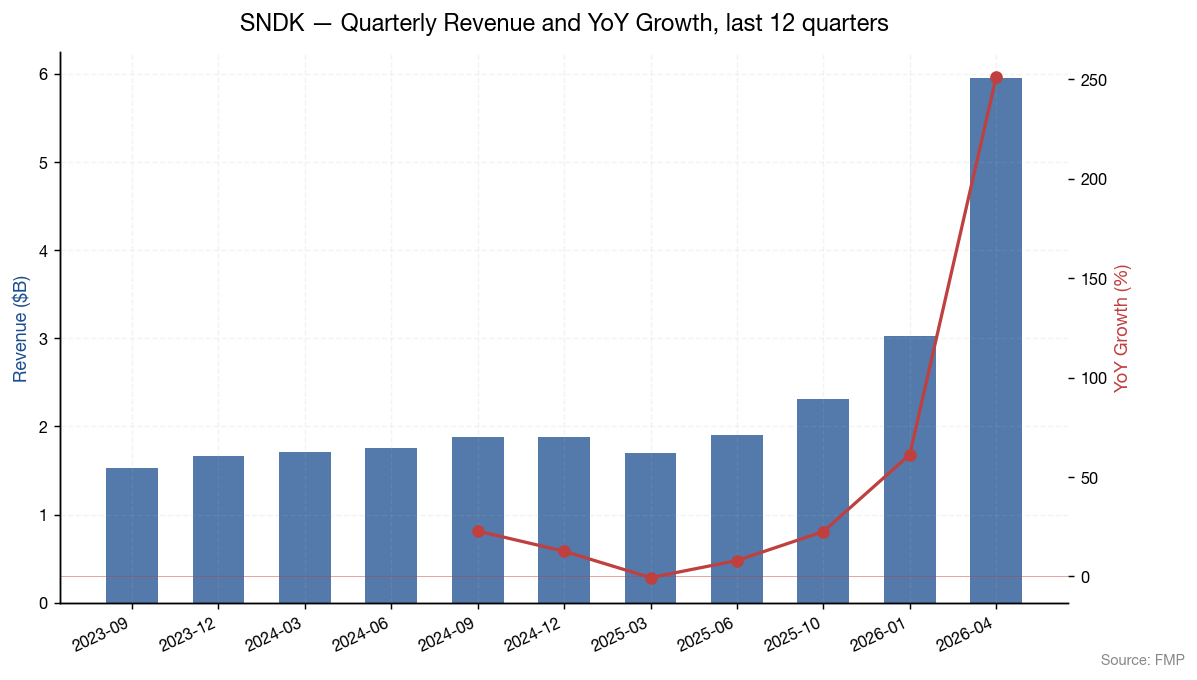
- SanDisk reported $5.95 billion in fiscal Q3 revenue (quarter ended April 3, 2026), up 251% year over year and 97% sequentially, with datacenter revenue up 233% as hyperscalers built out AI storage.
- The company now carries roughly $42 billion of remaining performance obligation from three multi-year supply agreements, backed by more than $11 billion in financial guarantees, which turns NAND's historically violent spot cycle into contracted backlog.
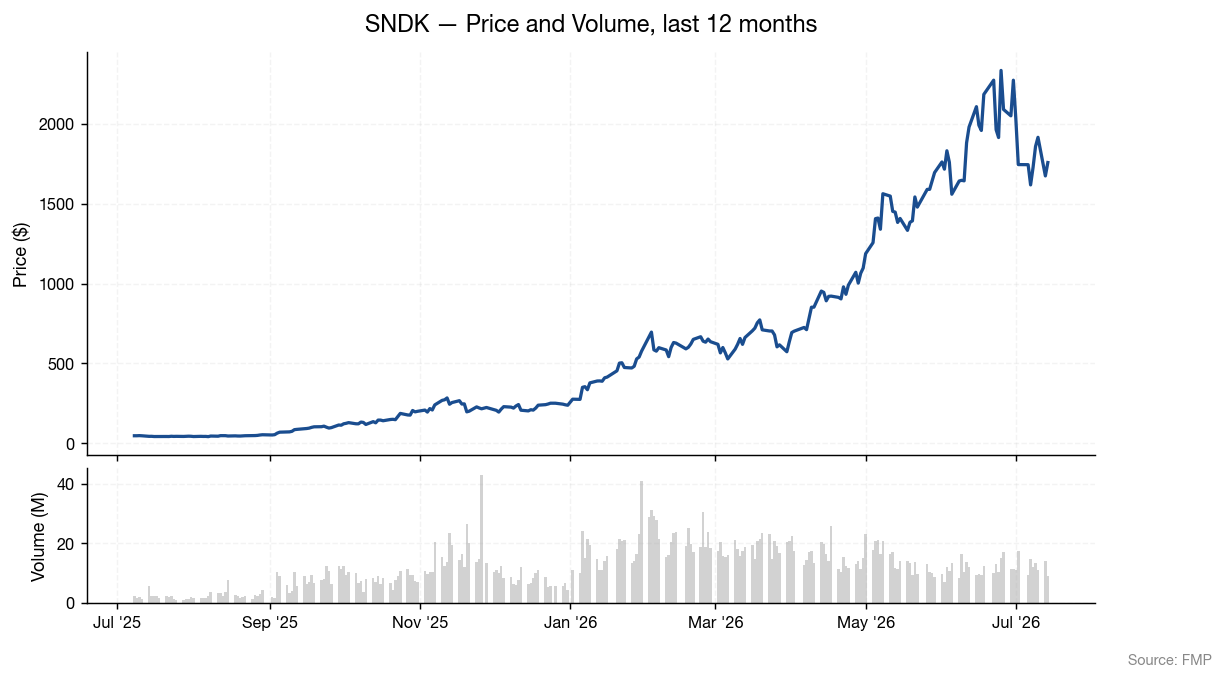
- Non-GAAP gross margin reached 78.4%, and the Q4 guide calls for $7.75 billion to $8.25 billion of revenue and $30 to $33 of non-GAAP EPS, a level that leaves the stock near 25 times forward earnings even after a 707% year-to-date run.
- TrendForce has the NAND industry structurally undersupplied into 2027 and 2028, with contract prices up more than 100% in the first half of 2026, and SanDisk supplies into that shortage on the shared fab scale of its Kioxia joint venture.
- High Bandwidth Flash, a new memory tier that stacks NAND the way HBM stacks DRAM, is the free option on top of the thesis, with samples due in the second half of 2026 and a first AI-inference device in early 2027.
Investment Thesis
The market is still valuing SanDisk with the reflexes it learned from twenty years of NAND boom-and-bust, where every up-cycle was a trap because spot prices always collapsed once the shortage cleared. I think that reflex is now the mispricing. SanDisk spun out of Western Digital and began trading on its own in February 2025, and in the fifteen months since it has done something the old NAND industry almost never did, which is to lock a large share of its output into multi-year supply agreements at fixed or range-bound pricing while the AI-storage shortage is still tightening. The result is a company reporting 78% gross margins and 251% revenue growth that also happens to be sitting on a $42 billion contracted backlog, with more than a third of its fiscal 2027 bit supply already committed. The stock has run 707% year to date and still trades at roughly 25 times the midpoint of management's own next-quarter guidance. The question going into the August 5 print is not whether the numbers are big, because everyone can see that they are. The question is whether the backlog and the supply discipline make this cycle different enough to justify paying up, and my argument is that they do.
The Demand Story: Hyperscalers Are Buying Storage Like They Bought GPUs
The single most important number in SanDisk's last report was not the headline revenue. It was the 233% year-over-year growth in datacenter revenue, because that is the line that tells you who is actually buying. NAND (the non-volatile flash memory that stores data in solid-state drives) has spent most of its history as a consumer commodity, going into phones, laptops, and cameras. What changed in 2026 is that AI datacenters became a first-order buyer of high-capacity storage, and they buy the way hyperscalers buy, in enormous committed volumes rather than spot orders.
The industry data backs the shift. Enterprise SSD revenue grew 86% sequentially in the first calendar quarter of 2026 on hyperscale AI infrastructure spend, per Astute Group, and hyperscalers now consume roughly 55% of enterprise SSD volumes, which means they set the pace for the entire supply chain. When a handful of buyers that large all reach for the same constrained supply at the same time, price does what it did here. TrendForce reported NAND contract prices up 70% to 75% sequentially in the second calendar quarter of 2026, after already rising sharply in the first, and by mid-June TrendForce described contract prices as having surged more than 100% across the first half of the year.
The part that I think is genuinely under-covered is what SanDisk did with that demand. Rather than sell every bit into a spot market that everyone knows will eventually turn, the company signed multi-year supply agreements with what it calls very meaningful AI and hyperscaler buyers, and it now reports roughly $42 billion of remaining performance obligation (RPO, the contracted revenue it has booked but not yet delivered) against those deals. That backlog is backed by more than $11 billion of financial guarantees and about $0.4 billion of prepayments already received. SanDisk declines to name the customers, so I will not invent them, but the structure is the tell. A commodity supplier does not get $11 billion of guarantees and cash up front unless the buyer is desperate to secure supply years in advance.
The Supply Story: The Shortage Runs Into 2028, And SanDisk Shares a Fab Empire
Demand only matters if the rest of the industry cannot simply flood the market and crush price, and this is where the current cycle diverges from the old ones. TrendForce frames NAND as supply-constrained into 2027 and 2028, with makers actively shifting capacity toward DRAM and away from NAND, and with meaningful new NAND capacity unlikely to arrive until late 2027 at the earliest. Order volumes are running ahead of production capacity across the industry. That is the opposite of the classic NAND glut, where everyone raced to add wafers into a peak and buried themselves in inventory.
SanDisk supplies into that shortage from one of the largest flash manufacturing footprints in the world, which it shares through its long-running joint venture with Kioxia. The two operate the Yokkaichi site in Mie Prefecture, Japan, which has been making memory since 1987, and the newer Kitakami site in Iwate, where a second fab building known as K2 opened in September 2025 and is tooled for high-layer NAND. The venture agreements were extended in January 2026 all the way to the end of 2034, and the Kioxia and SanDisk consortium raised its 2026 combined capital investment by 41% year over year to about $4.5 billion. Sharing the fab and the capex burden with Kioxia is what lets SanDisk run a pure-play NAND model without carrying the full weight of leading-edge memory capex alone.
Management has been explicit that capital discipline is the point. On the April 30, 2026 earnings call, chief executive David Goeckeler said, "This is what makes this franchise such a spectacular cash generator, capex as a percent of revenue is continuing to go down substantially." When revenue is compounding at triple digits and capex intensity is falling, the free cash flow math gets very favorable very quickly, which is the mechanism that funds both the buyback and the next technology transition.
The Technology Proof: BiCS8, a 128-Terabyte SSD, and the HBF Option
The technology underneath the demand story is what tells you the datacenter revenue is durable rather than a one-quarter pricing spike. SanDisk's current-generation 3D NAND is called BiCS8, and it uses a manufacturing approach called hybrid bonding, where the control logic is built on a separate wafer and then bonded to the memory array, which lets the company push more storage into the same footprint. The relevant point for datacenter buyers is capacity per drive. SanDisk is qualifying a storage-class enterprise SSD built on 128-terabyte QLC NAND, its highest-density flash, with two major hyperscalers as of the January 2026 call and a third hyperscaler plus a large storage OEM targeted through the rest of the year.
QLC (quad-level cell, meaning four bits stored per memory cell) is the density lever. Packing four bits per cell instead of three gives you more terabytes per wafer, which is exactly what an AI datacenter wants when it needs to park petabytes of training data and model checkpoints as cheaply as possible. The tradeoff is endurance, and the engineering job is managing that tradeoff well enough that hyperscalers qualify the drive, which is what the ongoing qualifications represent.
The longer-dated piece is High Bandwidth Flash, or HBF. HBM (High Bandwidth Memory) is the expensive stacked-DRAM that sits next to every AI accelerator and largely determines how big a model you can serve. HBF is SanDisk's proposal to stack NAND vertically in a similar way and slot it in as a new tier between HBM and conventional SSDs. The pitch is that AI inference is capacity-bound, because model weights and the key-value cache have to live somewhere fast, and HBM is both scarce and costly per gigabyte. SanDisk has described HBF as offering roughly 1.6 terabytes per second of bandwidth, more than 50 times a PCIe 5.0 SSD, at 8 to 16 times the capacity of a comparable HBM stack. A 2026 IEEE paper from SK Hynix modeling an HBM-plus-HBF hybrid alongside Nvidia's Blackwell showed up to 2.69 times better performance per watt versus HBM alone, though that is a simulation and not a shipping product. SanDisk plans to ship HBF samples in the second half of 2026 and a first AI-inference device in early 2027. I am not underwriting any HBF revenue in the thesis, because there is none yet. I am noting that the market is getting it as a free option.
The Competitive Vector: Why the Pure-Play Wins This Specific Cycle
The reader's fair question is why SanDisk, rather than one of the larger memory names, is the way to play this. The NAND market is roughly Samsung at 28% to 29% share, SK Hynix including its Solidigm unit at about 22%, Kioxia near 15% to 16%, Micron around 13%, and SanDisk in a similar 12% to 13% band, per Counterpoint-style 2026 data. SanDisk is not the share leader, so the argument is not scale. It is focus and structure.
SanDisk wins on two moats. The first is the Kioxia fab joint venture, which gives a company of SanDisk's size access to leading-edge NAND capacity and shared capex that it could not carry alone, at the exact moment the industry is capacity-constrained. The second is the combination of BiCS8 hybrid bonding and its first-mover position on HBF, which it is helping standardize with SK Hynix through the Open Compute Project. Being early to define a new memory tier is worth more when that tier maps onto the fastest-growing demand in computing.
The named competitors are real and I will not wave them away. Micron (MU) is arguably ahead on the very newest interface, having shown its 9650, described as the first PCIe Gen6 datacenter SSD, and a 6600 ION QLC drive reaching up to 245 terabytes at Computex 2026. Micron and Samsung also carry the advantage that SanDisk structurally lacks, which is a DRAM and HBM business alongside NAND. That diversification cushions them if NAND supply loosens, because they can lean on memory lines that are still tight. Kioxia is the most complicated name on the list, because it is both SanDisk's fab partner and a direct rival racing toward its own next-generation BiCS10. The honest read is that SanDisk's competitors are not losing. The reason to own the pure-play is that when the whole category re-rates on an AI-storage shortage, the company with 100% of its revenue levered to NAND captures more of the move than the diversified names do, and SanDisk has paired that leverage with the contracted backlog that limits the downside the pure-play would otherwise carry.
The Financial Confirmation
The demand, supply, and technology story is already in the numbers, which is what separates this from a narrative running ahead of results. Fiscal Q3 revenue of $5.95 billion did not just grow 251% year over year, it beat the company's own guidance range of $4.4 billion to $4.8 billion by roughly a quarter, and it did so at a non-GAAP gross margin of 78.4%, more than 1,100 basis points above the 65% to 67% the company had guided. Non-GAAP diluted EPS came in at $23.41 against a consensus near $14.36, a beat of about 63%. Gross margin (the share of revenue left after the direct cost of making the product) at 78% for a company that used to live in the 20s and 30s is the clearest single sign that the margin came from higher prices sitting on top of the volume growth.
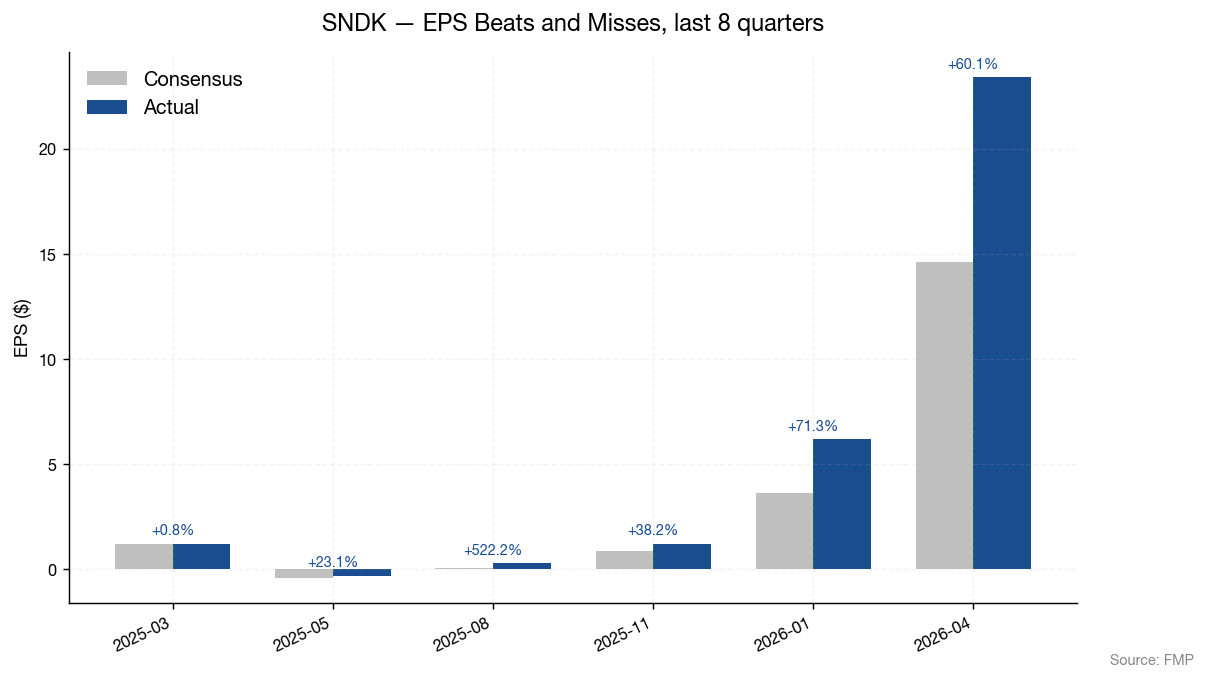
The guide is where the setup gets interesting. Management called for fiscal Q4 revenue of $7.75 billion to $8.25 billion, non-GAAP EPS of $30 to $33, and gross margin of 79% to 81%, and the Street has settled slightly above that, near $8.35 billion of revenue and $34.21 of EPS. When the sell-side consensus sits above the company's own guide, the market is telling you it expects another beat. The analyst revisions run the same direction. Bernstein raised its price target to $3,000 from $1,700 at the end of June 2026, Susquehanna went to $3,250 from $2,000, Cantor Fitzgerald to $2,900 from $1,800, BofA Securities to $2,500 from $2,100 in early July, and Barclays upgraded the stock to Overweight. The published target band runs roughly $2,000 to $4,000 with about 83% of ratings on the buy side, per MarketBeat in July 2026.
The Risks
I would not own this without being honest about what breaks it, and the first risk is the oldest one in the sector. NAND is cyclical, and roughly 40% of SanDisk's output remains exposed to uncontracted or spot pricing. If the AI-storage shortage eases faster than expected, spot prices re-rate down hard, and 78% gross margins compress toward something far more normal. Bear scenarios circulating in mid-2026, including notes on Seeking Alpha and 24/7 Wall St, put downside cases in the $1,000 to $1,204 range, which is a 30% to 45% drawdown from here. My response is that the $42 billion contracted backlog and the more than one-third of fiscal 2027 bits already committed are precisely the buffer the old NAND cycles never had, so a spot softening dents the uncontracted 40% rather than the whole book.
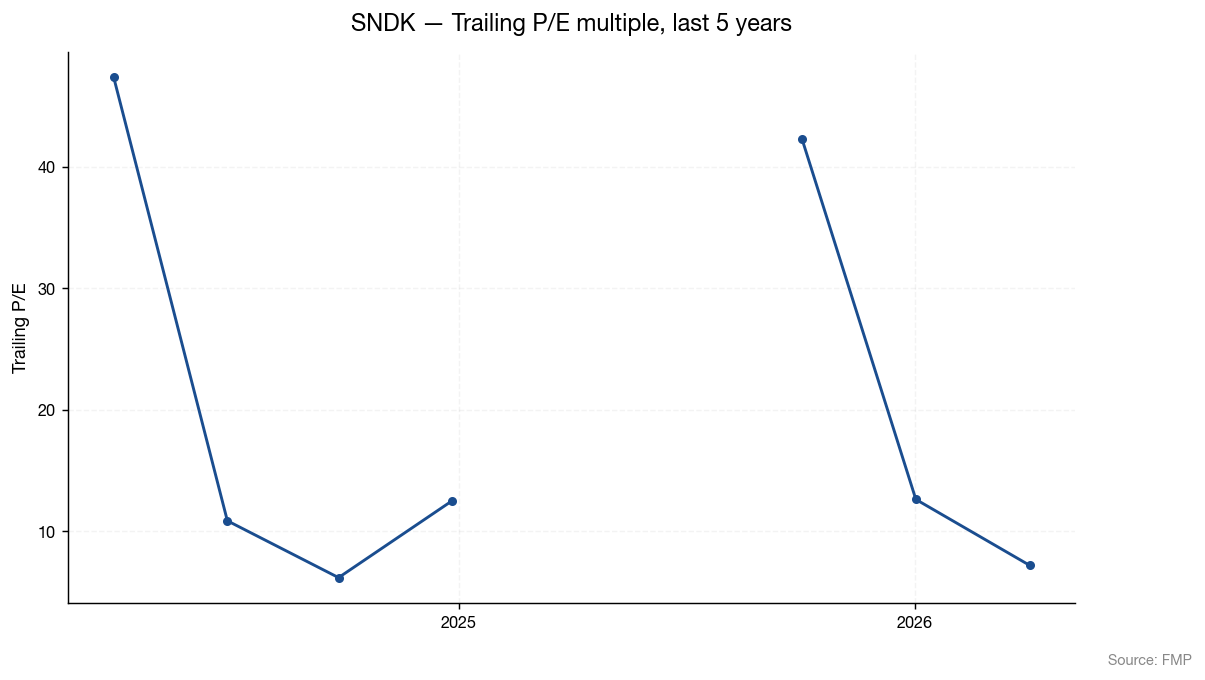
The second risk is valuation. Even after framing the growth, the stock trades near 25 times forward earnings and around 18 times book value, and pure-play NAND has historically been a business you buy near book value in the trough, not at a large premium near a peak. A multiple that rich can compress on its own, without earnings even falling, if the market simply decides the cycle has peaked.
The third risk is that the most exciting part of the story, HBF, is unproven and years from revenue, with samples only in the second half of 2026 and a first product in early 2027, while Kioxia and the broader industry ramp new capacity that could bring oversupply by 2027 or 2028. My response is that I am underwriting none of the HBF upside in the base case, so it can only surprise to the upside, and the near-term thesis stands on the backlog and the pricing that are already in the reported numbers.
Takeaway
SanDisk is a pure-play NAND company that has done the one thing the NAND industry historically failed to do, which is to sell a large slice of a shortage forward at contracted pricing, and it is doing it while reporting 251% revenue growth and 78% gross margins. The valuation is rich and the cycle is real, so this is not a stock to pretend is safe. The reason to be long is that the $42 billion backlog changes the shape of the downside while the AI-storage demand curve is still bending upward, and the next proof point lands on August 5, 2026, when fiscal Q4 either confirms the guide or does not.
Sources
Research, not a recommendation. Figures are sourced as cited and were current at publication; nothing here is personalized investment advice.