Analysts Cut Carvana's Targets After Its Biggest Quarter. Its Capacity Disagrees
October 31, 2026 · Carvana Co. (CVNA)
profitmonk
Summary
- Carvana sold 217,385 used cars in the third quarter, 39% more than a year earlier, in a market that was flat.
- Several analysts, Needham among them, cut their price targets anyway on higher rates, and the stock still sits 30% below its 52-week high.
- Consensus for 2028 implies about 1.25 million retail units, so growth would slow to about 23% a year while reconditioning capacity is about half used.
- If production reaches its 1.5 million-car capacity in 2028, today's profit per car would earn about $5.5B of adjusted EBITDA, roughly 20% above the $4.6B implied by Needham's target.
- The risk is the loan line, which earns 39% of gross profit and depends on buyers such as Ally, whose $8B commitment runs to July 2027.
The Quarter Carvana Crossed 200,000 Cars
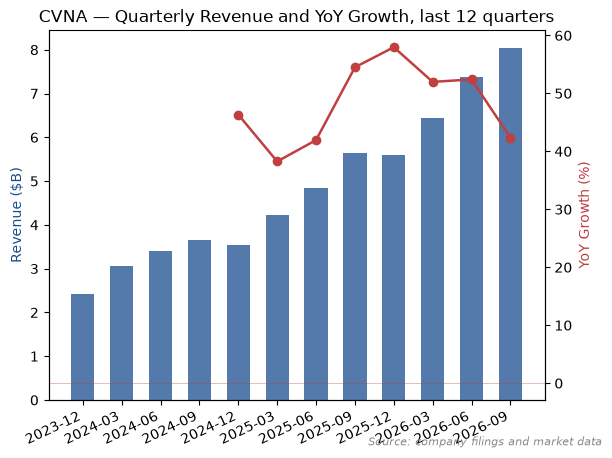
Carvana reported after the close on 28 October, and chief executive Ernie Garcia III opened the call with a milestone. "This is our first quarter with over 200,000 sales," he said. Retail units rose 39% to 217,385, and revenue passed $8B for the first time.
Earnings per share missed. GAAP diluted EPS was $0.39 against a $0.44 consensus, and because Carvana reports no adjusted EPS, I use the GAAP figure throughout. The beat came in the numbers the market actually trades this stock on: Investing.com reported that both units and adjusted EBITDA, at $800M, came in ahead of estimates.
24/7 Wall St.'s headline on 29 October had the stock up 15% on the day. Even so, at $68.29 it sits 30% below its 52-week high.
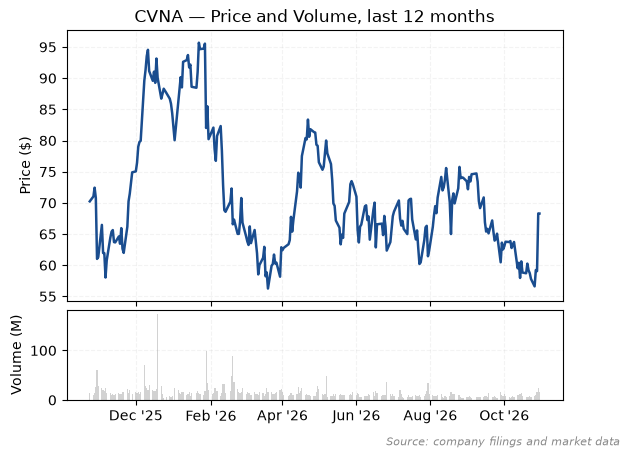
Then the targets came down. Benzinga's headline that day said analysts cut them even after a beat across all major KPIs. Needham's Chris Pierce kept his Buy but cut his target to $100, lowering the multiple he applies to 2028 adjusted EBITDA to 25 times "on higher rates." BofA stayed at Neutral, and TipRanks reported that Morgan Stanley named Carvana a top pick.
Those cuts are about the multiple, which turns on interest rates. I think the more useful question is how many cars Carvana sells in 2028.
The Company That Sells Used Cars Through a Website and a Glass Tower
Carvana is a Tempe, Arizona-based online used-car retailer, which its annual report calls "the leading e-commerce platform for buying and selling used cars." It buys cars from customers, at auction and from wholesale suppliers, then inspects, reconditions and photographs them in its own centers. Buyers take delivery at home or collect from one of 39 multistory vending machines, and every car carries a seven-day return.
Operations began in 2012 as a spin-off from DriveTime, the Garcia family's used-car dealer. Its Class A shares trade on the New York Stock Exchange as CVNA, and the company says 75% of the US population lives within 100 miles of one of its reconditioning or auction sites.
The Garcias control the company through high-vote Class B shares, and the 10-K says the Garcia parties hold "approximately 83% of the voting power." Carvana's market value is about $75B. A five-for-one stock split in May 2026 explains why some year-old price targets look several times higher than today's.
Three Revenue Lines, and the Smallest Earns Two-Fifths of the Profit
Carvana does not report segments, but it does report three revenue lines, and the gross profit on each shows where the money is made.
| Q3 2026 | Revenue | Change | Gross profit | Per retail unit | Per unit, Q3 2025 |
|---|---|---|---|---|---|
| Retail vehicles | $6.14B | +54% | $773M | $3,556 | $3,456 |
| Wholesale vehicles | $1.30B | +11% | $154M | $708 | $866 |
| Other | $594M | +25% | $594M | $2,733 | $3,040 |
| Total | $8.04B | +42% | $1,521M | $6,997 | $7,362 |
Retail is the car itself. Revenue grew faster than units because, as chief financial officer Mark Jenkins put it, Carvana is "selling a mix of higher-priced vehicles." Revenue per retail car rose to $28,263 from $25,625.
Wholesale covers the cars that miss Carvana's retail standard. Its profit per retail unit fell because, Jenkins said, retail unit growth outpaced wholesale gross profit growth.
Other is the most profitable line and the least understood. It is mostly the gain Carvana makes by writing a buyer's car loan and then selling that loan to investors. It also includes commissions on vehicle service contracts and GAP waivers. Revenue and gross profit on this line were both $594M, so its margin is essentially 100%.
Other profit per car fell by about $300. Part of that was a choice, because late in 2025 Carvana decided to pass some of its loan gains back to customers as lower rates. Part was the market, since, as Jenkins put it, "benchmark rates continued to rise meaningfully over the course of the quarter." Even after the fall, this line earned 39% of Carvana's gross profit.
How a Used-Car Retailer Is Measured
A car retailer comes down to cars sold, gross profit on each car, and the cost of selling each car. Carvana's growth story lives in the first, and its margin debate lives in the other two.
Carvana's unit growth has held near 40% for four straight quarters. CarMax, the largest used-car retailer, grew comparable-store used units 13.0% in its quarter to 31 August, and that came after three quarters of declines.
Retail gross profit per car is where Carvana's model shows. Its $3,556 compares with $2,105 in CarMax's September results. On Carvana's adjusted basis, total gross profit per car fell $410, most of it on the loan line.
Non-GAAP selling, general and administrative expense per car was roughly flat at $3,413 (GAAP $3,703, down from $3,816). Operations cost more per car "primarily due to higher fuel and logistics costs," Jenkins said, but lower overhead more than offset it.
The net of all this is adjusted EBITDA per car, which fell to $3,680 from $4,085. Even so, the shareholder letter says Carvana's margin remains "about 2x that of the industry average."
The loan gain is the last number to know. In the first nine months of 2026 Carvana originated $14.2B of loans and booked gains of about 7.6% of that amount on selling them. When RBC's Brad Erickson asked whether that premium can hold, Garcia said the absolute dollars have stayed "inside of a very, very tight range."
What Changed: The Constraint Moved From Money to Machines
Three years ago Carvana's problem was money. Its adjusted EBITDA margin in 2023 was 3.1%, and its restructured debt included 2030 notes that charged up to 13% a year, part of it payable in more debt.
Those notes are now gone. In August Carvana replaced the last $1.7B of them with a term loan that carries no financial covenant, and Jenkins expects "approximately $45 million of annual interest expense savings." Net debt is 0.8 times trailing adjusted EBITDA, a company record.
So Carvana no longer has to prove it can survive. What it has to prove is that it can produce cars fast enough. The macro pressures management cites are rates and fuel, which together cost "about $200 per unit" this quarter, while the annual report says tariffs "did not materially impact" 2025 results.
Management is also changing how it keeps score. "In 2027, we plan to shift our primary reporting focus from our historical Non-GAAP metrics to their GAAP counterparts," the letter says. The long-term goal is now "selling 3 million retail units annually at a 12.5% Operating margin between 2030 and 2035." From the February 2027 call onward Carvana does not plan to give outlooks, so the fourth quarter is the last one measured against guidance.
The Demand Story: Share Gains in a Flat Market
Carvana grows by taking share, because the market itself is not growing. Cox Automotive forecasts 38.5 million used-vehicle sales in 2026, of which 20.5 million are retail sales by dealers. Carvana's letter says "the industry was once again approximately flat compared to last year," and Jeff Lick of Stephens went further on the call: "the used car business was actually down."
At the 870,000 annual run rate Garcia cited, Carvana has about 4.2% of dealer retail sales. The 10-K says the ten largest used-car retailers together hold less than 10% of the market.
Garcia's view is that demand does not limit Carvana. "Our general premise and kind of belief over a multiyear period is that our rate of growth is constrained by our ability to scale the supply chain," he said. "We think that there's clearly additional demand available to us if we can produce the cars."
Two of his remarks back that up. Inventory "was growing a little slower than we kind of ideally would have liked," he said, so Carvana is spending more on advertising "to keep pressure up." He also said sales grow fastest wherever Carvana adds cars, and "the most notable area… is in prime," meaning buyers with strong credit.
The offer is improving too. Over two years, the letter says, Carvana roughly doubled its selection and cut delivery times by two days, and its net promoter score, a survey measure of how likely buyers are to recommend it, rose 9 points.
Regulation may help. Trade press reported that in March 2026 the FTC warned 97 dealer groups that advertised prices must include mandatory charges such as documentation fees, and Garcia said "directionally, that benefits us."
Funding is part of demand in this business, because every financed car needs someone to buy the loan. In the third quarter Ally amended its agreement and now commits "to purchase up to $8 billion of principal balance of finance receivables through July 2027." A separate loan purchase agreement was enlarged and extended to January 2028.
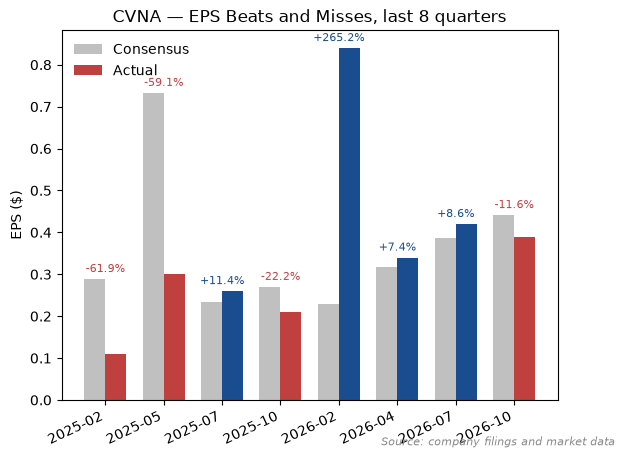
The earnings record is noisy, which is why I lean on units. The fourth quarter of 2025 beat by 265% because it carried a $685M non-cash tax benefit, while this quarter missed by 12% even as units beat.
The Constraint Is Reconditioning, and People Are the Hard Part
What limits Carvana is its own production line, because every car it sells passes through an inspection and reconditioning center before it is listed. "As we grow at 39%, our ability to hire and train these teams and to give them better tools and processes directly determines how we scale," Jenkins said.
The buildings are mostly in place. The 10-K puts reconditioning capacity at "approximately 1.5 million cars per year at full utilization," and the letter says Carvana has real estate to support 3 million. Producing a little over 200,000 cars in the third quarter, it is using only about half of that capacity.
Much of the spare room comes from ADESA, the auction business Carvana bought in 2022. Twenty-one ADESA sites now also recondition cars for retail, and three full buildouts are under construction, "all expected to begin production in 2027."
Carvana does not disclose how much capacity each new site adds, and its last fast expansion was costly. Late in 2025, Jenkins said, "adding facilities did have some outsized impacts on costs," and fourth-quarter retail profit per car fell. On this call Sharon Zackfia of William Blair asked about "the people side because that seems like it's a tougher part to scale." She was right to ask, because Carvana has to hire and train those teams while growing near 40%.
What It Is Worth: The Street Has Carvana Slowing With Room to Spare
I converted consensus into cars, because cars are the unit Carvana's capacity is measured in. The full walk is in the research brief that publishes with this article.
Analysts expect 2028 revenue of $46.3B. At the third quarter's revenue per retail car, that comes to about 1.25 million cars, so consensus has growth slowing from about 39% this year to about 23% a year.
My case disputes that one assumption, because the slowdown arrives just as three new ADESA buildouts start producing. If Carvana kept growing at this year's pace, it would hit its 1.5 million-car ceiling in 2028. That would mean about $55.5B of revenue, 20% above the consensus average and 5% above the single highest estimate.
| 2028 case | Retail units | Revenue | Adjusted EBITDA | Net income | EPS |
|---|---|---|---|---|---|
| Consensus-implied units | 1.25M | $46.3B | $4.61B | $2.78B | $2.24 |
| Capacity case | 1.50M | $55.5B | $5.52B | $3.33B | $2.69 |
| Capacity plus consensus margins | 1.50M | $55.5B | $4.24B | $3.42 | |
| Analyst consensus | $46.3B | $2.86 |
The first two rows hold third-quarter profit per car constant, with no margin improvement at all. The EPS column applies the third quarter's ratio of earnings per share to total net income, which is an approximation that moves with tax and ownership.
Needham is my anchor. Backing out its $100 target and multiple gives about $4.6B of 2028 adjusted EBITDA, and my consensus-units case lands right on it. Needham's own figure was not in the coverage I read, so this is my reconstruction. The capacity case is about 20% higher, all of it from 250,000 more cars at today's profit per car.
The earnings line tells a different story. Consensus EPS of $2.86 is already above my capacity case at constant margins. To reach it on 1.25 million cars, Carvana must earn about 27% more net income per car than it did this quarter. So the street is already bullish on margins and cautious on volume.
That margin expansion is plausible. Carvana targets a 12.5% operating margin against 8.9% this quarter, and Garcia said the cost-leverage items alone are enough to get there. The company dates that goal to 2030 through 2035, though. If both the volume and the margin arrived by 2028, EPS would be about $3.42.
So my variant is volume. I agree with the street on profit per car and disagree on cars, by about 250,000 in 2028.
What the Market Is Paying: A Platform Multiple on a Dealer's Business
On earnings Carvana looks expensive, at 23.9 times 2028 consensus EPS of $2.86.
Enterprise value to 2028 adjusted EBITDA is the better measure, and it is the basis Needham uses. On it Carvana trades at 16.7 times my consensus-units case and 14.0 times the capacity case, against the 25 times built into Needham's target.
| Trailing | P/E | EV/EBITDA | Price/sales |
|---|---|---|---|
| Carvana (CVNA) | 22x to 34x | n/m | 4.3x |
| CarMax (KMX) | 26.1x | 24.6x | 0.3x |
| AutoNation (AN) | 8.5x | 6.2x | 0.2x |
| Lithia (LAD) | 8.6x | 15.7x | 0.2x |
Carvana's trailing P/E is a range because it depends on how the late-2025 tax benefit is treated. Its trailing GAAP EBITDA absorbed $2.2B of tax receivable agreement expense, so that multiple means nothing, and CarMax's EBITDA multiple is inflated by its finance arm's debt. Price to sales is the cleanest comparison, and on it Carvana trades at about 14 to 21 times its peers.
Carvana's own history is too short to help, with only three profitable years, at 13, 118 and 41 times earnings.
My call, on 2028 EBITDA: the stock is fairly priced for the consensus path and cheap if the capacity case arrives. At 16.7 times, the market is paying for growth that slows to about 23%. Needham framed it differently, saying the current price implies Carvana reaches its 3-million-car goal after 2035, outside the company's own range.
Why Carvana Is Winning, and Why CarMax Is Not Out of It
CarMax sold 227,391 used cars at retail in its latest quarter, and Carvana sold 217,385 in a quarter ending a month later while growing almost three times as fast. "We've been the second largest seller of used cars in the country," Garcia said. "I think we're knocking on the door of becoming the largest."
Carvana's first advantage is that it owns the loan. Garcia argued that one integrated system beats "2 horizontally stacked businesses," because it lets Carvana "build better models and to price more effectively." Its underwriting is trained on over ten years of its own loans, and over two years it has cut customer loan rates by more than 100 basis points relative to benchmarks, which helps it sell more cars.
The second advantage is selection close to the buyer. "In many large metropolitan areas today with the inventory that we have, we already have more cars than the sum of dealers in many, many areas," Garcia said.
CarMax is not standing still. It is cutting $200M of exit-rate selling and administrative cost by the end of fiscal 2027, and new chief executive Keith Barr presents a strategic update on 3 November. When Oppenheimer's Brian Nagel asked whether a larger rival growing faster was hurting Carvana, Garcia said "we have not seen anything in particular from any given competitors that we believe has had any notable impact on our results."
The franchise groups compete differently. AutoNation and Lithia sell and service new cars and trade at under nine times earnings. Carvana has only just entered that business, with seven Stellantis stores bought for about $200M, and Garcia called it "very early in the game." Against all of them, its case rests on used-car economics, where its retail gross profit per car is about $1,450 above CarMax's.
What Could Go Wrong: Carvana's Own List Starts With Rates and Loans
Carvana's 10-K leads with the wider automotive ecosystem and warns that "elevated and volatile interest rates have pressured and may again pressure consumer affordability and monthly payments." That is the same force that just cut analysts' multiples. The third risk factor is blunter for a growth thesis: "Our rapid growth may not be indicative of our future growth."
The most business-specific risk heads its own category. "We depend on the sale of automotive finance receivables for a substantial portion of our gross profit," the 10-K says, and those sales depend on "investor demand and liquidity in the asset-backed securities and whole-loan markets."
Credit is softening. Auto Remarketing, citing Fitch, reported that subprime auto loan delinquencies hit a record 6.90% in January. If spreads widen and Ally renews for less, other profit per car could fall, and a 20% fall would take about $825M out of gross profit at 1.5 million cars.
The 10-K also says Carvana's agreements with DriveTime and other Garcia entities "cannot be assumed to have been negotiated at arm's length." That is where the short sellers aim. Gotham City Research alleged on 28 January 2026 that 2023-2024 earnings were overstated by more than $1 billion through DriveTime and Bridgecrest, both owned by Ernest Garcia II, the chief executive's father. Carvana called the claims "inaccurate and intentionally misleading." The 10-K also discloses a June 2025 SEC subpoena, which Carvana believes relates mainly to a report from a now-defunct short seller.
Two risks the company does not list worry me more. Adjusted EBITDA margin fell to 10.0% from 11.3% while units grew, and Carvana is dropping guidance and that metric just as it weakens. The competitive gap may also be narrowing: coverage of CarMax's call reported that management credited about half its 13% comparable gain to FTC enforcement, though I could not confirm that in a primary source.
The assumption most likely to be wrong is mine, that production keeps pace. Per-site capacity for the 2027 buildouts is undisclosed, and people are the stated bottleneck. If 2028 production reaches 1.2 million cars instead of 1.5 million, my case falls back onto consensus.
I can live with that, because the downside is roughly the consensus path the stock already trades on, while the upside is 20% more EBITDA than the street models. The funding risk is real, but net debt is 0.8 times EBITDA and the loan commitments run into 2028.
What I Am Watching
The first test is Carvana's fourth-quarter report in February, the last one measured against an outlook. Management has promised a sequential increase in units, so anything that fails to top the third quarter would undercut the capacity case. After that, I want to see 2027 growth stay well above the roughly 23% consensus implies once the ADESA buildouts start producing. The size of Ally's renewal, due by July, will set the loan line for 2028.
Takeaway
In the week after Carvana's best quarter, analysts cut their multiples for higher rates and left the more important number alone. Consensus already gives Carvana better margins by 2028, yet it assumes about 250,000 fewer cars than the reconditioning centers can handle. If the 2027 buildouts produce on time, the upside is in volume, and the loan market is the line to watch while it arrives.
Sources
- Carvana Q3 2026 shareholder letter (Form 8-K, Exhibit 99.1), 28 October 2026
- Carvana Q3 2026 earnings call, 28 October 2026 (Ernie Garcia III, Mark Jenkins; analysts Brad Erickson of RBC, Jeff Lick of Stephens, Sharon Zackfia of William Blair, Brian Nagel of Oppenheimer)
- Carvana Form 10-Q for the quarter ended 30 September 2026
- Carvana Form 10-K for fiscal 2025, Items 1, 1A and 7, filed 18 February 2026
- Carvana Form 8-K on the term loan refinancing, 14 August 2026
- Carvana Q1 and Q2 2026 results, 29 April and 29 July 2026; Q4 2025 results, 18 February 2026
- CarMax Q2 fiscal 2027 results, 29 September 2026
- Cox Automotive used-vehicle forecast update, September 2026
- Investing.com on Needham and BofA, 29 October 2026
- Benzinga, analyst price-target coverage, 29 October 2026
- TipRanks on Morgan Stanley, 29 October 2026; 24/7 Wall St., 29 October 2026
- Auto Remarketing, citing Fitch auto ABS indices, 2026
- Gotham City Research, "Carvana: Bridgecrest and the Undisclosed Transactions and Debts," 28 January 2026, and coverage of it
- Trade press on FTC warning letters to dealer groups, March and April 2026
- Company filings, reported results, analyst consensus and market price data
- Full working, including the units conversion, the anchor and the 2028 walk:
research/2026-10-31_CVNA.md
Research, not a recommendation. Figures are sourced as cited and were current at publication; nothing here is personalized investment advice.