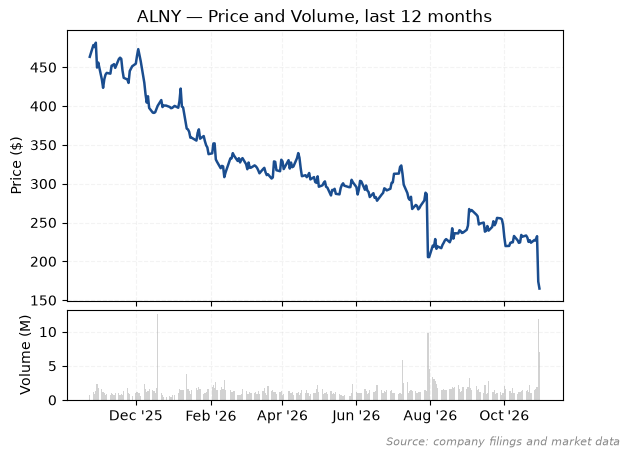
Alnylam Fell 25% in a Day. Its US Demand Still Grew $81M in the Quarter
October 31, 2026 · Alnylam Pharmaceuticals, Inc. (ALNY)
profitmonk
Summary
- Alnylam fell 25.1% on 29 October. It steered 2026 heart-drug sales to the low end of guidance and admitted its larger sales force has not yet added patients.
- AMVUTTRA, a quarterly injection for a heart disease, was 87.5% of third-quarter product sales. US demand for it still grew by $81M in the quarter.
- If that pace holds and US net price survives the 340B rule unchanged, my 2028 base case is about $8.73B of revenue. That is 10.5% above the $7.90B consensus, and it needs no re-acceleration.
- The bet rests on that one input. If quarterly demand growth halves, 2028 revenue lands near $7.22B, 8.6% below consensus.
- At $165 the enterprise value is about 2.2 times my base-case 2028 revenue. The 11 February 2027 report will show which path the company is on.
The Day a Profitable Quarter Cost Alnylam a Quarter of Its Value
On the morning of 29 October, Alnylam reported $2.2B of third-quarter net income, which was more than its entire revenue for the period. By the close the stock had lost 25.1% of its value.
The profit was mostly accounting. Alnylam released $1.95B of reserves against its US tax assets "based on sustained profitability and our expectations for future taxable income," as the quarterly filing puts it. The market traded on the call instead, where chief executive Yvonne Greenstreet told analysts: "We're not satisfied with the pace of AMVUTTRA demand growth, and we need to do better."
Chief financial officer Jeff Poulton said TTR drug sales would "land at the low end of our $4.2 billion-$4.5 billion range," and that range had already been cut in July. Poulton also called it "prudent to assume no material top-line contribution from our field expansion," meaning the enlarged sales force. AMVUTTRA itself came in just below the Zacks consensus.
The call also brought two access problems. Chief commercialization officer Tolga Tanguler said UnitedHealth had put in "a more restrictive first-line AMVUTTRA policy" for its Medicare Advantage plans from 1 October. Separately, a proposed federal rule would cut Medicare payments for drugs that hospitals buy through the 340B discount programme, starting 1 January 2027.
Stifel cut the stock to Hold and its target to $225, writing that "near-term numbers for Amvuttra are likely to decline significantly." The shares closed the week at $165, 65.6% below their 52-week high. I think the selling priced in a slowdown that the third quarter's own numbers do not yet show, and the rest of this piece explains why.
A Nobel Prize Mechanism That Finally Makes Money
Alnylam is a Cambridge, Massachusetts biotech founded in 2002 by a group that included the Nobel laureate Phillip Sharp. Its drugs use RNA interference, or RNAi, which switches off a single disease-causing gene so the body stops making the harmful protein. The discovery of RNAi won the 2006 Nobel Prize.
For two decades Alnylam was the textbook cash-burning platform biotech. It now sells four medicines and had about 2,500 employees at the end of 2025. ONPATTRO was the first RNAi therapeutic the FDA ever approved. GIVLAARI treats acute hepatic porphyria and OXLUMO treats PH1.
The drug that matters is AMVUTTRA (vutrisiran), a GalNAc-siRNA injected under the skin at 25 mg every three months. It silences the gene for transthyretin, or TTR, a protein that can misfold and clog the heart, and it cuts production of both the normal and the mutant form. The resulting disease is ATTR cardiomyopathy, or ATTR-CM, which the company says affects more than 300,000 people worldwide.
Alnylam also collects royalties on Novartis's Leqvio and on Sanofi's Qfitlia. The company is worth about $22.1B, holds $3.59B of cash and investments, and 2025 was its first full year of GAAP profit.
One Business, and One Drug Inside It
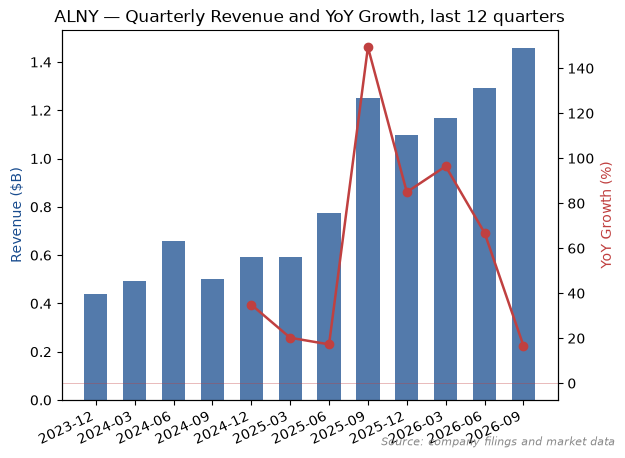
Alnylam reports a single business, so the useful split is between its two product families. TTR holds AMVUTTRA and the older ONPATTRO, and Rare holds GIVLAARI and OXLUMO. The annual report and the third-quarter release show how lopsided the company has become.
| Line | FY2024 | FY2025 | Change | Q3 2026 | Change on Q3 2025 |
|---|---|---|---|---|---|
| AMVUTTRA | $0.97B | $2.31B | +138% | $1.13B | +65% |
| ONPATTRO | $0.25B | $0.17B | −32% | $0.02B | −50% |
| TTR | $1.22B | $2.49B | +103% | $1.15B | +59% |
| Rare (GIVLAARI + OXLUMO) | $0.42B | $0.50B | +18% | $0.14B | +12% |
| Collaboration | $0.51B | $0.55B | +8% | $0.07B | −80% |
| Royalty | $0.09B | $0.17B | +90% | $0.09B | +105% |
| Total revenue | $2.25B | $3.71B | +65% | $1.46B | +17% |
| Operating income | −$0.18B | $0.50B | $0.35B | −6% |
TTR doubled in 2025 because AMVUTTRA won FDA approval for ATTR-CM in March that year. Before then it treated only the nerve form of the disease, which affects fewer than 30,000 people. Part of the growth is cannibalisation, as ONPATTRO patients switch to the newer drug.
Rare grew 12% in the quarter, led by GIVLAARI, whose sales rose 21%, while OXLUMO was flat. GIVLAARI is, in the company's words, "currently the only approved therapy for prophylactic treatment of AHP in the U.S. and EU."
The 17% headline growth understates the product business. A year ago Roche paid a $300M milestone when the first patient was dosed in a joint trial, and that payment did not repeat. Royalties, meanwhile, more than doubled on Leqvio.
How an Approved Rare-Disease Drug Earns
A biotech with approved drugs earns from three things: patients on therapy, the net price per patient, and the years of protection before generics. For Alnylam I track four numbers.
| Measure | Latest | Why it matters |
|---|---|---|
| US quarterly demand add | $81M (Q3 2026) | Growth from real patient use, first disclosed in dollars this quarter |
| Share of all TTR prescriptions | 24%, 18 months into the heart launch | Where the patient base stands today |
| Share of new-to-brand prescriptions | "north of 30%", stable | Where the patient base is heading |
| Product gross margin | 81.4% (2024), 77.3% (2025), 72.0% (Q3 2026) | Falling as the Sanofi royalty rate climbs |
| US protection, heart indication | Orphan exclusivity to 20 March 2032; patents to July 2036 | How long the earnings last |
The demand add is the increase in US sales once distributor stocking and price adjustments are stripped out. BridgeBio's rival pill Attruby gained $31M in total over the same quarter, so it grows faster in percentage terms only because its base is much smaller.
New-to-brand prescriptions count patients starting a drug for the first time, and they lead total share. That means AMVUTTRA's 24% should drift towards 30%. Greenstreet's stated target is one third.
What Changed: A Nerve Drug Became a Heart Drug
Three years ago AMVUTTRA was a roughly $0.5B drug for a rare nerve disease. The heart approval opened a market more than ten times larger by the company's own patient counts, and the drug sold $2.31B in 2025.
The scientific case is HELIOS-B, a 655-patient trial published in the New England Journal of Medicine on 30 August 2024. AMVUTTRA cut the combined rate of death and recurrent cardiovascular events by 28%.
The result was statistically solid, with a hazard ratio of 0.72 and a p-value of 0.01. Patients on AMVUTTRA alone did a little better, at 0.67, though that is a subgroup and not the primary result. Pushkal Garg, chief research and development officer, says the benefit is "preserved irrespective of background medications, including TTR stabilizers."
The macro conditions management names are mostly about policy. The 10-K says the Inflation Reduction Act "has affected and will continue to affect our business," through inflation rebates and Medicare price negotiation. It also cites an April 2025 executive order on drug pricing. The 2026 guidance assumes a euro at $1.14 and a yen at 162 to the dollar.
The Demand Story: Most Patients Are Still Untreated
The buyers are hospital systems, community cardiologists, specialty distributors and third-party infusion clinics. "Half of our actually patient base is coming from community centers," Tanguler said on the call, so this is no longer a drug used only in specialist centres.
The category is still filling. Total ATTR-CM prescriptions grew about 40% on a year earlier in the third quarter, and Tanguler said that "approximately 80% of prevalent ATTR-CM patients remain untreated."
Management sees about 75,000 treated ATTR-CM patients in the US by 2030 and wants a third of them. "If we can capture a third of the market in the U.S. with our current pricing assumptions… we believe we're well-positioned," Greenstreet said.
Diagnosis is the slow part. A study of Medicare patients reported in AJMC in May 2026 put the median gap between a heart-failure diagnosis and an ATTR-CM diagnosis at 494 days. "The enemy here is the time," Tanguler said.
The new sales force is aimed at the doctors who have not yet prescribed, and it has not paid off. More than 2,000 new prescribers have written AMVUTTRA since the heart launch, about a third of active prescribers in the category. Greenstreet explained why the next third is harder: these doctors have "fewer cardiomyopathy patients… less understanding of the disease and more entrenched prescribing behaviors." Converting them "is taking longer than we'd hoped," Greenstreet said.
My confidence comes from how prescribers behave once they start. "Trial begets preference," Tanguler said, and Greenstreet added that "those physicians who are familiar with AMVUTTRA prefer it."
The third quarter also carried noise, which I strip out. Of the roughly $100M sequential gain in US TTR sales, $81M was demand. The rest came from a distributor inventory build and a one-time Medicaid pricing adjustment, and Poulton warned that "both inventory and price in the U.S. will be headwinds" in the fourth quarter. Without those items, US AMVUTTRA ran at about $881M in the quarter, and that is my starting point.
The Constraint Is Getting the Injection to the Patient
Alnylam can make enough drug, although one supplier is a single point of failure. "Currently, Agilent is the sole manufacturer of the API for AMVUTTRA, ONPATTRO and GIVLAARI," the 10-K says, where API means the active ingredient. Alnylam also runs its own drug-substance plant in Norton, Massachusetts, which it announced it would expand in December 2025.
It has a Cambridge facility for ONPATTRO bulk drug product too. Beyond that it relies on a "limited number of CMOs in North America, Europe and Asia," the contract manufacturers named in the 10-K. No supply shortfall has been reported.
The real limit is getting the injection to the patient and getting paid for it. Access looks complete on paper, with about 99% of covered US lives able to get the drug. But AMVUTTRA is a Part B drug under Medicare, so a clinic or hospital usually buys it, gives it, and bills for it afterwards.
Tanguler listed the doubts new prescribers raise: whether they can navigate buy-and-bill, how to coordinate a referral to an administration site, and how their staff will clear prior authorisation. Pfizer's tafamidis and BridgeBio's Attruby are pills from a pharmacy and face none of it.
Alnylam has built the network to answer that. About 2,000 third-party infusion clinics give the injection, 90% of patients live within roughly ten miles of one, and Poulton said patients can also be treated at home.
The 340B rule makes the friction more expensive. The proposed rule would substantially reduce Medicare reimbursement for Part B medicines acquired through the 340B drug discount programme. Poulton called 340B "a meaningful portion of our business" and set out three ways hospitals might respond.
| Hospital response | Effect on Alnylam's net price |
|---|---|
| Keep buying through 340B | Down, because Alnylam would discount below the statutory rate |
| Switch to ordinary list-price (WAC) buying | Up |
| Move patients to infusion clinics or the home | Up |
Poulton would not size the exposure, saying the price effect could be "either positive or negative" and that the volume effect is unknown. Alnylam's own options are contracting to offer discounts to 340B hospitals and helping patients find other sites of care.
Payers add a second layer. UnitedHealth's step therapy leaves existing patients alone and has an exception process, but Tanguler said it could delay new patients. Poulton also expects possible "Q4 ordering volatility" while hospitals wait for the final 340B rule.
This is why Alnylam moved its 2027 guidance from the JPMorgan conference in January to the February results. The final rule is expected imminently, and Tanguler expects legal challenges from hospital groups. Fixing the prescriber side takes years of physician experience, while the 340B side depends on a rule Alnylam does not write.
The constraint gives a range of outcomes to 2028, and my scenarios map onto it.
| Path | What happens to access and price |
|---|---|
| Bear | Hospitals stay in 340B and net price falls; step therapy spreads beyond UnitedHealth; demand adds halve |
| Base | Demand adds hold at the third-quarter pace; 340B is neutral to the mix, so net price is flat |
| Bull | Health systems shift to WAC buying or other sites; the sales force converts; two-year HELIOS-B data helps adoption |
What It Is Worth: The Bull Case Only Needs the Pace to Hold
I built the 2028 forecast around one question. What happens if US demand keeps growing at the third-quarter pace, with no further acceleration and no change in net price? So I start US AMVUTTRA at the $881M underlying quarter and add $81M every quarter after it.
Outside the US I let sales keep the 28% growth they showed this quarter, and the rare drugs keep their 12%. I hold collaboration and royalty income flat at the guidance midpoint, even though royalties doubled this quarter, and ONPATTRO contributes almost nothing.
| Bear | Base | Consensus average | |
|---|---|---|---|
| US demand add per quarter | $40.5M | $81M | |
| Growth outside the US | 14% | 28% | |
| US AMVUTTRA, 2028 | $4.74B | $5.95B | |
| AMVUTTRA outside the US, 2028 | $1.15B | $1.45B | |
| AMVUTTRA, 2028 | $5.89B | $7.40B | |
| Total revenue, 2028 | $7.22B | $8.73B | $7.90B |
| Versus consensus | −8.6% | +10.5% | |
| Total revenue, 2027 | $7.07B | $6.66B | |
| Non-GAAP operating income per share, 2028 | $15.2 | $18.4 |
The table shows the base case beating the street in both years without any re-acceleration. Holding the third-quarter pace is enough.
The older outside anchor points the same way. Royalty Pharma reported in November 2025 that analysts expected AMVUTTRA to "exceed $6 billion by 2028," and my base case is about $1.4B above that.
That anchor predates both of this year's guidance disappointments, and I found no named 2028 forecast published since the October results. The current consensus ranges from $6.21B to $9.75B, a spread equal to 45% of the average and the widest of any year. The street does not agree on AMVUTTRA after 2027, and I think that disagreement is the opportunity.
The load-bearing assumption is the quarterly demand add. If it slips by a fifth, 2028 revenue falls to about $8.25B, still 4% above consensus. If it halves, and growth outside the US halves with it, I am on the bear path.
The weak point is 2027. My base case implies about 40% AMVUTTRA growth next year, the number the market stopped believing on 29 October, and Freedom Broker models 22%. Greenstreet said "we do not expect acceleration of growth in Q4 2026." Greenstreet did not guide a deceleration, and my case only needs the pace to hold.
Earnings follow from the margin. Alnylam made a 29.1% non-GAAP operating margin in the third quarter, close to the roughly 30% it targets by the end of the decade. I apply that margin to each revenue path to get the operating income per share in the table.
I do not turn those figures into EPS, because the company has not guided a tax rate and future profits will carry a full tax charge now the reserve is released. Consensus 2028 EPS of $11.47 sits well below my operating income per share. Tax and interest on royalty liabilities probably explain the gap, but I cannot reconcile it from published figures.
What the Market Is Paying: About Half the RNA Peers' Multiple
The headline multiple misleads. Alnylam trades at 8.1 times trailing reported earnings, but those earnings include the tax release, and stripping it out puts the trailing multiple at about 24 times.
| Measure | Multiple |
|---|---|
| Trailing P/E, as reported (includes about $13.6 a share of tax benefit) | 8.1x |
| Trailing P/E, excluding the tax release | about 24x |
| P/E on consensus 2027 EPS of $9.19 | 18.0x |
| P/E on consensus 2028 EPS of $11.47 | 14.4x |
| Price to base-case 2028 operating income per share (pre-tax, so not a P/E) | about 9x |
| Enterprise value to consensus 2028 revenue | about 2.5x |
| Enterprise value to base-case 2028 revenue | about 2.2x |
| Trailing price to sales: Alnylam / Ionis / Arrowhead | 4.4x / 8.3x / 12.6x |
Enterprise value is about $19.5B once cash is netted against the convertible debt. It rises to about $21.2B if I also count the royalty and funding liabilities on the 2025 balance sheet.
I make my valuation call on enterprise value to 2028 revenue, because revenue is the line I can model and earnings depend on a tax rate nobody has guided. On that basis the stock trades at about 2.5 times consensus and 2.2 times my base case. It looks cheap if the demand pace holds and roughly fair on the bear path, where 2028 revenue lands below consensus.
The closest listed comparisons are the two other RNA-targeting platforms, Ionis and Arrowhead, and the only like-for-like multiple is trailing sales. On that measure Alnylam trades at about half of Ionis, and it is the only one of the three that makes money. I could not compare it with BridgeBio, its most direct commercial rival, because I did not have reliable multiples for it.
Alnylam's own history gives no useful benchmark. Its only profitable year was 2025, when it traded at 166 times earnings. At today's price, the market is assuming the third quarter was the high-water mark for demand growth.
Why AMVUTTRA Wins the Science and Must Still Win the Logistics
There are three ways to treat ATTR-CM. You can stabilise the misfolded protein with a pill, silence the gene with an injection, or delete the gene once.
| Drug (company) | Approach | Where it stands |
|---|---|---|
| AMVUTTRA (Alnylam) | Silencer, injection every three months | HELIOS-B positive, hazard ratio 0.72 (95% confidence interval 0.56 to 0.93) |
| Tafamidis: Vyndaqel, Vyndamax (Pfizer) | Stabiliser pill | $6.38B of 2025 sales; growth slowed to 8% in Q2 2026 |
| Attruby, acoramidis (BridgeBio; Beyonttra from Bayer in Europe) | Near-complete stabiliser pill | US Q3 2026 sales $253.2M, up 134% |
| Eplontersen, Wainua (AstraZeneca, Ionis) | Antisense silencer | Failed the 1,432-patient CARDIO-TTRansform trial, 9 July 2026 |
| Nex-z (Intellia) | One-time CRISPR gene edit | MAGNITUDE hold lifted 2 March 2026, with added liver monitoring |
| Nucresiran (Alnylam) | Silencer twice a year, more than 95% knockdown | TRITON-CM enlarged to about 2,250 patients; heart launch targeted for 2030 |
Pfizer is the slowing incumbent, and Pfizer's filing shows its growth fading. Tafamidis loses US patent protection in 2028 and Vyndamax generics can enter from June 2031 under settlements, so payers get a cheaper pill to put ahead of AMVUTTRA in the middle of my horizon.
BridgeBio is the fast-growing challenger and still assumes a "$4 billion peak." An indirect comparison of vutrisiran and acoramidis will be presented at the ISA meeting on 15 to 18 November.
The silencer class was meant to have two members, and since July it has one. Garg gave three reasons for the AstraZeneca failure. First, "eplontersen is an ASO that achieved much less TTR knockdown than vutrisiran," under 70%. Second, the trial enrolled more advanced patients. Third, its endpoint centred on cardiovascular death and was "not optimized for success."
The positive signal in that trial, a monotherapy hazard ratio of 0.71, came from a subgroup of a failed study, so I give it no weight. What matters is the design lesson. Garg argues that all-cause mortality is "a more sensitive endpoint in this disease than CV mortality" and that an event-driven study beats a time-bound endpoint.
TRITON-CM, nucresiran's heart trial, was built on those lessons. It uses all-cause death and recurrent events, runs until enough events accrue, and screens for earlier patients on NT-proBNP, a blood marker of heart strain. In earlier-stage populations, Garg said, Alnylam has seen "upwards of 40% reduction in cardiovascular event rates."
Intellia's 1,200-patient MAGNITUDE trial was put on hold on 29 October 2025 after a liver event and a later patient death. The hold was lifted on 2 March 2026 with added liver monitoring.
So AMVUTTRA is now the only silencer with a positive outcomes trial in ATTR-CM. That, plus prescriber preference that deepens with use, is the pair of moats I am backing. The competition's moat is the convenience of a pill, which is why the 340B rule and step therapy matter so much.
What Could Go Wrong: Alnylam Lists the Concentration First
Management names the main risk itself. The first risk factor in the 10-K reads: "If we are unable to sustain and grow revenues from sales of AMVUTTRA, our business would be materially harmed." The second concedes the format problem, saying AMVUTTRA "may not compete favorably with" Pfizer's and BridgeBio's drugs, both "administered in pill form."
The 10-K also discloses an October 2025 subpoena from the US Attorney in Massachusetts on government price reporting for all four products, with no status given. It notes that "there are a limited number of CMOs worldwide" able to make its drugs. A risk factor on its "projected guidance" reads as boilerplate, but it carries more weight after the July cut, when the stock fell about 28%, and October's low-end steer.
Three risks the filing does not spell out would, in my view, break this case. The first is decay in the demand add, because each new group of prescribers has fewer patients by Greenstreet's own account, and Stifel's downgrade is a bet on exactly that. The second is net price, where the 340B rule, step therapy spreading beyond UnitedHealth, and cheap tafamidis all push the same way.
The third is the Sanofi royalty, which no scenario escapes. Alnylam pays Sanofi a royalty on AMVUTTRA, and management says higher sales raise the average rate, which is what has pulled product gross margin down since 2024. A 10-K extract puts the top tier at 30% on annual sales above $1.5B. That extract describes the ladder on the Qfitlia royalty Sanofi pays Alnylam, and I have not verified that it applies to AMVUTTRA, but if it does, Sanofi takes 30 cents of every extra dollar.
The successor carries risk too. TRITON-CM has been enlarged twice because "secular trends do tend to reduce event rates," Garg said, and the closest comparison, eplontersen, failed. If nucresiran slips, AMVUTTRA's franchise life beyond its 2032 orphan exclusivity gets shorter.
My answer to the first risk is that the numbers have not decayed yet. New-to-brand share is stable above 30%, the category grew 40%, and the only rival silencer just failed. My answer to the second is that Poulton set out more 340B outcomes that raise net price than lower it, and I accept that this stays unproven until February.
What I Am Watching
The decisive date is 11 February 2027, when Alnylam reports the fourth quarter and gives its first 2027 guidance. If the US demand add, excluding inventory and pricing items, comes in below $40M, the business is on my bear path and this case is wrong.
| Date | Event | What it would show |
|---|---|---|
| 6 to 9 November 2026 | Two-year HELIOS-B data at the American Heart Association meeting | Durability of the mortality benefit; ammunition for new prescribers |
| November 2026 | Final CMS 340B rule | The size of the 2027 price risk |
| 15 to 18 November 2026 | Indirect vutrisiran and acoramidis comparison at ISA | The clinical case against the main pill |
| 1 January 2027 | 340B rule takes effect, if finalised | The first shifts in where patients are treated |
| 11 February 2027 | Q4 results and 2027 guidance | Demand add against $81M; whether guidance supports the $6.66B 2027 revenue consensus |
Takeaway
The market has priced Alnylam as a stalled launch, at about 2.2 times my base-case 2028 revenue. The third quarter says AMVUTTRA is still adding $81M of US demand a quarter, with stable new-patient share and the only rival silencer gone. The bull case does not need management to fix the sales force. It only needs the current pace to survive 340B and step therapy, which is a single, observable bet that gets settled in February.
Sources
- Alnylam Q3 2026 earnings release, 29 October 2026
- Alnylam Q3 2026 earnings call, 29 October 2026 (Yvonne Greenstreet, Jeff Poulton, Tolga Tanguler, Pushkal Garg)
- Alnylam Form 10-Q for Q3 2026, income-tax and revenue notes
- Alnylam Form 8-K for Q3 2026, 29 October 2026
- Alnylam Form 10-K for fiscal 2025, Items 1 and 1A and financial statements, filed 12 February 2026
- Alnylam Q4 2025 results (Business Wire), 12 February 2026
- Alnylam brezosiran press release, 23 October 2026
- Zacks via TradingView on the Q3 AMVUTTRA consensus, 30 October 2026
- BioSpace and BioPharma Dive on the July guidance cut, 30 July 2026
- Investing.com and MarketBeat on analyst rating and target changes, 30 October 2026
- BridgeBio Q3 2026 results, 29 October 2026
- Pfizer Form 10-Q for Q2 2026; FiercePharma on tafamidis
- AstraZeneca CARDIO-TTRansform release, 9 July 2026
- Intellia release on the MAGNITUDE hold, 2 March 2026
- New England Journal of Medicine and TCTMD on HELIOS-B, 30 August 2024
- AJMC on time to ATTR-CM diagnosis, May 2026
- Royalty Pharma release and AMVUTTRA presentation, November 2025
- Company filings, reported results, analyst consensus and market price data
- Full working, including the base and bear model, the anchor and the valuation arithmetic:
research/2026-10-31_ALNY.md
Research, not a recommendation. Figures are sourced as cited and were current at publication; nothing here is personalized investment advice.