$52.8 Billion of Free Cash Flow Buys Back a Fifth of Sandisk by 2028.
Sep 21, 2026 · Sandisk Corporation (SNDK) profitmonk
Summary
- Sandisk is listed because SK hynix vetoed the merger Western Digital wanted. Four days after those talks collapsed in October 2023, WDC's board authorised the split instead.
- On 5 August, chief executive David Goeckeler described selling Sandisk's output forward on multi-year contracts with floor and ceiling prices, struck while the shortage was still tightening.
- Enterprise SSDs went from 26% to 48% of global NAND bit shipments in a year, per Counterpoint, while every other NAND bit shrank about 18.5%.
- Supply grows by fitting more bits onto the same wafer, which caps Sandisk near 12.3% a year, and no new joint-venture wafers arrive before 2029.
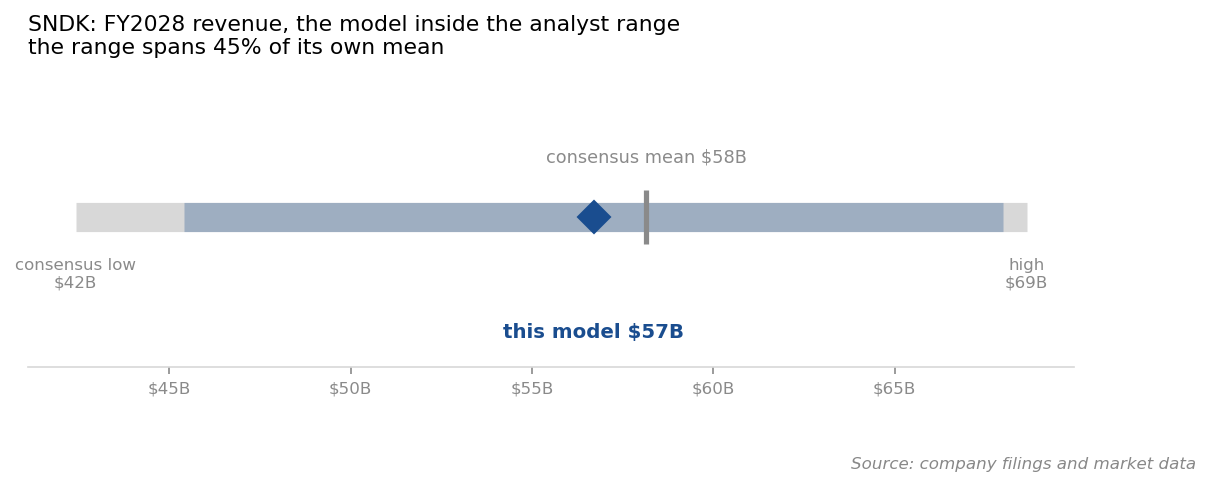
- My fiscal 2028 revenue of $56.7B sits 2.4% under consensus, so on revenue I agree with the Street. The variant is share count: $52.8B of free cash flow retires 30.3M shares and lifts earnings to $296 a share against $261.76.
Sandisk Is Listed Today Because A Rival Exercised A Veto In 2023
Western Digital spent two years trying to merge its flash memory business with Japan's Kioxia. On 26 October 2023 the talks collapsed. SK hynix held an indirect stake in Kioxia, the combination would have demoted it from second place in memory, and it refused to support the deal. Four days later, on 30 October 2023, Western Digital's board authorised splitting the company in two instead. Sandisk is listed because a competitor said no.
Three years on, that same SK hynix is Sandisk's co-author on the High Bandwidth Flash specification published on 3 August 2026. It is also its fastest-scaling competitor, at 22% of second-quarter bit shipments per Counterpoint.
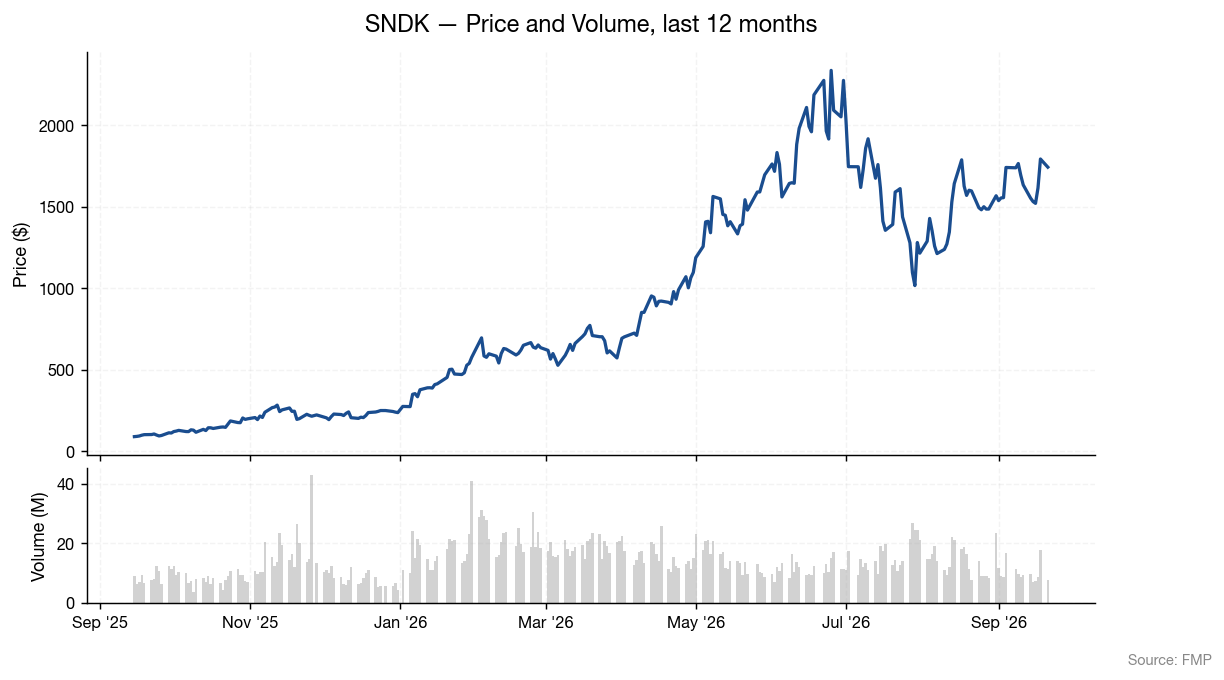
The market is trading none of that. Sandisk fell 4.98% after Dario Amodei of Anthropic argued on 12 September that the AI industry should slow its capability gains, and Sam Altman agreed.
Five weeks earlier Goeckeler had described a different company from the one the tape was pricing. "We want to get this kind of boom and bust out of it," he said on the 5 August call. "It doesn't work for anybody." Sandisk had spent the spring selling output forward under agreements carrying floor and ceiling prices. Every previous memory cycle signed its long contracts near the bottom. Sandisk signed these while the shortage worsened.
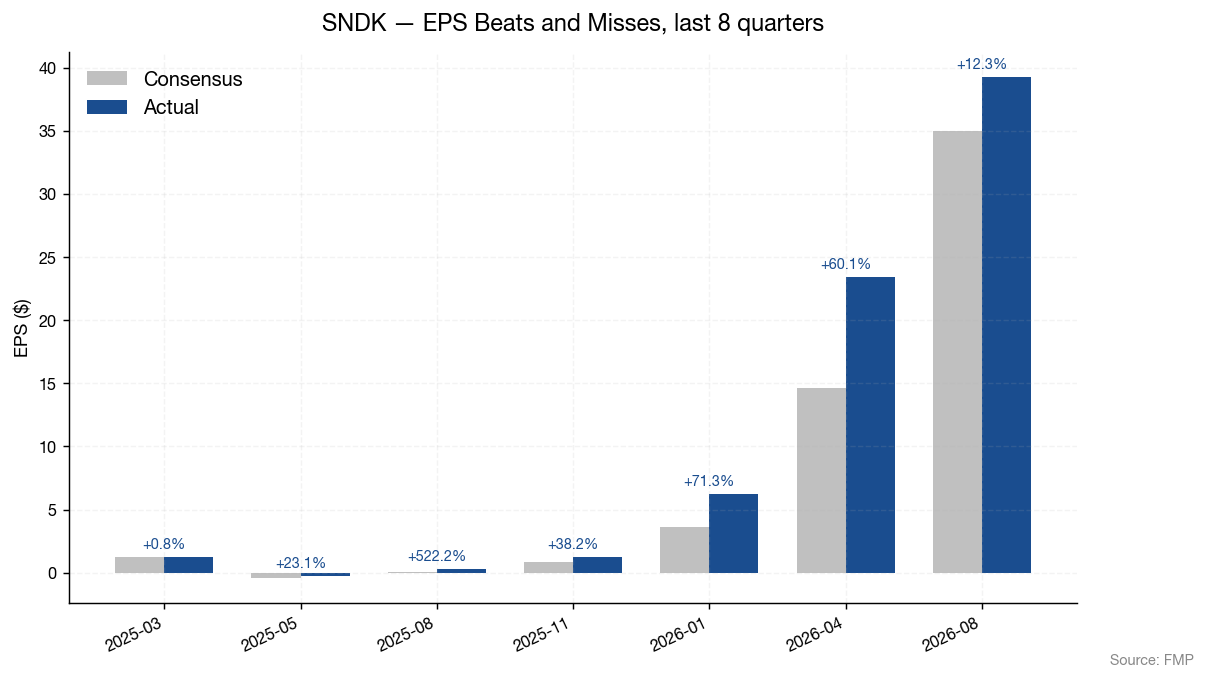
Two versions of that quarter are in circulation. Earnings printed $44.83 a share on a GAAP basis and $39.25 adjusted, the difference being an $807M Nanya gain, less $170M of tax and $67M of stock compensation. I use the adjusted basis, because guidance, the Investor Day model and consensus are stated that way.
A Milpitas Memory Company That Owns No Factory At All
Sandisk Corporation designs and sells solid-state drives, embedded storage, removable cards, USB drives and raw wafers. A solid-state drive, or SSD, is a storage drive built out of flash memory chips. It sits at 951 Sandisk Drive in Milpitas, California, and was founded in 1988 as SunDisk by Eli Harari, Sanjay Mehrotra and Jack Yuan. NAND flash is the storage that holds data when the power is off. Roughly 11,100 employees work across 33 countries behind about 8,000 granted patents.
Western Digital bought SanDisk outright on 12 May 2016 for approximately $19B. The separation completed on 21 February 2025 as a distribution of 116,035,464 shares, 80.1% of the company, and Nasdaq trading began three days later. The shares are at $1,766.64 this morning for a market cap of $261.62B, and the company enters the S&P 100 before today's open. The model below was struck at $1,740.66, which shifts fiscal 2028 earnings by a dollar a share.
Sandisk owns no wafer fab. Every flash memory wafer it sells comes from Flash Ventures, and every controller wafer from outside foundries. Flash Ventures is three entities, Flash Partners, Flash Alliance and Flash Forward, in each of which Sandisk holds 49.9% and Kioxia the balance. Kioxia owns the buildings and the ventures the equipment, and between them they run eight plants in Japan, six at Yokkaichi and two at Kitakami. The ventures were extended co-terminously to 31 December 2034 on 29 January 2026, alongside $1.2B Sandisk pays Kioxia across 2026 through 2029.
Those terms decide the margin story. Each partner may buy about half of the output, and the price each pays is cost plus a small markup, so the venture itself earns almost nothing. Every dollar of NAND price above that cost lands in Sandisk's gross profit close to undiluted. Fiscal 2026 revenue rose 175% while cost of revenue rose 12.3%. The obligation runs backwards with equal force, because Sandisk owes half of Flash Ventures' fixed costs whether or not it takes its bits. That is what produced a 26.4% gross margin in the fiscal fourth quarter of 2025.
Three End Markets, And Only One Gross Margin Line Between Them
Sandisk reports revenue in three end markets, and each is worth a walk.
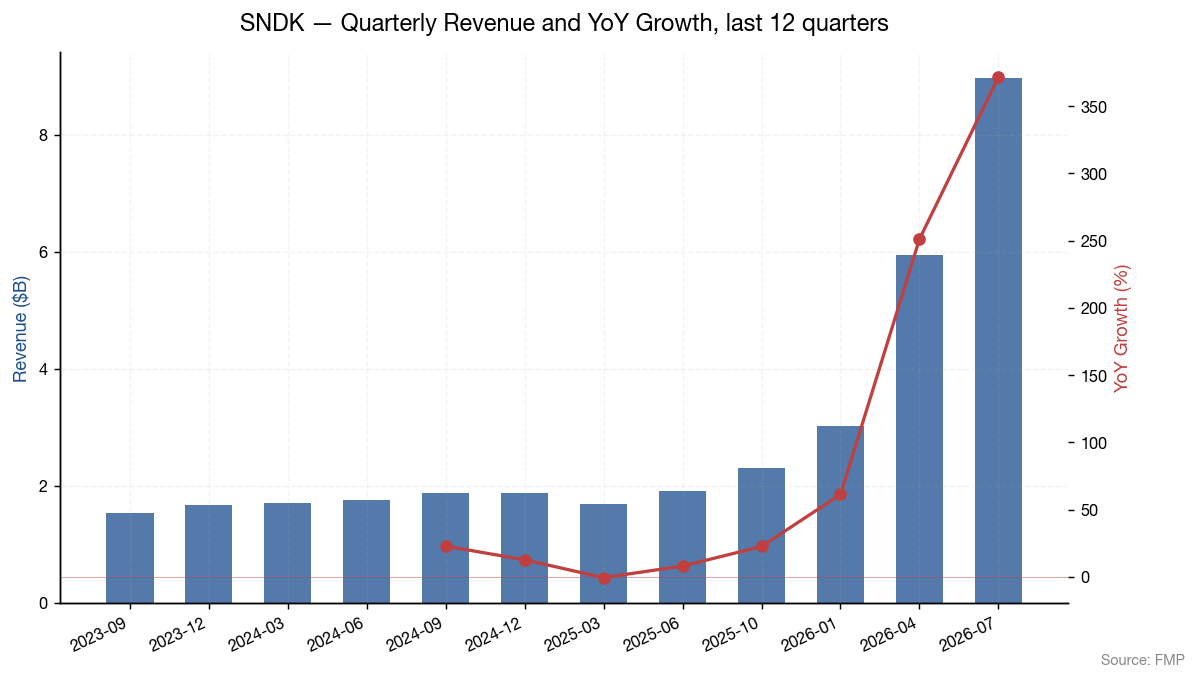
Datacenter sells enterprise SSDs to cloud and AI operators. It booked $5,153M in fiscal 2026 against $960M, a rise of 437%. Management attributes the move to higher sales and higher pricing, with bits up almost 120% and revenue per gigabyte up almost 150%. The line was $325M as recently as fiscal 2024.
Edge covers embedded storage and client SSDs sold to phone and PC makers. Revenue was $12,160M against $4,127M, up 195%, and Edge is still 60.1% of the company. Almost all of that came from price, since Edge bits grew by high single digits while revenue per gigabyte rose almost 180%.
Consumer is the retail business of memory cards and USB drives. It booked $2,935M against $2,268M, up 29%, on higher pricing partly offset by lower sales. It shipped fewer bits than a year earlier and grew anyway. Consolidated revenue was $20,248M against $7,355M, up 175%, in a 53-week fiscal year.
Here is what the filing does not give. Gross profit is not disclosed by end market anywhere in the 10-K. The company reports one consolidated figure, $14,472M at 71.5% of revenue, against $2,212M and 30.1% a year earlier. No segment margin is published, so nobody outside the company can say what a datacenter bit earns against a consumer bit, and I will not estimate it. Operating income was $12,389M against a $1,377M loss.
That loss deserves a sentence. In fiscal 2025, months after the spin, Sandisk tested its single reporting unit, found carrying value above fair value, and wrote off $1,830M of goodwill. Its own test said the business was worth less than its book, a year before it reported $12,389M of operating income.
Enterprise SSDs Went From A Sideline To Half The Industry's Bits
The change that makes this worth writing about now is where NAND bits go. Enterprise SSDs were 26% of global NAND bit shipments in the second quarter of 2025. They were 48% a year later, per Counterpoint's tracker published on 13 August, and Counterpoint has them above half of all bits by the end of 2026. Everything NAND did for twenty years, cameras and phones and laptops and memory cards, is now the minority of the bits.
Set that against Omdia's 15% to 17% growth in total industry bits and the mix resolves into two curves. Enterprise-SSD bits grew roughly 114% year over year. Every other NAND bit shrank roughly 18.5%. Sandisk's own book reproduces the shape, with Datacenter going from about 12% to 38% of company bits in twelve months.
Management's account of conditions, in Item 7, is that the rapid growth of AI infrastructure is driving demand for high-performance storage. It expects that demand to persist through calendar 2027 and beyond. It writes that the long-term agreements should become its predominant way of doing business, and that it believes they reduce industry cyclicality. One item points the other way. Pending United States investigations under Sections 232 and 301 could change tariff rates on its products, and 82% of fiscal 2026 revenue was international.
Ten Agreements, Eight Customers, $91.1 Billion Of Committed Revenue
What Sandisk did with that demand is the under-covered part. Contracted backlog is reported as remaining performance obligation, or RPO. RPO is revenue a customer has committed to buy and has not yet taken. Sandisk's RPO was $42.0B at the fiscal third quarter and is now $91.1B, up 117% in one quarter, with $16.5B of customer deposits behind it. Weighted-average duration runs beyond four years, and they cover more than half of Sandisk's bits in fiscal 2027 and two-thirds in fiscal 2028.
Two of the ten agreements are expansions of deals signed a quarter earlier, because customers' demand ran ahead of their estimates. Goeckeler: "we already have customers coming back for the second round of NBMs a quarter in."
The counterparty list is the weakest evidence here, and I would rather flag it. Only one buyer is public. Meta was reported on 9 July to have named Sandisk a key supplier for its AI build, value and duration undisclosed. The rest is management's account of ten agreements across eight customers.
Sandisk Grows Supply Through Density, And Density Caps It Near 12% A Year
Sandisk cannot simply build more. Growth inside Flash Ventures comes from fitting more bits onto each wafer. Goeckeler: "we grow supply primarily through nodal transitions rather than wafer additions."
The current generation is BiCS 8, which stacks 218 layers of memory cells. BiCS 10 entered production at Kitakami Fab2 on 3 July, stacking 332 active layers and reaching above 29 gigabits per square millimetre in TLC, the mode that stores three bits per memory cell. That is roughly 59% more density, which across a four-year node cycle compounds to 12.3% a year. Management confirmed on 8 September that no extra wafers are needed.
New wafers arrive after this argument is settled, since the third Kitakami building targets operation after 2029. The nearer swing factor is China, where YMTC held 14% of Q2 2026 bit shipments, ahead of Kioxia's 13%, and TrendForce expects Chinese suppliers near 19% of global output. Enterprise SSDs also use more DRAM than any other flash product, and TrendForce has DRAM's own shortfall widening in 2027.
Now put the two sides together. The sufficiency ratio is supply divided by demand, minus one. A negative reading means the industry cannot make the bits buyers want. Omdia has 2026 bit demand up 20% to 22% against supply up 15% to 17%, and TrendForce prints a 4% to 5% deficit. They agree on today and split on tomorrow, because TrendForce, on 21 July, has the ratio turning positive in 2027. Goeckeler is further out still, seeing the industry approach $500B in calendar 2027. Nothing below depends on that.
So how much would demand have to cool before the shortage clears? Take Counterpoint's end-2026 position of enterprise SSDs at half of all bits, hold non-enterprise bits shrinking 5% a year, and set supply growth at 15%. On those inputs the fastest-growing corner of the memory market has to slow by two thirds. Enterprise-SSD bit demand would need to fall below 35% a year and stay there. It ran at 114% last quarter. This is where I part from TrendForce, by about a year and by the sign of the balance.
What The Contracts Are Worth, And Why The Share Count Is The Argument
That disagreement matters less to Sandisk's 2028 earnings than it looks. Two-thirds of fiscal 2028 bits are already sold under agreements carrying price floors. Chief financial officer Luis Visoso said those floors carry "around 80%" gross margin, struck near today's realised price per bit.
The insulation comes from one division nobody appears to have published. Spread $91.1B of RPO across the sixteen quarters its duration implies and it gives $5.69B a quarter of contracted, floor-priced revenue. That covers 54% of the $10.55B first-quarter guide midpoint, while the agreements are only just past half of bits. Volumes probably back-load, so treat 54% as an upper bound.
The rest of the model is the company's own framework applied to the Street's revenue. The guide midpoint annualises to $42.2B against a fiscal 2027 consensus of $48.91B, so the Street already expects 16% more build through the year. The Investor Day framework of 13 August governs fiscal 2028 through 2030. It calls for revenue growth in the mid-to-high teens consistent with bit growth, which means flat prices, gross margin near 80%, operating margin near 75%, and free cash flow near a 50% margin.
Carry the same 16% step one year further and fiscal 2028 revenue comes to $56.7B against a $58.08B consensus, 2.4% under the mean. On revenue this model agrees with the Street.
The disagreement is about how many shares that revenue gets divided by. Run those margins on $56.7B, at the 86.8% conversion of operating income to net income the fourth quarter printed, and net income lands near $36.9B. Free cash flow across fiscal 2027 and 2028 comes to $52.8B, and all of it is returnable. Spent near today's $1,740.66 that retires 30.3M shares, taking the diluted count from a guided 155M to 124.7M. Earnings land near $296 a share against a $261.76 consensus, a gap of 13.1%, all of it share count. Sandisk ran that playbook once already, taking 2,836,000 shares in a quarter at $1,587. The full walk is in the research brief.
Three assumptions carry the conclusion, and each breaks it if I am 20% wrong. The fiscal 2027 base of $48.91B is the largest lever, and a fifth either way puts fiscal 2028 earnings at $226 or $374. The buyback is second, since 20% less cash retires 24.3M shares for $282. At a 60% operating margin the number falls to $237. Margin is where this case breaks.
One conflict belongs on the record. Visoso described gross margin reaching "86.5%" on the August call, while the reported fourth-quarter adjusted figure is 84.6%. I use 84.6%.
At $1,740.66 the stock trades at 8.2 times fiscal 2027 consensus and 5.9 times my derived $296. Goldman Sachs, per reporting on 27 July, carries normalised mid-cycle earnings of $110 and a $2,200 target, putting the stock at 15.8 times normalised. My $296 is 2.7 times Goldman's number, and the valuation debate is the distance between them. Part of the discount is the price of Goeckeler's decision, since Sandisk's NAND revenue grew 50.7% sequentially in the June quarter, slowest of the top five against Micron's 99.2%.
Six Times My 2028 Number Is The Market Saying Those Earnings Do Not Last
Sandisk trades this morning on 22.7 times trailing earnings, 19.7 times EV/EBITDA and 12.9 times sales, which is what a buyer pays today.
The eight closest comparables average 39.3 times earnings, which puts Sandisk in line with them, at a 7.4% premium on its blended basis. On the simple earnings multiple Sandisk sits well under that average, so I take the in-line verdict. Teradyne carries 52.1 times earnings and 40.9 times EV/EBITDA. Keysight carries 47.1 times and 34.2 times. Super Micro anchors the cheap end at 11.3 times earnings and 0.7 times sales. Sandisk is low on earnings and high on sales, which is what a 71.5% gross margin does to a price-to-sales ratio. No sector median is published for this classification, so I will not quote one.
Its own record is two profitable years, 2022 at 5 times and 2026 at 22 times. Today's 22.7 times ranks at the top of that range, in the 100th percentile. Four loss-making years drop out, and two observations are too thin to carry a case.
The forward number matters more. At $1,766.64 the stock trades at 6.0 times my derived $296 and 6.7 times the $261.76 consensus. On our own numbers that is cheap against every peer above, none of which trades under 11 times. A single-digit forward multiple carries one assumption, that NAND pricing hands the earnings back. Goldman's normalised $110 states it in a number, 63% below my 2028 figure.
My revenue sits 2.4% under consensus, so the bits and the prices are not in dispute. The variant is the share count. If $296 is right, the multiple is the whole question, and six times is the market answering that the floors do not hold through the cycle.
Density Per Square Millimetre Is The Moat, And High Bandwidth Flash Is The Option
The obvious question is why a competitor cannot take these bits. On raw layer count Sandisk is behind all of them. SK hynix ships 321 layers in late 2026, Samsung has 430-layer V10 in mass production, and Micron is at 276-layer G9.
Buyers pay for bits per square millimetre, because that sets cost per gigabyte. BiCS 10's 332 layers reach above 29 gigabits per square millimetre in TLC, which Sandisk and Kioxia claim beats Samsung's 400-plus-layer part.
The forward option is High Bandwidth Flash, or HBF. HBF stacks NAND beside an AI accelerator the way High Bandwidth Memory stacks DRAM. Sandisk and SK hynix published the first Open Compute Project specification on 3 August, allowing 512 gigabytes per stack, with Samsung outside it. I underwrite none of HBF above.
SK hynix is the awkward case, being both that standards partner and the fastest-scaling competitor, with a ₩100 trillion Cheongju fab behind it. No customer quote in the record explains a choice of Sandisk over a named competitor.
Management's Own Risk Factors Name The Failure Mode Before I Do
The strongest case against this article is partly written by the company. Four of Sandisk's Item 1A headings are specific rather than boilerplate.
The first is "We rely substantially on strategic relationships that subject us to risks and uncertainties." That is Flash Ventures, filed as a risk by a company with no other source of wafers. The second is new this year: "Long-term agreements, which we also refer to as New Business Models or 'NBMs', expose us to certain execution, financial, and market risks, which could be significant." That heading did not exist a year ago, and it lands on the model above, because those floors are what insulate the fiscal 2028 profit and loss statement. The factor names the failure mode exactly. If a customer breaches, the company "may be unable to resell those products at comparable prices, or at all". The same factor adds that the agreements "may constrain a portion of our available supply and limit our flexibility to respond to changes in market conditions."
The third sits under Financial Risks: "Our guarantees of certain obligations of Flash Ventures may negatively impact our financial position." The fourth sits under Risks Related to Our Common Stock: "Provisions in our joint venture agreements with Kioxia Corporation may deter, prevent or delay an acquisition of us." The structure that produces the margin also caps the takeout.
Read the headings for what is missing. There is no standalone risk factor for NAND price cyclicality, none for DRAM supply, and none for customer concentration. Declining selling prices sit inside a heading on competitive conditions, DRAM inside supply chain, and customer loss beside base consolidation.
One dated overhang sits outside the risk factors. Western Digital kept 19.9% of Sandisk at the separation and has been selling since, 21,314,768 shares on 9 June 2025 and 5,821,135 on 18 February 2026. It expects to monetise all remaining Sandisk shares by the end of calendar 2026. That is a known seller with a published deadline.
The Floors Protect The Margin While Leaving The Revenue Line Exposed
My own strongest case against is that TrendForce is right and early. Chinese output reaches 19% of global supply and the Korean ramps land on schedule. Spot NAND falls, the uncommitted third of fiscal 2028 bits reprices down, and the long agreements settle at their floors.
Size that honestly. Floor-priced contract revenue runs at $22.8B a year. Grossing it to the whole portfolio at the two-thirds bit share gives $34.2B, which is 41% below the $58.08B consensus. The floors defend the margin all the way down. They do nothing for the revenue line.
Two further points deserve weight. Eight customers are contracted for two-thirds of fiscal 2028 bits, while no single customer exceeded 10% of fiscal 2026 revenue, so concentration is being manufactured at the top of a cycle. Edge is still 60.1% of revenue with its bits down 19%.
Of my three assumptions the buyback is likeliest to be wrong. It is the sole source of the variant, and it needs a board authorisation that does not yet exist. The current one is $15.5B, exhausted around the June 2027 quarter at the fourth quarter's $4.5B pace.
What I Am Watching
Fiscal first-quarter results print on 5 November against a $46.23 consensus and a $44 to $46 guide. Two lines decide the model. If RPO fails to exceed $91.1B, the backlog has stopped compounding. If contract coverage fails to cross 50% of bits, the insulation that makes fiscal 2028 indifferent to TrendForce is gone. Watch the Western Digital sell-down alongside it.
Takeaway
The revenue argument here is not contrarian, since my $56.7B sits 2.4% under consensus. What the Street has not carried through is the cash, because $52.8B deployed near today's price takes shares from 155M to 124.7M and earnings from $261.76 to $296. The company disclosed both sides of that trade itself, warning that the agreements protecting the margin also constrain its supply. At 5.9 times my number and 15.8 times Goldman's normalised $110, the question is where in that range the cycle settles.
Sources
- Sandisk: Q4 FY2026 call, 5 Aug 2026; Investor Day, 13 Aug 2026; Form 10-K, Items 1, 1A and 7, 17 Aug 2026; Citi Global TMT, 8 Sep 2026
- Separation: Western Digital 8-K, 2016; board authorisation, 30 Oct 2023; distribution, Feb 2025; Flash Ventures extension, 29 Jan 2026; merger collapse, Bloomberg and Nikkei Asia, 26 Oct 2023
- Counterpoint Research, Q2 2026 Memory and Storage Tracker, 13 Aug 2026. Omdia, 2026 NAND bit estimates
- TrendForce: NAND supply and demand, 21 Jul 2026; DRAM sufficiency, 30 Jul 2026; vendor revenue, 18 Aug 2026
- Kioxia and Sandisk, BiCS 10, 3 Jul 2026; Sandisk and SK hynix, HBF OCP specification, 3 Aug 2026; StorageNewsletter, 15 Sep 2026
- Reporting: Meta, 9 Jul 2026; Goldman, 27 Jul 2026; Amodei and Altman, 12 Sep 2026; S&P Dow Jones Indices, 4 Sep 2026. Consensus, peer multiples and price data, 21 Sep 2026
- Full working: the research brief,
research/2026-09-21_SNDK.md, publishes alongside and carries every derivation.
Research, not a recommendation. Figures are sourced as cited and were current at publication; nothing here is personalized investment advice.