Dell Took 3.7 Times More AI Orders Last Quarter Than It Could Ship
Sep 27, 2026 · Dell Technologies Inc. (DELL) profitmonk
Summary
- Dell booked $60.9B of AI server orders in the three months to 31 July 2026 and shipped $16.4B of them, leaving a backlog of $95B.
- Management has said for three consecutive quarters that demand runs ahead of what it can build, so reported AI server revenue measures Dell's factory rather than its market.
- Building FY2028 from that supply capability gives revenue near $245B and non-GAAP earnings near $33.90 a share, against a consensus of $235.21B and $30.90.
- That is 9.7% above the consensus mean and roughly the midpoint of a consensus revenue range running from $194.26B to $297.76B. The street has no FY2028 view to disagree with.
- The assumption that decides it is net margin, because Dell holds $95B of orders written before NVIDIA told its largest customers that system prices rise more than 15% from early 2027.
Jeff Clarke Read Out $60.9 Billion of Orders and the Stock Fell 6.8%
At 4:30pm Eastern on Tuesday 1 September 2026, Dell's vice chairman and chief operating officer Jeff Clarke opened the second-quarter call with four words, "Another outstanding quarter." Then came numbers that were hard to process in real time. Revenue of $46.97B, up 57.7% on the year. Non-GAAP earnings of $7.04 a share against a $4.91 consensus, a beat of 43.4%. Non-GAAP is Dell's own adjusted measure, and it is the basis on which the company guides and analysts forecast. AI server orders of $60.9B in ninety days. An AI backlog, meaning signed orders not yet shipped, of $95B.
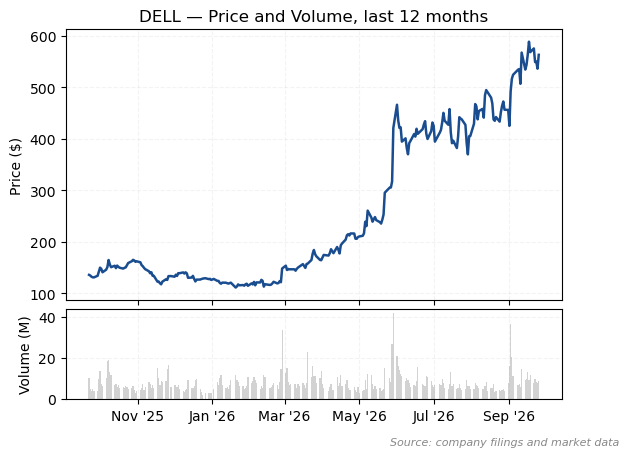
The stock closed that afternoon at $425.00, down 6.80% on the day, per FinanceFeeds on 2 September. It is $562.90 now, up 32.4% from that close, and the average price target compiled over the last month sits at $574.63 across 19 analysts, 2.1% above it. Dell has beaten consensus by 43.4%, 64.2% and 10.2% in its last three reports, after five quarters that ran between a 5.4% beat and an 8.8% miss.
A 42-Year-Old PC Company That Now Sells Servers
Dell Technologies Inc. is headquartered at One Dell Way in Round Rock, Texas, and incorporated in Delaware. Michael Dell has run it, with a three-year gap, since 1984, and management referred on the September call to "the company's 42-year history." The listed security is Class C common stock, trading as DELL on the New York Stock Exchange, and it carries one vote against ten for the Class A and Class B shares. Michael Dell and the Silver Lake funds held about 91.7% of total voting power at 9 March 2026, so Dell is a controlled company under exchange rules.
The company designs and supports computers at both ends of the stack, from notebooks, desktops and workstations to servers, network switches and storage arrays, with the consulting, deployment, financing and support around them. About 97,000 people work there, it sells into more than 170 countries, and it held 25,859 granted patents at 30 January 2026, per the FY2026 annual report. Dell Financial Services, the in-house lending arm, carried a $14.3B portfolio of financing receivables at that date.
At $562.90 the market capitalisation is $373.91B, against a 52-week range of $110.22 to $595.51. The stock has risen roughly fivefold inside a year and sits 5.5% below its high.
Two Segments, and the Server One Earns Four Fifths of the Profit
Dell reports two segments. Infrastructure Solutions Group, or ISG, sells AI-optimised servers, traditional servers and networking, and storage. Client Solutions Group, or CSG, sells commercial and consumer PCs and peripherals.
ISG revenue in the July quarter was $31,782M against $16,800M a year earlier, up 89.2%, per the quarterly filing of 8 September. AI-optimised servers went from $8,208M to $16,401M, up 99.8%, and traditional servers and networking from $4,736M to $10,531M, up 122.4%. Storage rose 25.8% to $4,850M. ISG gross profit was $7,513M against $3,636M, a margin of 23.6% against 21.6%. Operating income more than tripled to $4,781M, taking the ISG operating margin from 8.8% to 15.0%. Chief financial officer David Kennedy attributed most of that to volume, saying scale "was a driver of just over 400 basis points." A basis point is one hundredth of a percentage point.
CSG revenue was $15,034M against $12,503M, up 20.2%, with commercial up 22.4% and consumer up 7.0%. Gross profit was $2,408M against $1,921M, a margin of 16.0% against 15.4%, and operating income rose 42.2% to $1,142M. The annual report explains commercial strength as "an increase in units sold and richer configurations," and consumer weakness as "a decline in average selling prices."
Consolidated revenue was $46,971M, up 57.7%. ISG is now 67.7% of revenue and 80.7% of segment operating income, and AI-optimised servers alone are 34.9% of company revenue.
The AI Server Line Has Existed as a Reported Number for Three Quarters
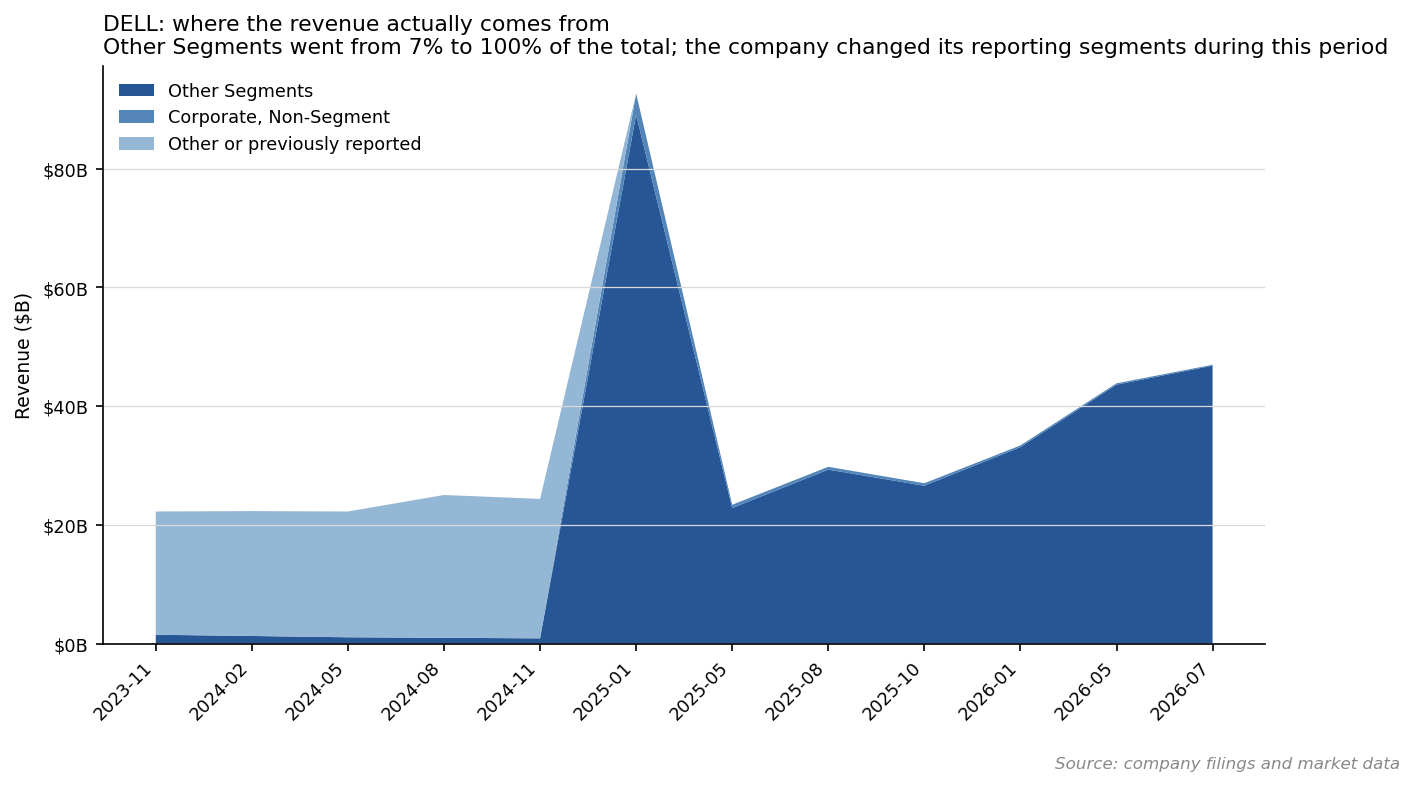
Three years ago Dell was a low-multiple assembler working off a leveraged buyout, and its AI server revenue was roughly $120M in FY2023. It was $1.81B in FY2024, $9.73B in FY2025 and $24.56B in FY2026, per The Next Platform on 1 March 2026. Management guides FY2027 to $74B, a 617-fold increase in four fiscal years. Dell only began disclosing the line separately in the fourth quarter of FY2026, so anything longer than three quarters of history here is reconstruction.
Management's framing of conditions is about cost rather than demand, which is unusual for a hardware company. The FY2026 annual report warns of "margin rate pressure resulting from a continuing shift in mix towards our AI-optimized servers offerings." It then states plainly, "We anticipate notable inflation for component costs in Fiscal 2027," and says the next generation of components "will be subject to supply constraints." Meeting AI demand, it adds, "has resulted in increased inventory levels, higher purchase obligations, and new working capital dynamics."
Six Thousand Five Hundred Customers, and Half of Them Arrived Recently
The named wins are recent. Dell delivered the first NVIDIA Vera Rubin NVL72 rack systems to CoreWeave, which announced on 1 June 2026 that it took them from delivery to production workloads in under 6.5 hours. The NVL72 specification wires 72 GPUs into one coherent memory domain, so a rack behaves as a single accelerator. For xAI's Colossus cluster Dell supplied 50,000 GPUs of phase one alongside 50,000 from Super Micro. The Next Platform reported on 1 March 2026 that Super Micro appears to have taken all 100,000 of phase two, a named win and a named loss in one account. Dell also discloses the US Department of Energy and G42 as customers, and names nobody inside the $95B backlog.
The cleanest demand evidence Dell publishes is a customer count. AI Factory customers passed 6,500, and Clarke said 3,300 arrived in the last three quarters against 3,200 in the eight before, a 2.7-fold acceleration in the acquisition rate.
The order book reconciles almost exactly, which matters because it is the only public check on cancellations. Dell exited FY2026 with $43.0B of AI backlog. Add first-quarter orders of $24.4B, subtract revenue of $16.1B, and you get the $51.3B Dell reported. Repeat with second-quarter orders of $60.9B and revenue of $16.4B and you get $95.8B against a reported $95B. That $0.8B difference is under 1% of backlog, the whole visible extent of slippage. Trailing twelve-month AI orders are $131.7B, and Clarke called the five-quarter pipeline "multiples of our backlog."
The demand the market under-weights is the boring half, and the reason is physical. "We still have 1.2 million assets that are 14G or older in the installed base. They have to be upgraded," Clarke said, meaning Dell's fourteenth-generation PowerEdge servers and earlier. The current 17th generation consolidates six to eight of those machines into one, because a decade of node shrinks, higher core counts per socket and wider memory bandwidth raised compute density that much. The 18th generation, shipping from October 2026, does twelve to fourteen. At thirteen to one, that installed base retires into roughly 92,000 new systems. Dell has taken "more than 10 points of traditional server share" over two quarters.
DRAM, DRAM, DRAM
Asked by Asiya Merchant of Citi what is holding him back, Clarke gave the most quotable answer on the call. "The constraints remain the same. DRAM, DRAM, DRAM, followed by NAND, NAND, NAND. We have spotty CPU shortages. There are shortages with disk drives." DRAM is the working memory a server computes out of, and NAND is the flash storage it keeps data on. He said "just about every product going through a leading node is constrained," and named mature nodes, ABF substrate, T-Glass and optics too. Then a finish: "The AI supply chain is working red line all out to build CDUs, power, racks."
Memory is the binding one and the price history says why. Server DRAM contract prices rose 43% to 48% in the fourth quarter of 2025, then 93% to 98%, then 58% to 63%, then 13% to 18%, per TrendForce through 9 July 2026. Compounded, that is roughly 5.3 times the level a year earlier. Gartner expects the shortage to run at least through the first half of 2027, and Deloitte expects no meaningful new capacity before 2029 or 2030, per implicator.ai on 23 August 2026.
Memory dominates the cost of an AI server because of the architecture. A training GPU runs out of memory bandwidth long before it runs out of arithmetic. So each accelerator carries stacked HBM, or high-bandwidth memory, beside the compute die, and each rack carries conventional DRAM for its host processors on top of that. Memory is about 29% of the bill of materials of a fully configured NVIDIA Vera Rubin VR200 system costing around $2.1M, against the 20% NVIDIA would prefer.
That leads to the fact a bull has to sit with. NVIDIA's contract builders have told its largest customers that Vera Rubin and Grace Blackwell system prices rise more than 15% from early 2027. That is per implicator.ai on 23 August 2026 and Tom's Hardware the same month. Dell's $95B backlog was written before it.
Dell's answer this year was reallocation rather than capacity. Clarke was explicit about the $25B guidance raise. "As we saw the PC market showing signs of softening in the second half, we optimized the bits and bytes we have towards the infrastructure business," he said. Dell paid for its AI upside out of memory allocated to PCs, and that lever works once.
When the Factory Is the Constraint, Shipments Measure the Factory
Here is the step that makes this a supply model rather than a demand forecast. Clarke has now said for three quarters that "demand outran supply last quarter, demand outran supply this quarter." When that holds, Dell's reported AI server revenue measures its output rather than its market, so I built FY2028 upward from the exit rate Dell has already guided to.
Dell guides FY2027 AI server revenue to $74B. Take out the $16.1B and $16.4B already shipped and the $19.0B guided for the third quarter, and the fourth quarter has to be $22.5B. Growing that at 10% a quarter through FY2028 gives $115B, slower than the 15.9% and 18.4% sequential steps just printed and guided.
Demand does not bind that number on any reasonable assumption. If second-half orders halve against the first-half rate, Dell still exits FY2027 with $97.0B of backlog after shipping the guided $41.5B. That alone pre-funds 84% of a $115B year before a single new order arrives, against a booking rate of $131.7B over the last twelve months. The unit check holds too. At FY2026 realised pricing near $58,476 a GPU, $115B is 1.97 million GPU-equivalents, or 1.71 million at the repriced level, four to five times FY2026 volume in two years. In power that is 3.1 to 3.6 gigawatts, against the roughly 100 gigawatts of Dell-addressable AI additions Clarke cited through 2030.
The rest of the business carries the other half. Non-AI revenue in the FY2027 guide is $118B, and growing it 10%, below the mid-teens rate management guides for storage and CSG, gives $129.8B. Add the two and FY2028 revenue is about $245B. Dell's FY2027 guide implies a net margin of 8.8%, and the July quarter alone printed 9.8%, so holding 8.8% assumes margin below the last realised quarter. On roughly 637 million diluted shares, that gives non-GAAP earnings near $33.90 a share. The full walk, with the bear case at $29.10 and the bull case at $37.80, is in the published brief.
The anchor for the AI line is IDC. Its Worldwide Quarterly Server Tracker of 17 September 2026 measured the accelerated server market at $87.4B in the June quarter, growing 28.1%, with Dell holding 18.8%. Annualised and carried at IDC's own growth rate, calendar 2027 is about $447B, and $115B of that is 25.7%. So this model needs Dell's accelerated share to rise 6.9 percentage points in six quarters. That is demanding, and it has happened once: in the four quarters to June, Dell's server revenue grew 165.4% against a market up 52.0%. If the market instead grows at IDC's measured rate and Dell's share stops at 20%, FY2028 AI server revenue is $89B and earnings are about $30.60 a share, below consensus.
Dell'Oro's competing figure has to be set aside rather than averaged in. It puts worldwide server revenue at "nearly $0.5 trillion by 2028," and IDC already measures $166.3B in a single quarter.
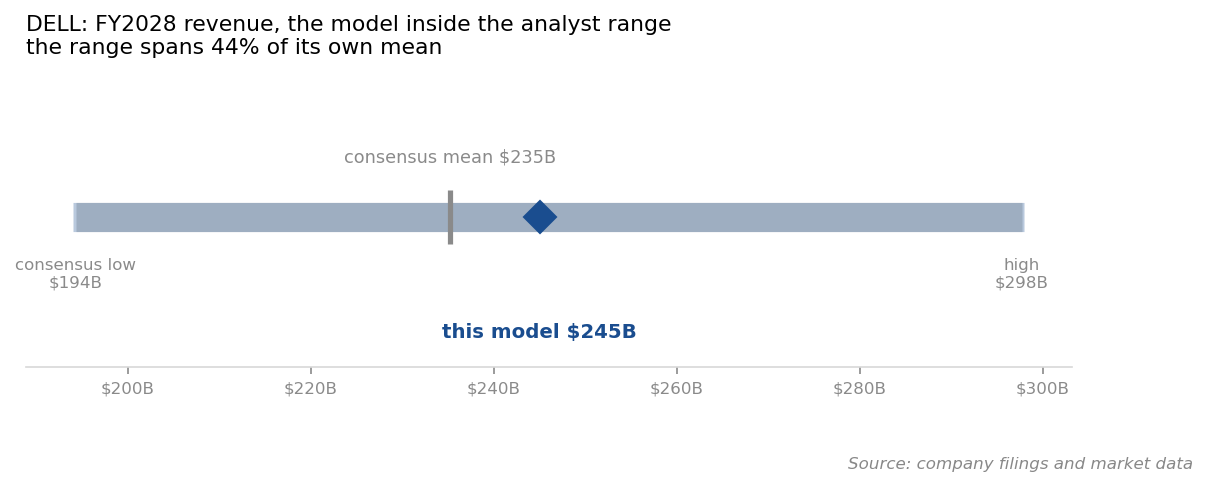
Now the part that surprised me. Consensus FY2028 revenue is $235.21B and consensus earnings are $30.90 a share. My $245B and $33.90 sit 4.2% and 9.7% above those, which is not a large gap and I will not pretend otherwise. The interesting number is the range behind the mean. Street FY2028 revenue estimates run from $194.26B to $297.76B, a spread of $103.5B, or 44% of the mean, and my build lands almost exactly in the middle of it. The finding is that there is no FY2028 consensus at all, because nobody can price what a $95B backlog written at pre-repricing terms converts at. The input that decides it is net margin. At 7.0% instead of 8.8%, the same revenue gives $26.92 a share, 12.9% below consensus.
Thirty-Two Times Earnings, Against Server Makers at Eight to Thirteen
The model says what Dell might earn. This says what the market charges for it, and the answer depends on which year you are paying for.
Dell trades at 32.2 times trailing earnings, 21.6 times enterprise value to EBITDA, and 2.5 times sales. EV/EBITDA compares the whole capital structure to pre-tax operating cash earnings, the cleaner comparison for a company carrying $34.5B of debt. The PEG ratio, the earnings multiple divided by the expected growth rate, is 0.21, which is what happens when trailing earnings have not caught up with forward growth. On forward numbers the stock is 22.1 times the $25.50 Dell guides for this year, 18.2 times the $30.90 consensus for FY2028, and 16.6 times my $33.90.
The automatic peer screens are useless here. They pair a server maker with a crypto treasury company on 105 times sales and negative earnings, and with a games platform that has no earnings either. So I picked comparables on one test, which is who competes for the same orders. Hewlett Packard Enterprise builds rack-scale AI systems for the same buyers and traded at 12.6 times forward earnings on 2 September 2026, per FinanceFeeds. Super Micro Computer competes head to head for neocloud business and traded at 8.1 times forward earnings on that date. Western Digital is the closest listed proxy for the storage and drive half of ISG, at 16.8 times trailing earnings and 18.1 times EV/EBITDA. Dell's forward multiple is roughly 1.8 times HPE's and 2.7 times Super Micro's.
Against its own history the stock has nothing above it. Across the seven profitable years in Dell's record the annual earnings multiple ran between 4 and 18 times, at 13 times in 2026 and 18 times in 2024. At 32.2 times, today is the 100th percentile of that history, and the price is 2.0 times the 200-day average of $280.80. What the multiple assumes is that the margin holds. At 18.2 times FY2028 consensus the shares are not expensive on the earnings I model. At 32.2 times trailing they have left nothing for the component costs in NVIDIA's 2027 price list.
The Biggest Competitor Is Not HPE
The IDC tracker for the June quarter reads differently from the way this sector gets discussed. The total server market was $166.3B, up 52.0%, and accelerated servers were $87.4B of that, up 28.1%. The slower-growing half of the market this quarter was the AI half. Dell did $22.24B for 13.4% share, up 165.4%. Super Micro did $10.18B and 6.1%, up 97.2%, Lenovo $8.41B and 5.1%, up 99.6%, and HPE $5.87B and 3.5%, up 46.0%. ODM Direct, the original design manufacturers that build racks for hyperscalers to their own designs, did $89.66B for 53.9% share, up 35.2%.
Read the last line again. Dell's largest competitor is the category that builds for hyperscalers directly, and Dell is growing 4.7 times as fast as it. Kuba Stolarski, a research vice president at IDC, gave the reason: "demand is broadening beyond hyperscalers toward specialized cloud providers, sovereign AI programs, and enterprises adopting agentic and inferencing workloads." Those buyers cannot self-build. They need engineering, deployment, financing and support, which an ODM does not sell. Dell earns 5% to 7% operating margins on AI servers against roughly 3% for Quanta and Foxconn, per The Next Platform.
HPE ended its third quarter on 9 September 2026 with $3.1B of total AI orders and an AI backlog of $7.6B. Dell's backlog is 12.5 times that, and HPE guides FY2027 revenue growth of 13% to 17% against Dell's roughly 70% this year. The serious threat is Super Micro, which disclosed about $39B of orders from more than 20 customers in June 2026 and said fiscal fourth-quarter new orders exceeded $60B. That is comparable order volume on a much smaller base, from a company that can buy share with price at 8.1 times earnings.
On product, Dell ships PowerEdge M9822 and R9822 with NVIDIA Vera CPUs from September 2026, and the 18th-generation M9825 and R9825 in the second half. The XE8812 with Vera Rubin NVL4 arrives in 2027 at a rack density of 144 GPUs, where liquid cooling stops being optional. The competing systems are HPE's ProLiant Compute XD690 and Lenovo's ThinkSystem SC777 V4 Neptune, whose architecture is also direct-liquid-cooled.
Dell Filed the Bear Case Itself
The strongest argument against this stock is in Dell's own annual report, in Item 1A, where a company lists what could go wrong. Under the category "Risks Relating to Our Business and Our Industry," the first three headings run in this order. "Adverse global economic conditions may harm our business and result in reduced net revenue and profitability." "Competitive pressures may adversely affect our industry unit share position, revenue, and profitability." "The operating results of our business units may be adversely affected if we fail to successfully execute our strategy and related initiatives." The fourth covers product and component vendors, and the fifth single-source and limited-source suppliers, which is the written form of the memory constraint above.
The sixth is this article's risk section written by the company. "The nature of the demand for AI solutions may have adverse effects on our operating performance." Underneath it Dell states that "to date our AI solutions have been purchased primarily by a small number of larger customers and cloud service providers." Large orders are "generally subject to intense competition and pricing pressure, which can have an impact on our gross margins." They also expose Dell "to the risk of holding excess and obsolete inventory due to delays or cancellations." Every clause there describes something already visible in the accounts.
Now the risks Dell does not rank, in the order I would. The assumption most likely to be wrong is the 8.8% net margin, and FY2026 is the control case. In that year Dell grew ISG revenue 40% and lost 110 basis points of ISG operating margin, which the annual report puts down to "a shift in mix towards our AI-optimized servers offerings." Margin only turned once scale arrived in FY2027, and every margin datapoint so far came from converting backlog written before the component shock. At a 7.0% net margin the stance inverts.
Second, part of the backlog is a queue rather than a forecast. Wamsi Mohan of Bank of America asked the best question on the call, whether a customer needing 100 servers orders 50 today with 50 landing in backlog. Clarke conceded the mechanism, saying large sophisticated customers are acting to secure access to supply, and called it "probably a new phenomenon." An order book built by buyers hedging allocation reprices when supply loosens.
Third, Dell is financing its own demand. Inventory went from $10,437M to $21,290M in six months, and financing receivables from $14.3B to $20.4B, against $8.1B of adjusted free cash flow in the quarter. In a neocloud credit event Dell holds the receivable and the inventory at once. Total debt was $34.5B at 31 July, before $5.0B of senior notes on 15 September.
Fourth, a policy risk with no hedge. A 25% Section 232 tariff already applies to a narrow band of advanced logic chips, with a carve-out for items imported for use in US data centres. That carve-out shields US$143 billion of US server imports, per EY on 9 February 2026, and DigiTimes reported on 28 August 2026 that it is on the table.
What I Am Watching
Dell reports its third quarter on 24 November 2026, with consensus at $6.56 a share, and four numbers decide this. AI revenue against the $19B guide, orders against $60.9B, backlog against $95B, and the ISG operating rate against 15.0%. A backlog below roughly $110B means orders decelerated hard, and it would take this model's supply ramp with it. The falsifying event for the margin assumption lands in the first quarter of calendar 2027, when NVIDIA's price rise takes effect on Vera Rubin and Grace Blackwell. That quarter is reported around late May 2027, and its ISG margin settles whether pre-shock backlog converts at 2026 margins or 2027 component costs.
Takeaway
Dell is shipping as fast as it can buy memory, and the gap between $60.9B of quarterly orders and $16.4B of shipments is what the $95B backlog is made of. Building FY2028 from that supply capability gives $245B of revenue and $33.90 of earnings, 9.7% above the consensus mean and near the midpoint of a consensus range 44% wide. I am bullish at 18.2 times FY2028 consensus earnings and would not be at 32.2 times trailing. What decides it is what the orders convert at, because the order book itself reconciles to within 1%. Dell's own Item 1A names pricing pressure on large AI orders before I do.
Sources
- Dell Technologies Q2 FY2027 earnings call, 1 September 2026 (Jeff Clarke, David Kennedy, with questions from Asiya Merchant of Citi and Wamsi Mohan of Bank of America)
- Dell Technologies Form 10-K for FY2026, Items 1, 1A and 7, filed 16 March 2026
- Dell Technologies Form 10-Q for Q2 FY2027, segment and supplemental notes, filed 8 September 2026
- Dell Technologies Form 8-K on the $5.0B senior notes, 15 September 2026
- IDC Worldwide Quarterly Server Tracker, calendar Q2 2026, published 17 September 2026, including Kuba Stolarski
- The Next Platform on Dell's AI server history, margins and the Colossus split, 1 March 2026
- CoreWeave newsroom on the first Vera Rubin NVL72 deployment, 1 June 2026, and DataCenterDynamics, June 2026
- TrendForce server DRAM contract price prints through 9 July 2026
- implicator.ai on memory share of bill of materials, NVIDIA system repricing, and the Gartner and Deloitte capacity views, 23 August 2026, with Tom's Hardware, August 2026
- Hewlett Packard Enterprise Q3 FY2026 results and FY2027 guidance, 9 September 2026
- Super Micro Computer order disclosures, June and July 2026
- FinanceFeeds on the 1 September reaction and peer forward multiples, 2 September 2026
- Dell'Oro Group Data Center IT Capex five-year forecast, with its August 2026 update
- EY Global Tax News on the Section 232 data centre carve-out, 9 February 2026, and DigiTimes, 28 August 2026
- Company filings, reported results, analyst consensus and market price data
- Full working, including the supply ramp, the margin cases and the anchor reconciliation:
research/2026-09-21_DELL_claude.md
Research, not a recommendation. Figures are sourced as cited and were current at publication; nothing here is personalized investment advice.