Moderna's 177% Day Now Needs $10.80 Billion of Revenue. The Data Lands 24 October.
Sep 27, 2026 · Moderna, Inc. (MRNA) profitmonk
Summary
- Moderna traded at $22.28 within the last 52 weeks and closed at $198.88 on 26 September, after one cancer trial readout added roughly $45B of market value in a single session.
- At the 7.20x average price-to-sales of its own six named peers, the $77.78B enterprise value requires about $10.80B of annual revenue.
- Every published third-party peak forecast added together gives a 2028 revenue ceiling of $5.05B, which is 53.2% short of that.
- The ceiling sits 47.7% above the 2028 consensus mean of $3.42B and 31.7% below the $7.40B consensus high, and the high cannot be rebuilt from any named forecast of any Moderna product.
- No hazard ratio from the trial has been published. The full data arrives at the ESMO Presidential Symposium in Madrid on 24 October 2026.
A Press Release Added $45 Billion Before the Market Opened
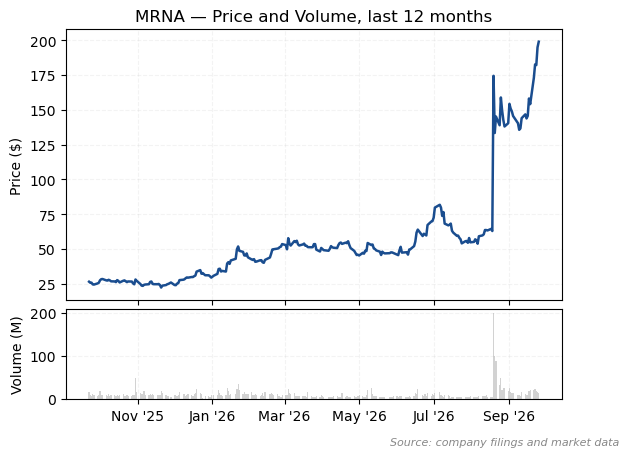
On Tuesday 19 August 2026, before US trading began, Merck and Moderna announced that Phase 3 INTerpath-001 had met its primary endpoint of recurrence-free survival and its key secondary endpoint of distant metastasis-free survival. The trial enrolled 1,137 patients with completely resected stage IIB to IV cutaneous melanoma. Moderna had closed the previous session around $63. It closed that day at $174.38, up 177%, adding nearly $45B of market value in one session. Intismeran autogene became the first individualised neoantigen therapy, and the first mRNA cancer therapy of any kind, to hit a Phase 3 endpoint.
Two other things happened that month. On 5 August the FDA approved mFLUSIVA, the first mRNA seasonal influenza vaccine licensed in the United States, with a label specifying adults aged 50 and over. Eight days after the oncology readout, with the stock at $142.77, Moderna launched a convertible offering; by 1 September it had closed $3.0B at a 0.00% coupon. By 24 September the shares were up 561% year to date. No hazard ratio from the trial has been published.
Moderna Makes Medicines Out of Messenger RNA
Moderna, Inc. was founded in 2010 and is headquartered at 325 Binney Street in Cambridge, Massachusetts. Stéphane Bancel has been chief executive since 2011. The company makes medicines out of messenger RNA, a set of instructions telling a patient's own cells to manufacture a protein rather than delivering the finished protein as a conventional drug does. The same platform architecture can teach an immune system to recognise a virus or a tumour.
Three products are on the market. Spikevax and mNEXSPIKE are COVID vaccines, and mRESVIA protects against respiratory syncytial virus. The customers are governments, wholesalers and retail pharmacies. Behind those three sit 25 development candidates across 35 clinical programmes. About 4,700 full-time employees in 18 countries worked there on 31 December 2025.
The manufacturing footprint is wide for a company with $1.9B of revenue. Marlborough, Massachusetts was purpose-built for intismeran and began supplying clinical batches in September 2025. Drug-product onshoring at Norwood targets the first half of 2027 for end-to-end US supply. Plants in the United Kingdom, Australia and Laval, Quebec were licensed or producing by September 2025, and capital spending of $0.2B to $0.3B in FY2026 adds little new capacity. The shares closed at $198.88 on 26 September 2026, for a market capitalisation of $78.91B.
One Reportable Segment, and Europe Fell 96% Inside It
There is no segment margin walk to produce here, because Moderna "operates as a single operating and reportable segment." What the annual report does disaggregate is geography and product.
Net product sales by region, in millions of dollars:
| FY2025 | FY2024 | FY2023 | |
|---|---|---|---|
| United States | $1,165 | $1,726 | $1,720 |
| Europe | $50 | $573 | $1,353 |
| Rest of world | $603 | $810 | $3,598 |
| Total | $1,818 | $3,109 | $6,671 |
COVID vaccines were $1,810M of that FY2025 total, against $3,084M and $6,671M in the two prior years. RSV contributed $8M against $25M and nothing. Management's stated reason is demand: "we experienced a decline in customer demand for our COVID vaccine in 2023 and 2024, and this trend has continued into 2025."
Two lines matter most. Gross product sales were $3,304M against net product sales of $1,818M, a provision of $1,486M, or 45% of gross. Anyone turning a list price into revenue here is modelling against a 45% haircut. The other line is Europe, down 96% in two years. Bancel gave the reason on the July call: "we have not been able to participate in the European market because of an exclusive partnership that the EU set up during the pandemic. But this partnership expires … in 2026."
The June quarter shows the cost base rather than the demand base. Revenue was $145.0M, up 2.1% year over year, on a 35.9% gross margin and an operating margin of negative 562.1%. Loss per share was $1.97. The quarter beat consensus by 3.0%, the eighth consecutive beat, and the beats come from spending less than modelled. CFO Jamey Mock cut guidance again on the same call.
A COVID Company Became a Cancer Company on One Readout
Three years ago the question about Moderna was how far COVID demand would fall. In FY2023 it earned $6.8B selling a COVID vaccine into a collapsing market and lost $4.7B. Net losses ran $4.7B, $3.6B and $2.8B across FY2023 to FY2025.
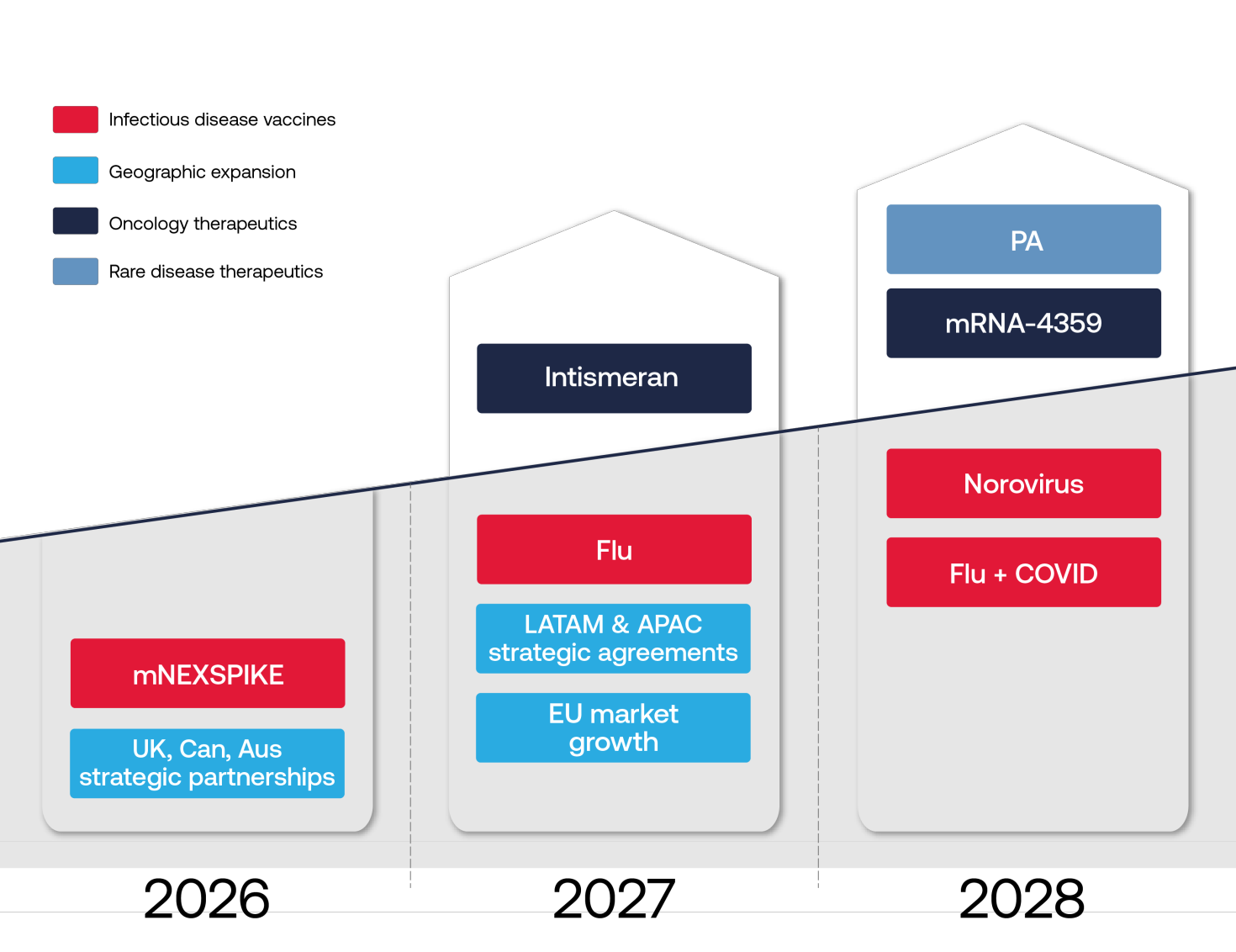
Since 19 August the most valuable asset in the company is a cancer drug. The market now trades the ticker as an oncology story, which is accurate about what changed and incomplete about what the company earns. In FY2025, 99.6% of product sales were COVID vaccines, and intismeran was a net expense of $407M after Merck's reimbursements, following $390M in FY2024. The drug that re-rated the equity is a cost line.
The Entire US Market for the Drug Is 37,477 Patients a Year
Demand for intismeran comes down to how many patients can be treated and at what price. GlobalData put US adult melanoma diagnoses at 112,431 in 2025, with approximately one third in the stage II to IV high-risk group the drug addresses. That is 37,477 patients a year, and it is the entire US demand pool.
The regimen specification sets the unit. Intismeran is dosed at 1mg every three weeks for up to nine doses, alongside KEYTRUDA at 400mg every six weeks for up to nine cycles, running about 56 weeks. Each patient is a nine-dose manufacturing order.
Price is the number nobody has. The only named third-party figure is William Blair's assumed US wholesale acquisition cost of $475,000 a course, anchored to CAR-T cell therapy pricing. At that price, $1.0B of intismeran product sales needs 2,105 courses a year, which is 5.6% of the US high-risk pool. GlobalData's dated forecast has intismeran sales surpassing $1B by 2031. The only house with a dated number has it reaching 5.6% of that pool five years after the Phase 3 win.
Reimbursement looks better than the price tag suggests. A published early economic evaluation models the combination at 14.16 quality-adjusted life years and $1,070,705 of lifetime cost, against 7.65 years and $745,939 for pembrolizumab alone. That is $49,887 per quality-adjusted life year gained, well inside what US payers routinely fund.
The vaccine business carries the contracted demand. The European Commission ran a joint procurement contract for up to 24 million doses of mRESVIA across six countries. Long-term supply commitments with the United Kingdom, Canada and Australia drive the 2026 international mix, and a multi-year COVID supply agreement with the Government of Brazil is now backed by local manufacturing capacity. Deferred revenue on product sales was $107M at the end of 2025, out of $252M of total customer advances, so there is no order book in the industrial sense.
For influenza the precedent is mNEXSPIKE. It took roughly 24% of the US retail COVID vaccine market in its first season and roughly 34% among customers aged 65 and over. mNEXSPIKE is the only evidence that Moderna can win customers in a mature, contested US retail vaccine market, which is what mFLUSIVA must now do. US manufacturers estimated supplying 154 million influenza doses for the 2025-26 season, and 135.6 million were distributed by 7 March 2026, which is the supply Moderna has to displace. Moderna's 2026 guidance assumes no revenue from mFLUSIVA or from mCOMBRIAX, its flu-plus-COVID combination, so that demand is incremental from 2027.
Every Dose Is a Different Medicine
The supply constraint here is not floor space. Intismeran is an individualised neoantigen therapy. A patient's tumour is sequenced, and a machine-learning algorithm designs a single mRNA that specifies up to 34 neoantigens specific to that tumour and to the patient's HLA type. HLA type is the immune signature specifying which protein fragments a T cell can see. The mRNA is wrapped in a lipid nanoparticle and injected into muscle, and it raises CD8+ and CD4+ T cells against tumour cells that KEYTRUDA has already de-repressed. Every dose is a different medicine, so the supply chain restarts for each patient.
Chief Development Officer David Berman has explained why the design tolerates imprecision. About 29% of the designed neoantigens turn out to be immunogenic, with between 1 and 18 reactive in each patient, and "you only need 1 neoantigen reactive T cell in order for there to be activity." The current generation of the algorithm does that selection, and the next generation is being built with AI.
The annual report concedes the manufacturing risk in its own words: "Our intismeran autogene product candidates are uniquely manufactured for each patient using a novel, complex manufacturing process and we may encounter difficulties in production." The bottleneck is per-patient turnaround rather than plant capacity. President Stephen Hoge has said the dedicated Marlborough line "will be able to support launch" and "can support our commercial profile that ourselves and our partner, Merck have articulated for several years to come."
Neither company has published a courses-per-year capacity figure for Marlborough. That is the largest hole on the supply side of any model here, and it sits under the revenue line everyone is arguing about. Meeting GlobalData's $1B threshold takes 2,105 bespoke courses a year, so the binding question is payer demand rather than capacity.
What Would Have to Be True
The gap between the price and the sourceable business can be stated in one pair of numbers, so here is how each side is built.
Start with the price. Moderna has 396.77M shares outstanding, and the convertible notes add 14,246,100 more at an initial conversion price of $210.58. That gives 411.02M fully diluted shares and a fully diluted market value of $81.76B. Pro-forma cash is $7.33B to $7.83B against $3.0B of converts and $600M of drawn term loan, so net cash is $3.73B to $4.23B, a midpoint of $3.98B. Enterprise value is $77.78B.
Next, the multiple that turns enterprise value into required revenue. The six biotechnology peers in Moderna's own comparison set trade on price-to-sales ratios of 9.4x, 3.4x, 6.0x, 9.3x, 9.1x and 6.0x, an average of 7.20x. At 7.20x, $77.78B of enterprise value requires about $10.80B of annual revenue.
Against that, a 2028 ceiling. Inventing a ramp would be guesswork, so every line below sits at its own published peak or prior high. By construction the total cannot be exceeded in 2028.
| Line | 2028 ceiling | Basis |
|---|---|---|
| Base infectious disease | $2.09B | FY2025 revenue of $1.9B grown at management's "up to 10%" |
| Influenza and flu/COVID combination, US | $1.16B | William Blair's full US peak for mFLUSIVA |
| Europe headroom above the FY2025 base | $1.303B | Europe restored to its FY2023 peak of $1,353M, less the $50M already counted |
| Intismeran, Moderna's share | $0.50B | Half of GlobalData's $1.0B 2031 threshold, pulled three years early |
| 2028 ceiling | $5.05B |
Every line is deliberately generous. Influenza hits its analyst peak two years early. Intismeran reaches GlobalData's 2031 level three years ahead of schedule, and Moderna books half of it as revenue when the collaboration actually shares "costs and any profits or losses generally … equally." Norovirus and methylmalonic acidemia contribute nothing, which is correct, because one missed its interim analysis and the other is deferred. Every line also assumes the supply and the demand exist to meet it.
The ceiling is $5.05B against a requirement of $10.80B. The shortfall is $5.75B, so the most generous sourceable 2028 revenue is 53.2% short of what the enterprise value asks.
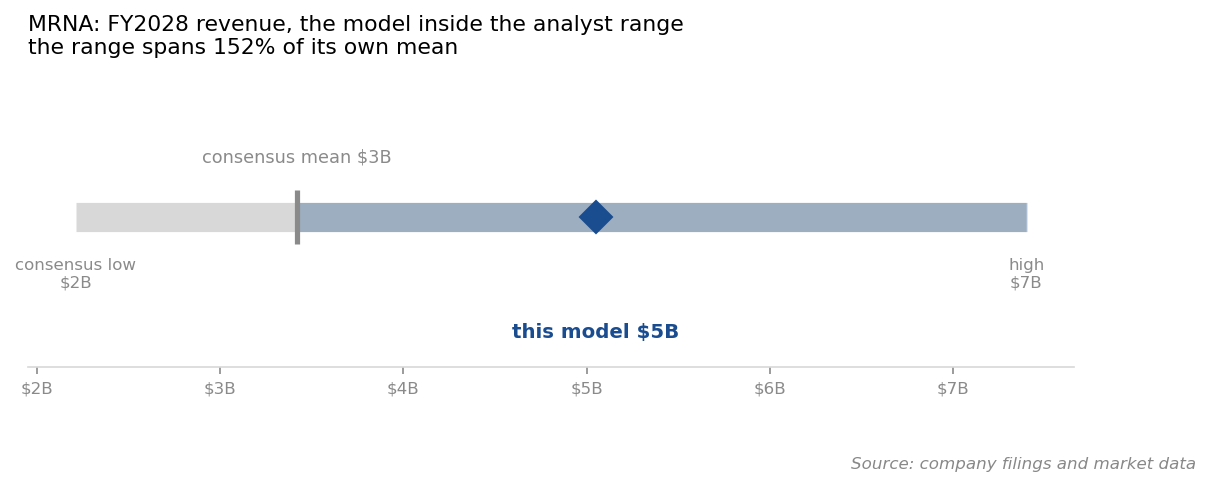
Against consensus the finding splits in two. The $5.05B ceiling is 47.7% above the 2028 mean of $3.42B, so the mean is comfortably achievable on published forecasts alone. It is 31.7% below the 2028 high of $7.40B, and that high cannot be rebuilt from any named peak forecast of any Moderna product. The bulls inside consensus are modelling something nobody has published.
So what would have to be true? Three things could move the arithmetic, and they are not equal in size.
A stronger hazard ratio moves it most in probability and least in dollars. The hazard ratio is the ratio of event rates between the treated arm and the control arm, so a lower number means fewer recurrences. The benchmark is Phase 2b KEYNOTE-942, which produced a 49% reduction in the risk of recurrence or death, a hazard ratio of 0.51 on a 95% confidence interval of 0.294 to 0.887. Management's own Phase 3 bar was a 20% reduction, a hazard ratio of roughly 0.80. A result near 0.51 supports a premium price, fast adjuvant uptake and read-through to other tumours. A result near 0.80 supports none of the three.
A broader label moves it most in dollars, and melanoma alone cannot get there. The US high-risk melanoma pool is 37,477 patients a year, and the only dated forecast for that indication tops out at $1B in 2031. Goldman Sachs sees melanoma plus lung reaching $10.9B of peak annual sales, half of which is $5.45B to Moderna under the 50-50 split. That is within rounding of the $5.75B shortfall. Closing the gap on published numbers means the whole melanoma-and-lung peak arriving in 2028 rather than at peak. That is why the adjuvant non-small-cell lung Phase 3 and the event-driven renal cell Phase 2 matter more here than the melanoma launch does.
A faster launch moves the timing and leaves the ceiling alone. Hoge's stated case is "we'd be ready to go next year if all went perfectly to plan." Pulling first revenue into 2027 changes which year the ramp starts.
The longer-dated forecasts are the honest bull case, and all of them are peak numbers. Morningstar raised its 2035 intismeran forecast to $16.8B from $7.2B. Bloomberg Intelligence models up to $12B of non-risk-adjusted peak sales by 2040, against roughly $5.4B risk-adjusted. Half of Goldman's $10.9B puts the oncology franchise on 14.3 times its own peak revenue, whenever that peak arrives. The story is real. The 2026 price is a 2032 price.
Thirty-Five Times Sales, Against Peers at Seven
The model says what the business can earn. This says what the market charges for it, and on every available comparison Moderna is expensive.
The stock trades at 35.4 times trailing sales, which is 4.9 times the 7.20x peer average. BioMarin Pharmaceutical trades at 3.4 times sales and is a profitable rare-disease company, on under a tenth of Moderna's sales multiple. Exelixis trades at 6.0 times sales and is a profitable oncology company, on a sixth of it. Earnings multiples are uninterpretable here, because trailing earnings are negative 24.9 times and EV/EBITDA negative 27.7 times. Against its own history, 35.4 times sales is the 0th percentile of its only two profitable years, which printed roughly 8 times earnings.
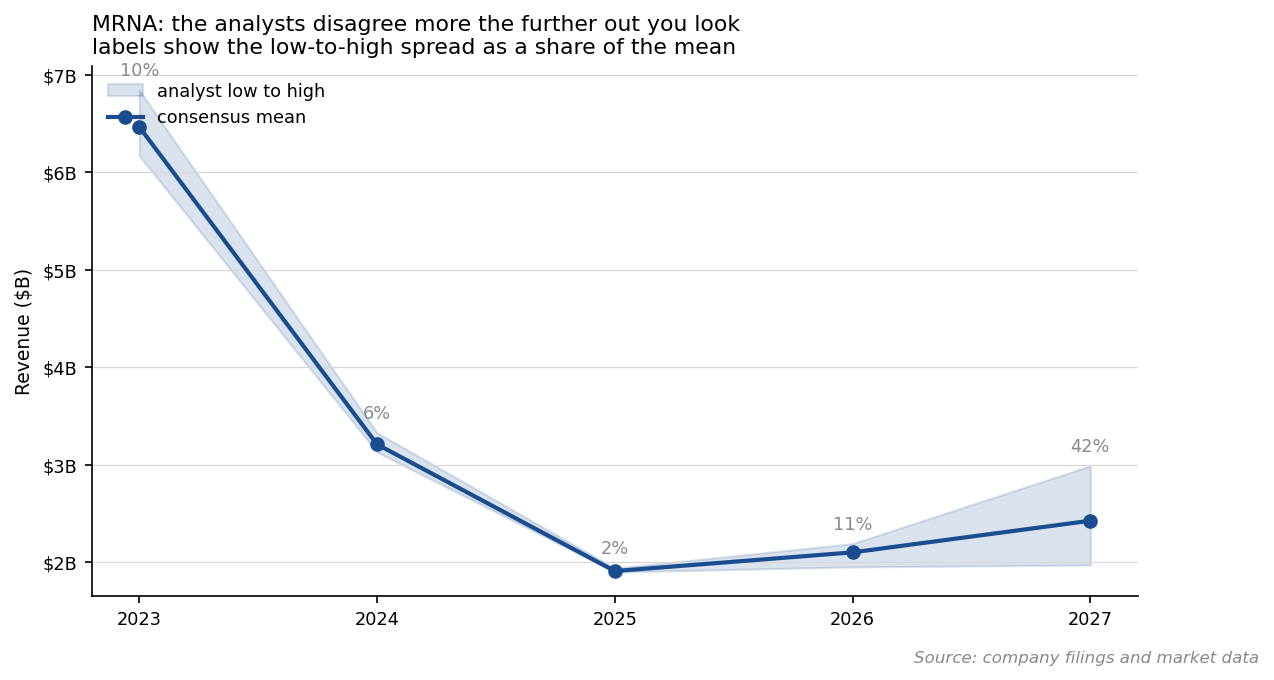
The sell side agrees, which is what stops this reading as contrarianism for its own sake. Targets are rising, from $65.00 a year ago to $111.83 last quarter to $130.50 last month. The stock is $198.88, so the consensus target implies 34.4% downside. Ratings at 1 September were one strong buy, four buys, seventeen holds, one sell and one strong sell across 24 analysts. Analysts are raising their numbers and declining to follow the price.
Cory Kasimov of Evercore ISI said it on the day of the readout. The valuation, he said, "already prices in substantially more conviction than the data disclosed thus far supports."
The Only Serious Rival Left the Field in the Same Month
For most of the last decade two serious individualised neoantigen programmes existed, Moderna's with Merck and BioNTech's autogene cevumeran with Roche's Genentech. Both work by sequencing a tumour and printing the mRNA. In August 2026 BioNTech terminated its Phase 2 BNT122-01 trial in adjuvant colorectal cancer after the safety monitoring board found a numerical overall-survival imbalance between arms, having already failed in first-line melanoma. In the same month Moderna's programme hit a Phase 3 endpoint and its closest competitor withdrew from two indications.
Moderna's advantage is the loop between that algorithm and that factory, plus a specific result Hoge volunteered. Low tumour-mutational-burden adjuvant melanoma patients "had a consistent hazard ratio as those with high." Tumour mutational burden counts how many mutations a tumour carries, and low-burden tumours are where neoantigen approaches were expected to fail.
The counter-moats are specific too. Intismeran only works alongside KEYTRUDA, which Merck owns, and Merck takes half the economics. Berman named the scientific limit himself: "the big question comes out in tumors where checkpoints don't work, and that's pancreatic cancer and to a lesser degree, gastric." In vaccines, Moderna re-enters Europe from $50M against Sanofi, GSK and Pfizer, which hold decades of tender relationships and tender allocation in those markets. Management names its competitors in the filing: "Pfizer and Sanofi for sales of our COVID vaccines and Pfizer and GSK for our RSV vaccine." In enhanced influenza the incumbents are Sanofi's Fluzone High-Dose and Flublok and CSL Seqirus' Fluad, and mFLUSIVA's claim against them is about 27% greater effectiveness than a standard shot.
Management Ranked Its Own Risks, and the Eighth One Is This Article
The strongest case against the current price is filed with the SEC under Moderna's own name. Item 1A of the FY2025 annual report is where a company lists what could go wrong, and its first headings run in this order.
"Regulatory and market uncertainty have and may continue to impact our business and the markets for our products." "We may experience difficulties executing our near-term strategy and prioritized pipeline." "The vaccine market, and pharmaceutical market more generally, is intensely competitive." "We have experienced commercial challenges and may experience additional challenges in the future." Sixth names "reference pricing or most-favored-nation pricing models."
The eighth heading governs everything above it: "The market opportunities for our products and product candidates may be smaller than we believe." The first is not boilerplate either. It names CDC and Advisory Committee on Immunization Practices recommendations on eligibility and target populations as having already changed demand. That is live for mFLUSIVA today, because FDA approval is not a CDC recommendation, and the 65-plus indication is an accelerated approval contingent on a specified post-marketing study.
Now the risks that are ours. The assumption most likely to be wrong is the $475,000 course price. It is one bank's analogy to CAR-T pricing for a nine-dose outpatient injection, in a market where Moderna's realised provision is 45% of gross sales and where its own risk factor six names most-favoured-nation pricing. A 30% net-price haircut cuts Goldman's $10.9B and Morningstar's $16.8B by the same proportion. Europe is the second weakest line. Hoge expects the combination's "full effect really probably not felt until 2028 and maybe a little bit beyond," with roughly half of European markets on tender contracts, some of them already covering 2028 allocation. Cutting that line 20% takes the ceiling to $4.79B.
The third gap cannot be closed with published information. No gross margin for a bespoke nine-dose course has been disclosed by either party, so $1B of intismeran product sales cannot be converted into Moderna's half of the profit. The collaboration shares profits and losses, and today it produces about $400M a year of net cost. Anyone who tells you what intismeran contributes to 2028 earnings has filled that gap with an assumption.
Solvency is no longer the binding risk. Cash and investments were $6.9B on 30 June, guided to $4.7B to $5.2B at year end after the $950M Arbutus and Genevant settlement paid in July. With the net convert proceeds, pro-forma year-end cash is $7.33B to $7.83B. FY2025 consumed $2,065M, being $1,873M of operating outflow plus $192M of capital spending. At that rate the cash funds 3.55 to 3.79 years from 1 January 2027, so the runway runs out around mid-to-late 2030. If the contingent $1.3B payment to Arbutus and Genevant triggers on appeal, exhaustion moves to about the first quarter of 2030. On consensus burn it never happens, because FY2027 works out near $1.25B and FY2028 near $0.41B, with consensus FY2029 earnings per share positive at $0.500. A further $900M of term loan sits undrawn, the second tranche conditioned on "specified regulatory approval milestones."
The 1 September convertible did not fix the business. It converted a solvency question into a dilution question. Moderna raised $3.0B at a zero coupon, at a conversion price of $210.58 that sits 47.5% above the $142.77 close on 27 August and above today's $198.88. That is excellent treasury work, and the clearest public statement anyone inside the company has made about where they think the shares are.
What I Am Watching
The falsifying event has a date. On 24 October 2026, at the ESMO Presidential Symposium in Madrid, Merck and Moderna present the full INTerpath-001 dataset. The number to read first is the recurrence-free survival hazard ratio, with its confidence interval and its stage-specific subgroups. A hazard ratio near the 0.51 benchmark of Phase 2b, with distant metastasis-free survival consistent and no subgroup falling apart, supports a premium price and fast label expansion into lung. The $5.45B half-share of Goldman's peak then becomes a question of timing. A hazard ratio near management's own 20% bar, around 0.80, leaves melanoma as a $1B-by-2031 product and the $77.78B enterprise value with nothing to grow into.
Two dates follow. Third-quarter results on 5 November carry the first US vaccination-rate print against Mock's provisioned decline, and any mFLUSIVA revenue is upside to guidance that assumed zero demand. Analyst Day in Cambridge on 12 November is where the company must put a price, a launch plan and a courses-per-year capacity number against a $78.91B valuation.
Takeaway
The market has priced a result nobody has seen. At $198.88 the enterprise value asks for $10.80B of annual revenue at peer multiples, and every published peak forecast added together produces $5.05B for 2028. The ceiling lands 47.7% above the consensus mean and 31.7% below the consensus high, and the high has no published forecast behind it. The bull case is displaced in time rather than dead, because Morningstar's $16.8B and Goldman's $10.9B are peak numbers for the middle of the next decade. What is genuinely undecided is the hazard ratio, and on 24 October the argument becomes arithmetic instead of anticipation.
Sources
- Merck and Moderna joint press release on INTerpath-001, 19 August 2026
- BioPharma Dive on the mFLUSIVA approval, 6 August 2026, and on the INTerpath-001 reaction including Kasimov, 19 August 2026
- Moderna Form 10-K FY2025, Items 1, 1A, 3 and 7, filed 20 February 2026
- Moderna Q2 FY2026 earnings call, 31 July 2026 (Bancel, Hoge, Berman, Mock)
- Moderna Form 8-K on the $3.0B 0.00% convertible notes, 1 September 2026
- GlobalData on US melanoma epidemiology and the intismeran forecast, 25 August 2026
- William Blair (Myles Minter) on mFLUSIVA peak US sales and the $475,000 course assumption, 2026
- Goldman Sachs, Morningstar and Bloomberg Intelligence intismeran peak forecasts, 2026
- Published early economic evaluation of intismeran plus pembrolizumab in resected stage IIIB to IV melanoma (SSRN)
- KEYNOTE-942 Phase 2b results via ASCO 2026
- ApexOnco and BioNTech disclosure on the BNT122-01 termination, August 2026
- Bloomberg on the Arbutus and Genevant settlement, 3 March 2026
- CDC FluVaxView influenza dose distribution, 7 March 2026
- Company filings, reported results, analyst consensus and market price data
- Full working, including the ceiling build and the cash-runway walk:
research/2026-09-27_MRNA.md
Research, not a recommendation. Figures are sourced as cited and were current at publication; nothing here is personalized investment advice.