Rubrik's CEO Said 'Accelerated' Twice. Analysts Model a 30% Slowdown
October 24, 2026 · Rubrik, Inc. (RBRK)
profitmonk
Summary
- Rubrik is speeding up. New annual subscriptions added in the July quarter grew 35%, and the full-year guide for them has doubled from 7% growth to 14%.
- Analysts' numbers assume the reverse. Consensus revenue for fiscal 2028 implies new subscription dollars fall about 30% next year, once the move to the cloud is over.
- My fiscal 2029 revenue is $2.66B, 7.3% above the $2.48B consensus and above the highest estimate. That assumes revenue keeps tracking the subscription book at the rate this year's guidance implies. On that assumption, revenue still lands $59M above consensus even if new business never grows again.
- The price is steep. At $128.74 the stock trades at 13.7 times its guided year-end subscription book and 103 times analysts' fiscal 2029 adjusted earnings.
- The proof comes in December and March. The third-quarter report tests the slowdown, and the first fiscal 2028 guide settles who is right.
The Quarter Rubrik Called an Acceleration, and the Market Sold
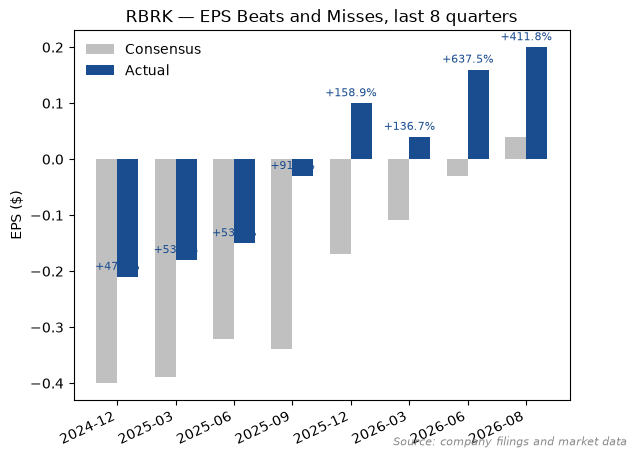
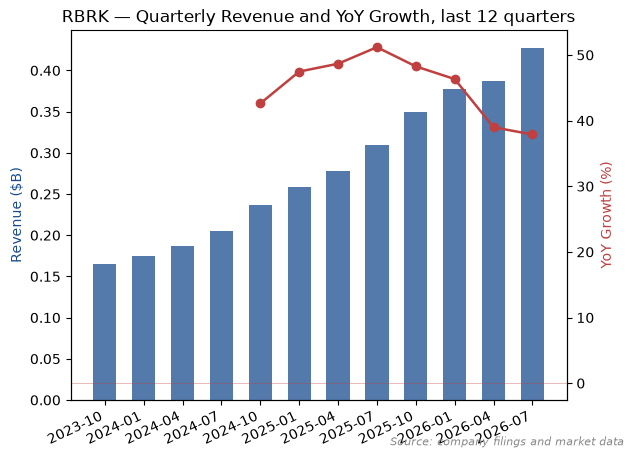
On 27 August Rubrik reported a quarter that beat every metric it had guided. Revenue rose 38% to $427M, and adjusted earnings of $0.20 a share cleared a consensus of about four cents. Adjusted here means non-GAAP, and I use that basis for earnings throughout because guidance and consensus use it too.
Co-founder and chief executive Bipul Sinha wanted analysts to hear one number. "Let me repeat, accelerated net new subscription ARR growth," he said on the call. ARR, annual recurring revenue, is the yearly value of all subscriptions in force. Net new ARR is how much that book grows in a period, and in the quarter it grew by about $96M, 35% more than a year earlier.
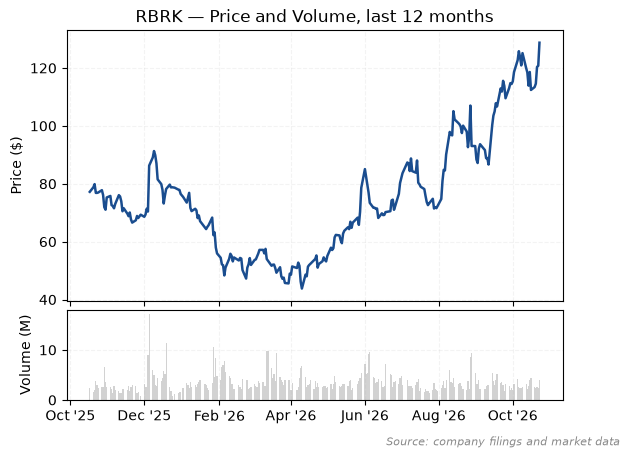
The stock fell the next day anyway. Invezz put the drop between 5.6% and 12%, citing slower growth in cloud bookings, a lower free cash flow margin and a slip in gross margin. Two months later the view had flipped, and on 23 October Rubrik closed at a record $128.74 after launching an AI product for securing customers' code.
The Company That Gets Your Data Back
Rubrik is a Palo Alto software company that backs up an organisation's data and restores it cleanly after an attack. Sinha has run it since he co-founded it in December 2013. It began by selling backup appliances and now sells subscriptions to Rubrik Security Cloud. That cloud-hosted platform covers data on a company's own servers, in public clouds, in apps such as Microsoft 365, and in identity systems such as Active Directory.
The pitch is recovery. Rubrik's annual report describes a Ransomware Recovery Warranty of up to $10M, which puts a guarantee on the recovery itself. Newer products stretch the same idea to identities, human and machine. Rubrik Agent Cloud, on sale since February 2026, watches what AI agents do inside a company and can undo their actions.
Rubrik listed in April 2024 at $32 a share, above its marketed range. At $128.74 it is worth $26.5B.
One Segment, and Nearly All of It Subscriptions
Rubrik reports a single operating segment, so the useful split is by type of revenue. Subscriptions are almost everything. The small "other" line holds services, appliances and maintenance. Fiscal 2026 is the year to 31 January 2026.
| Fiscal year | FY2026 | FY2025 | Change |
|---|---|---|---|
| Subscription revenue | $1.26B | $829M | +53% |
| Other revenue | $52M | $58M | −10% |
| Total revenue | $1.32B | $887M | +48% |
| Gross margin | 80% | 70% | +10 pts |
| Subscription gross margin | 82% | 74% | +8 pts |
| GAAP operating loss | $(345)M | $(1.13)B |
Subscriptions surged because Rubrik finished moving its installed base to the cloud. The annual report says customers began switching from the older on-premises product in fiscal 2023, and the migration was largely complete in fiscal 2026. Margins rose with it, as the table shows.
The other line is small and shrinking, mostly hardware shipped in Asia-Pacific regions that have not yet moved to partners. In the July quarter it "benefited from the higher price and volume of hardware," chief financial officer Kiran Choudary said. The 10-K's own explanation for each line sits in a part of the filing I could not retrieve, so these reasons come from the call and the business description.
The fiscal 2025 GAAP loss looks enormous because of the IPO. Stock-based compensation that year was $914M, inflated by the IPO, and it fell to $329M in fiscal 2026.
Three Years Ago Rubrik Burned Cash. This Year It Guides to $328M
What changed most is that Rubrik became a cash business. Its own profitability gauge is the subscription ARR contribution margin, which measures what the subscription book earns after the costs of running and selling it. That margin has gone from negative to double digits in three years, and free cash flow followed.
| Fiscal year | FY2024 | FY2025 | FY2026 | FY2027 guide |
|---|---|---|---|---|
| Subscription ARR contribution margin | −12% | 2% | 12% | about 15.5% |
| Free cash flow | −$25M | $22M | $238M | $323M to $333M |
Management is candid about the backdrop. The annual report warns that economic conditions "may adversely affect the buying patterns of our customers," through tighter budgets and longer sales cycles, and it flags chip shortages and server allocation pushing up hardware prices. On the August call Choudary said rising hardware costs and supply constraints had no material impact on subscription ARR.
Why Buyers Now Treat Recovery as Mandatory
My demand argument is simple. AI makes break-ins faster, so getting back up fast becomes the first thing a company pays for. Sinha put it bluntly on the call, citing Anthropic's Mythos model: "You cannot detect or prevent pretty much anything if the vulnerability exists. So the real strategy is fast recovery." He added that customers "increasingly view Rubrik's unified single platform approach to cyber resilience as a board-level mandatory requirement rather than a discretionary purchase."
The deals Sinha described fit that story, though none of the customers is named. A US state agency displaced "its legacy incumbent." A Global 2000 financial firm chose Rubrik, "displacing a legacy vendor and outcompeting a new gen competitor." A large US health-care system called "a single pane of glass across on-prem, cloud, SaaS and identity data" the deciding factor.
Existing customers keep buying more. Subscription net revenue retention, which compares what last year's customers spend now with what they spent a year ago, was "over 119%" in the July quarter. So the base grew by roughly a fifth before Rubrik signed a single new logo. The biggest accounts drive it, because customers paying more than $100,000 a year carry 88% of subscription ARR.
Identity is the second engine. Call summaries for the April quarter said identity ARR "topped $50 million," and identity customers passed 900, up from 400 three quarters earlier. MarketsandMarkets expects spending on identity threat detection and response (ITDR), the software that spots and repairs attacks on login systems, to reach $35.6B by 2029.
A third engine is mostly a promise so far. Agent Cloud has "more than 15 paying customers," and Choudary said the guide carries only a "minimum assumption" for it this year. In October Rubrik put Code Guardian into private preview. Channel Insider reported that it runs Anthropic's Claude Mythos against air-gapped copies of customer code, with AHEAD, Trace3 and WWT signed on as partners.
The surprise is a business that used to shrink. Non-cloud ARR, sold to customers who host Rubrik themselves, is growing. Analyst Gray Powell put that growth at around 10% this year, based on the guidance model points, after declines in prior years. Sinha tied it to sovereign, government and regulated buyers building "digital embassies." Choudary added that it carries higher margins, because "the customer is self-hosting and we are not hosting it for them."
The Constraint Is Sellers, Because Servers Do Not Bind
Rubrik's product is software, so it has no supply bottleneck in the usual sense. In August management said it saw no material ARR impact from "rising hardware costs or supply constraints."
The one physical exposure is small. Appliances sit in the other revenue line, 4% of fiscal 2026 revenue. Supermicro builds those servers, and the annual report says the agreement "expires in November 2026." Choudary said lead times "actually get better from the start of the year." A lapsed contract would touch only that small line, and I have not confirmed whether it has been renewed.
The real limit is how many sellers and engineers Rubrik can hire and point at the right accounts. Management plans to "invest in our go-to-market, specifically targeting regions and verticals that we believe offer the most attractive ROI." That spending competes with margin, which is why the contribution margin climbs slowly.
There is also a dependency. Rubrik's Agent Identity product works with Okta and Microsoft Entra ID, identity providers it may one day compete with. BMO's Keith Bachman raised this on the call, saying agent governance "sounds a lot like what the identity providers are suggesting."
What It Is Worth: Consensus Assumes New Business Falls 30%
My fiscal 2029 revenue comes out at $2.66B, 7.3% above consensus and above the highest single estimate. Fiscal 2029 ends on 31 January 2029, so it covers most of calendar 2028.
The whole gap comes down to one question: what happens to new business once cloud migrations end? Rubrik runs itself on ARR. "That's the primary metric we focus on," Choudary said. So I build ARR first, then turn it into revenue at the rate this year's guidance implies, which is almost exactly the average ARR on the books, about 1.01 times.
Rubrik's guidance implies $420.5M of net new ARR in fiscal 2027, 14% more than last year. I carry three growth rates forward from there, and Rubrik has reported or guided each of them.
| Case | Net new ARR growth a year | Where the rate comes from | FY2029 ending ARR | FY2029 revenue |
|---|---|---|---|---|
| Bear | 0% | New business stays flat | $2.72B | $2.54B |
| Base | 14% | Rubrik's guide for fiscal 2027 | $2.91B | $2.66B |
| Bull | 35% | July quarter, as reported | $3.22B | $2.86B |
| Consensus | about −30% in FY2028 | Implied by consensus revenue | $2.48B (range $2.37B to $2.59B) |
The bear case is the useful one. Suppose Rubrik adds the same $420.5M of new subscriptions every year and that figure never grows. Fiscal 2029 revenue still lands $59M above consensus.
Run consensus backwards and its assumption shows. To hit analysts' fiscal 2028 revenue, Rubrik's ARR would end that year near $2.18B, so new ARR would have to fall about 30% from this year. My base case ends the year at $2.36B.
I think analysts are anchoring on the second-half guide, which implies new ARR only 3% to 5% above a year earlier. Citi's Fatima Boolani called that "a pretty precipitous deceleration." Choudary replied that Rubrik runs the business "on an annual net basis, our sales compensation as well," and noted it had raised the year's guide by "the full beat in Q2 as well as raise some more." By Sinha's count, this was Rubrik's tenth straight quarter of beating its own guidance as a public company.
For earnings, I take the net margin implied by consensus fiscal 2029 adjusted earnings of $1.25 a share and apply it to my revenue. That gives about $1.35 a share. At its June Analyst Day Rubrik set a long-term operating margin target above 20%, with no year attached, and reaching it would lift earnings well past my figure.
Three assumptions carry the model, and any one of them breaks it if it is wrong by a fifth:
- Net new ARR keeps growing after migrations end. If fiscal 2028 new ARR falls 20%, revenue that year comes to about $2.07B, roughly consensus.
- Revenue keeps tracking ARR at about 1.01 times. It was 1.03 last year, inflated by material rights, a type of customer credit booked as revenue when it expires. At 0.99 times, consensus would imply only a 10% drop in new business.
- Retention holds near 119%. Expansion from existing customers supplies most of the growth, and a slide to 110% would cost about $130M of new ARR a year.
As a ceiling check, my fiscal 2029 ARR is 2.3% of the "$125B+ by 2029" market Rubrik sized at its Analyst Day. That is the company's own figure, far larger than any outside forecast I found. Global Industry Analysts puts data protection at $17.0B by 2030, and Rubrik's fiscal 2026 year-end ARR of $1.46B is about 8.6% of that.
The full arithmetic is in the published research brief.
What the Market Is Paying: 13.7 Times Its Subscription Book
My model says the business beats consensus, but the price already expects a lot. Enterprise value is market value plus convertible debt minus cash, about $25.9B here. My main yardstick is enterprise value against the year-end ARR Rubrik guides for this year. For earnings, I use analysts' fiscal 2029 adjusted figure.
| Measure | Multiple |
|---|---|
| Enterprise value / FY2027 guided year-end ARR | 13.7x |
| Enterprise value / FY2029 consensus revenue | 10.4x |
| Enterprise value / FY2029 revenue, my base case | 9.7x |
| Price / FY2027 guided non-GAAP EPS | 257x |
| Price / FY2029 consensus non-GAAP EPS | 103x |
| Free cash flow yield on FY2027 guide | 1.3% |
Rubrik has no GAAP earnings to compare, so against peers I use trailing sales. Commvault, the closest listed backup rival, is the cleanest comparison. Rubrik's ARR is about 1.6 times Commvault's and growing about 1.5 times as fast, yet it trades at about four times the sales multiple.
| Company | Trailing sales multiple | Latest ARR growth |
|---|---|---|
| Rubrik | 17.2x | 33% |
| Commvault (ChartRow, 16 October) | about 4.3x | 22% |
| Okta | 11.6x | |
| Zscaler | 12.4x |
Rubrik's own history offers no anchor. It has never earned a GAAP profit and has been public for only two and a half years, so it has no long-run earnings multiple range. The shares have gone from a $32 IPO to a March 2026 low of $45.58, then to a record this week.
My call: the stock is expensive today and fair only if the base case holds. A 1.3% free cash flow yield needs years of growth above 20% and margins that reach the long-term targets. Sentiment gives little extra lift. The stock already trades above the roughly $114 average target of analysts who updated last quarter, and all 28 analysts covering it rate it a buy.
The stock has also crossed $124.76, the conversion price of Rubrik's $1.15B zero-coupon convertible due 2030. Full conversion would add about 4% to the share count. Rubrik bought capped calls, hedges that offset that dilution economically up to $175.10.
Rubrik Wins on Recovery Design, Against Rivals With Bigger Estates
Rubrik's competitive case rests on architecture. It stores backups as a time series with its own metadata, which lets it "continuously precalculate clean points of recovery... before an attack occurs," Sinha says, and that design is what supports the $10M warranty. The second advantage is breadth sold under one contract. Rubrik's Flex licence promises "one license, one contract, one commitment," and the identity base doubling in three quarters shows customers adding products this way.
The rivals are large and well funded. Gartner's 2026 Magic Quadrant for backup named Rubrik a Leader for the seventh year and placed it furthest on vision. It also put Veeam highest on ability to execute, which is honest evidence against Rubrik. TechCrunch reported that Veeam bought Securiti AI for $1.725B in October 2025 to move into data security and AI. Rubrik built Agent Cloud and bought Strata Identity on undisclosed terms.
Cohesity is the rival with the most to prove. It absorbed Veritas in December 2024, taking on the NetBackup installed base and a $2.8B term loan. Its chief executive, Sanjay Poonen, told CNBC a public Cohesity should be valued "comparable to or higher than Rubrik." Rubrik's $1.66B of ARR now matches or exceeds the $1.5B to $1.6B attributed to Cohesity around the merger.
Commvault has been a Gartner Leader fifteen times but grows ARR at 22%. Native tools are the cheapest threat: Microsoft sells its own Microsoft 365 Backup, and Rubrik's health-care win came against "cloud-native backup tools." In agent governance Rubrik faces Okta and Microsoft Entra, platforms with thousands of customers, while Agent Cloud has just over 15.
Rubrik's Own Filing Lists the Bear Case
Rubrik's annual report opens its risk factors with growth itself: "Our recent rapid growth may not be indicative of our future growth." The second risk warns that Rubrik suffers if "the market for data security and AI solutions does not grow." That AI framing is new, and it rides on a product with 15 customers.
The filing also says "We have a history of operating losses and may not achieve or sustain profitability." That warning has numbers behind it. The GAAP operating loss was $345M last year, and stock compensation runs near a quarter of revenue.
Another risk factor warns of harm if Rubrik's solutions "fail or do not perform as intended," and Rubrik was itself breached in March 2023. Clop took data from "a non-production IT testing environment" through Fortra GoAnywhere, and Rubrik said customer data was untouched. The eighth risk heading names the Supermicro agreement expiring this November.
Three risks the filing does not stress matter as much to me. The first is distribution. Three distributors, Arrow, Exclusive Networks and Ingram Micro, handled about 68% of fiscal 2026 revenue. They resell to many end customers, but a dispute with one would hurt.
The second is that the AI story runs ahead of the AI revenue. Agent Cloud carries minimal ARR and identity is about $50M of a $1.66B book, yet the stock's two biggest moves this year came from AI headlines. The Motley Fool reported a 15.6% jump on 14 September after Dario Amodei's essay on AI-enabled hacking.
The third is a 2023 Justice Department grand jury subpoena over federal sales tied to a former employee's companies. Reuters reported possible diversion on contracts worth about $46M. I have not confirmed the investigation's status in 2026.
The assumption most likely to be wrong is my 14% growth in new business. It is a guided figure, but it includes the last year of migrations. Cloud net new ARR excluding migrations grew only 20% in the July quarter, and Choudary said the migration tailwind "is wrapping up this year." If cloud growth settles there and non-cloud stays small, consensus is right and the multiple has nothing under it. My answer rests on the non-cloud turn and the record of beats, and I hold it as a judgment the next two reports will test.
What I Am Watching
The next two reports will show whether new business keeps growing once the migrations end.
| When | Event | What would support the base case |
|---|---|---|
| 27 October 2026 | Commvault's Q2 fiscal 2027 results | ARR growth holding near 22%, a read on backup demand |
| November 2026 | Supermicro agreement expires | A quiet renewal |
| 3 December 2026 (unconfirmed) | Rubrik third-quarter results; revenue guided at $429M to $431M | Net new ARR well above the 3% to 5% growth the second-half guide implies |
| About mid-March 2027 (estimate, from last year's timing) | Fourth-quarter results and the first fiscal 2028 guide | A year-end ARR guide pointing above the $2.18B consensus implies, toward my $2.36B |
March is the decisive date. If the first fiscal 2028 guide bakes in a 30% fall in new business, the analysts were right and I was wrong.
Takeaway
I am bullish on Rubrik's business and cautious about its price. Analysts expect new subscription dollars to fall about 30% next year, while the company guides to 14% growth this year and has a record of beating its own guidance. Carry Rubrik's own rates forward and even the flat case clears fiscal 2029 consensus. At 13.7 times ARR, though, the stock already pays for much of that. The reason to own it is the distance between a 30% slowdown and continued growth, and I would wait for the December report to confirm new business is still growing before adding.
Sources
- Rubrik Q2 FY2027 earnings call, 27 August 2026 (Bipul Sinha, Kiran Choudary; analysts Fatima Boolani of Citi and Keith Bachman of BMO)
- Rubrik Q2 FY2027 press release and Form 10-Q, filed 1 September 2026
- Rubrik Form 10-K for fiscal 2026, Items 1, 1A and 7 and financial notes, filed 19 March 2026
- Rubrik Q1 FY2027 call highlights (Quartr, Nasdaq), 5 June 2026, and Q4 FY2026 call, 12 March 2026
- Rubrik Analyst Day summary (Quartr), June 2026
- Rubrik and BusinessWire on the Gartner Magic Quadrant, 2 July 2026; Virtualization Review, 2 July 2026
- Invezz on the post-earnings decline, 28 August 2026, and on the record close, 23 October 2026
- The Motley Fool on the 14 September 2026 move
- Channel Insider on Code Guardian, 9 October 2026; StorageNewsletter, 22 September 2026
- SiliconANGLE on Rubrik Agent Identity, 4 August 2026
- Benzinga on short interest, 6 August 2026
- ChartRow on Commvault's valuation, 16 October 2026; Commvault Q1 FY2027 results, 28 July 2026
- TechCrunch on Veeam and Securiti AI, 21 October 2025
- CNBC on Sanjay Poonen and Cohesity, September 2025; CNBC and Reuters on the Rubrik IPO, April 2024
- MarketsandMarkets ITDR forecast (PRNewswire); Global Industry Analysts data-protection forecast
- Nextgov on the DOJ subpoena, October 2024; BleepingComputer and TechTarget on the 2023 breach
- Company filings, reported results, analyst consensus and market price data
- Full working, including the three-case model, the anchor and the earnings bridge:
research/2026-10-24_RBRK.md
Research, not a recommendation. Figures are sourced as cited and were current at publication; nothing here is personalized investment advice.