Palantir Sold Off on 6% Bookings Growth. The 2028 Forecast Needs None.
November 8, 2026 · Palantir Technologies (PLTR)
profitmonk
Summary
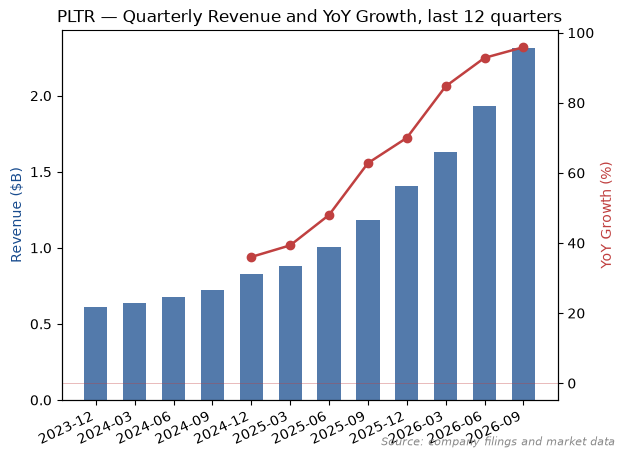
- Palantir grew revenue 96% in the third quarter, and the stock fell 12.9% that week, because the value of new contracts grew only 6%.
- U.S. commercial revenue passed U.S. government revenue for the first time, reaching $984M, up 148% on a year earlier.
- The 2028 consensus of $19.2B needs no growth in bookings, provided Palantir keeps signing about $3.15B a quarter and its backlog is realised. On those assumptions, about 76% of what it signs from now on must become revenue by the end of 2028.
- The market sold on the bookings slowdown. Management says shorter contract durations explain it, and shorter contracts would turn bookings into revenue sooner. That makes the 2028 number easier to reach, but only if customers renew.
- At $160.38 the stock trades at 42.8 times 2028 consensus earnings, which pays in full for consensus and nothing for the faster path. Fourth-quarter bookings on February 1 are the test.
The Quarter the Market Did Not Want
On November 2 Palantir reported the fastest growth in its public history, and the market sold the stock anyway. Revenue rose 96% to $2.31B, and David Glazer, the chief financial officer, raised the full-year guide to $8.53B. Later in his remarks he said several eight-figure Sovereign AI deals had been "shorter in duration than usual."
That remark, and the bookings number behind it, decided the week. Total contract value, or TCV, counts every year of the contracts signed in a quarter at once, so it swings with contract length. TCV grew just 6% on a year earlier after 49% in the second quarter, and the stock fell 12.9% in the week to November 6.
The coverage split along that line. CNBC reported that Citi called the bookings metrics "less strong," and Trefis asked whether the stock was ready for slower growth. The bulls accepted Glazer's duration explanation, which TIKR put plainly: at the same annual price, a one-year deal books a third of the TCV of a three-year deal.
Nobody I read asked the next question, which is how much booking growth the 2028 forecast actually needs. I worked it out, and at Palantir's current signing pace the answer is none.
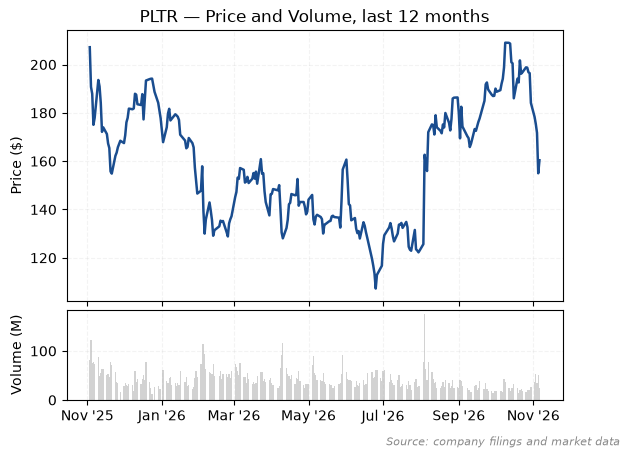
The sell-off left the stock at $160.38, about 25% below its 52-week high.
A Spy-Agency Software House That Now Sells More to Companies
Palantir started out selling to spies and now earns more from companies. "We were founded in 2003 and started building software for the intelligence community," its annual report says. Stephen Cohen, Alexander Karp and Peter Thiel hold concentrated voting power through Class F shares.
It sells four platforms. Gotham is the defence and intelligence product. Foundry, which every commercial customer uses, is "a central operating system for their interconnected data, logic, and action." AIP, first deployed in 2023, gives customers "unified access to open-source, self-hosted, and commercially available LLMs," and Apollo delivers the software "in virtually any environment."
Underneath them sits the Ontology, which ties an organisation's data to the decisions that run on it. The annual report calls it "the heart of our platforms." Sovereign AI, the current pitch, builds on that layer: customers post-train open-weight models on the operational data the Ontology captures, so the model runs on weights they control. Shyam Sankar, the chief technology officer, described AIP on the call as "a closed-loop model factory." In that framing any one model "is a commodity item," and the lasting value lies in "the post-training pipeline" fed by the customer's own data.
Where the Revenue Comes From
U.S. commercial is now the largest segment, and it is growing fastest.
| Segment | Q3 2026 | Change vs Q3 2025 | Change vs Q2 2026 |
|---|---|---|---|
| U.S. commercial | $984M | +148% | +29% |
| International commercial | $184M | +21% | +1% |
| Commercial | $1,168M | +113% | +24% |
| U.S. government | $953M | +96% | +18% |
| International government | $192M | +31% | +6% |
| Government | $1,146M | +81% | +16% |
| Total revenue | $2,313M | +96% | +19.5% |
Margins are widening as well, which matters because the valuation rests on earnings. Adjusted operating margin reached 62% in the third quarter, up from 51% a year earlier, and GAAP net margin was 48.8%.
The two halves grow in different ways. In commercial, new customers matter as much as expansion, and the annual report shows about 45% of 2025 commercial growth coming from new logos. Government is the opposite, because existing customers supplied 93% of its growth.
International is the weak spot. Commercial revenue there rose just 1% on the quarter, and management does not want to discuss Europe. Karp told the call it was best avoided "because of what's going on," and later said that bringing European allies along "is going to be hard."
The Metrics Disagree, and Management Blames Contract Length
Revenue and net retention rose sharply this quarter while bookings and backlog barely moved, and management puts the gap down to shorter contracts. Net dollar retention, which tracks what the same customers spend a year later, rose eight points to 165%. Existing customers, in other words, spent 65% more than a year earlier.
Palantir reports its backlog three ways:
| Measure | What it counts | Q3 2026 | Change |
|---|---|---|---|
| TCV | Full value of contracts signed in the quarter | $2.92B | +6% on a year earlier |
| Remaining performance obligations (RPO) | Contracted revenue not yet recognised, excluding contracts shorter than 12 months | $4.9B | flat on the quarter |
| Total remaining deal value | All contracted value outstanding, assuming every option is exercised and no contract is terminated | $13.4B | +2% on the quarter |
Each measure misleads in its own way. RPO leaves out short contracts, so a shift to shorter deals flattens it mechanically, whatever demand is doing. Glazer also reminded analysts that it skips obligations beyond termination-for-convenience clauses, which are common in government work, so RPO is mostly a commercial gauge. Remaining deal value assumes everything goes right, so I treat it as a ceiling on contracted revenue. TCV is the one to carry forward, because my argument turns on the pace of new signing.
What Changed: Commercial Became the Larger Half
Commercial now leads the company. Karp, the chief executive, said on the call that commercial was "viewed as a nice-to-have part of our business as late as 3 years ago" and is now "the dominant part of our business."
Management credits Sovereign AI, launched in the second quarter, for the acceleration, and Ryan Taylor, the chief revenue officer, called it "barely 1 quarter old." Palantir sells through bootcamps, short sessions that "deliver real workflows on actual customer data in days," as the annual report puts it. Those pilots convert into contracts that then expand.
The spending backdrop helps, with Gartner forecasting worldwide IT spending of $7.35T in 2027, up 15%. The annual report also names the headwinds, among them the federal shutdown in the third quarter of 2025 and the administration's push to evaluate and cut government spending.
The Demand Story: Pilots That Become Eight-Figure Contracts
The best evidence of demand is how fast pilots grow into large contracts. Taylor walked through four commercial customers on the call, each of which went from a pilot to several times as much in annual contract value, or ACV.
| Customer (unnamed on the call) | Pilot | ACV signed |
|---|---|---|
| Industrial materials company | about $3M (Q2) | $29M |
| Global athletic company | $1.6M (Q1) | about $21M |
| Home appliance maker | $1M (Q2) | $3M in Q2, then $15M in Q3 |
| Apparel company | $2.5M | $11.5M |
Karp summed up the change: "instead of being, like, $250,000, it's like $25 million to start." The deal counts support him only in part, because mid-sized deals rose while the very largest fell.
Named customers show what the software does, and most of the evidence concerns small models trained on a customer's own data. Sankar said AIG's underwriting workflow for complex commercial lines runs in AIP. McCarthy Building Companies will save 30,000 hours a year with a post-trained Nemotron model of 4 billion parameters. Taylor said L3Harris fine-tuned a sovereign model that beat its frontier model in under 48 hours and cut costs 95% in preliminary results. He added that Nvidia now post-trains its own open models in Palantir workflows.
Government demand moves more slowly, because it depends on appropriations and on options exercised a year at a time. Its anchor is the enterprise agreement the U.S. Army awarded on July 31, 2025, with a ceiling of up to $10B over up to ten years, usable by the Army and other DoD agencies. Maven, which Taylor called the foundation of the government work, now has more than 100,000 users and is available to all the services. In the third quarter the Army also awarded a prime agreement to produce eight TITAN systems.
The cash shows customers paying ahead faster even with RPO flat, because deferred revenue plus customer deposits rose 13.2% in the quarter to $1.21B. Karp's verdict was that "we really cannot satiate demand."
The Constraint: People and Appropriations
If demand outruns supply, the limit on 2028 revenue is how fast Palantir can deliver and, in government, how fast it gets funded. Software has no factory, and Karp said as much about the commercial queue: "we don't have even the bandwidth to do that."
The company is adding capacity more slowly than revenue. Third-quarter adjusted expenses rose 53% on a year earlier while revenue rose 96%, and Glazer pointed to platform investment and "technical hiring as we welcomed our latest class of new grad hires." Automation is the lever. Sankar described AI FDE, with which service members build read-write integrations with legacy sensors and bring them online "in hours, entirely unassisted."
Compute does not bind. Third-party cloud hosting was the largest driver of higher cost of revenue in 2025, yet GAAP gross margin still rose to 83.4% in the third quarter.
Appropriations are the slower constraint. Federal operations run on a continuing resolution, a form of stopgap funding, to December 11, as cantechletter.com and samsearch.co report, and under one new starts are restricted. The annual report says such resolutions and lapses "have and could in the future adversely affect" the timing of revenue. Options also run a year at a time, because "the U.S. federal government is prohibited from exercising contract options more than one year in advance."
Neither constraint has capped revenue yet. In the third quarter revenue rose 19.5% on the quarter and expenses 20%, so capacity kept pace.
What It Is Worth: Consensus Needs Flat Bookings
The market reacted as if bookings had to keep growing, so I tested the sell-side average of $19.2B for 2028 against what Palantir has signed plus what it signs at today's pace.
Start with growth. Consensus needs revenue to compound at about 9% a quarter, between 8.6% and 9.5% depending on the year, which is roughly half the 19.5% Palantir just delivered.
| Constant quarterly growth from Q4 2026 | FY2027 revenue | FY2028 revenue | vs FY2028 consensus |
|---|---|---|---|
| 8.6% (matches 2027 consensus) | $13.09B | $18.21B | −5% |
| 9.5% (matches 2028 consensus) | $13.37B | $19.23B | about equal |
| 12% | $14.19B | $22.33B | +16% |
| 14.6% (the Q4 guided rate) | $15.08B | $26.01B | +35% |
Most of that revenue is not yet under contract. Guidance and consensus together need about $35B from the fourth quarter of 2026 through 2028. Palantir has just over $13B of remaining deal value, itself a best case, so at least $21B must come from contracts it has not yet signed.
What matters is the share of new signing that becomes revenue inside that window, which I call the conversion rate. At the recent pace of about $3.15B a quarter, the nine quarters to the end of 2028 bring about $28B of new contracts. The $21B gap is roughly 76% of that.
Whether 76% is demanding depends on contract length, because revenue is recognised over a contract's life. The annual report describes terms of one to five years, so a five-year deal signed in 2028 barely converts before year end while a one-year contract converts almost entirely.
The sensitivities show that 76% is no stretch, and that only a 20% drop in signings makes the target close to impossible.
| Case | Required conversion |
|---|---|
| Base: flat bookings at about $3.15B a quarter | 76% |
| Bookings grow at the third quarter's 6% | 70% |
| Bookings stay at the third quarter's own $2.92B | 82% |
| A fifth of remaining deal value never arrives | 86% |
| Bookings run 20% below the base pace | 95% |
Every row assumes renewal, since short contracts help only if customers come back.
The model supports consensus, with my 9.5% path landing on $19.2B. Analysts have also raised their 2028 numbers since the report, from the roughly $17.9B TIKR cited beforehand, so the sell side moved up despite the TCV miss.
The 2028 estimates run from $15B to $25B, a spread four times as wide as for 2027. The high matches the 14.6% path and the low sits below even the 8.6% path. The disagreement is really about whether bookings reaccelerate or decay.
Earnings follow revenue. At the third quarter's net margin and today's share count, each path gives a 2028 figure:
| 2028 path | Revenue | Earnings per share |
|---|---|---|
| Consensus | $19.2B | about $3.64 (analysts: $3.75) |
| 12% a quarter | $22.33B | about $4.23 |
| 14.6% a quarter | $26.01B | about $4.93 |
The analysts' $3.75 implies a net margin of about 50%, in line with the third quarter.
What the Market Is Paying: Full Price for Consensus, Nothing for the Faster Path
I judge the price on 2028 consensus earnings of $3.75 a share, because that is the year the model tests, and on that basis the stock trades at 42.8 times. That is dear for an ordinary stock and reasonable for one whose consensus revenue grows about 47% that year. It pays in full for consensus and nothing for the faster paths in the earnings table above.
Because sales and earnings are growing so fast, the multiples shrink quickly on later years.
| Measure | Multiple |
|---|---|
| P/E, trailing | 104.8x |
| EV/EBITDA, trailing | 97.0x |
| P/E on 2027 consensus | 64.0x |
| P/E on 2028 consensus | 42.8x |
| Enterprise value / 2027 consensus sales | about 27.4x |
| Enterprise value / 2028 consensus sales | about 18.7x |
| Market value / 2026 free cash flow guide midpoint | 75.3x |
Enterprise value here is the $369B market value less $10.4B of cash, with no adjustment for debt.
Cash flow looks less generous once stock compensation counts as a cost. Third-quarter adjusted free cash flow was $1.22B, which falls to $897M after the $319M of stock compensation.
The bears' headline comparison is the one Trefis made: 51.2 times trailing sales, against 3.2 times for the S&P 500. Against Palantir's own history, though, even the trailing multiple is low. At about 105 times earnings, the stock is cheaper than at any year-end in its three profitable years, when it ran from 176 to 360 times. Adjusted for growth, the trailing PEG ratio is 0.46.
The bears' deeper point is that the price leaves no margin for error. At 42.8 times 2028 earnings and 18.7 times 2028 sales, the consensus path is already paid for, and the low 2028 estimate of $15.1B sits below even my slowest path. Trefis argued that the multiple assumes growth persists while bookings hint it will not. A Seeking Alpha contributor downgraded the stock on valuation alone, under the headline "Great Business, Wrong Time." I accept the arithmetic and disagree with the conclusion, because at flat bookings consensus is reachable, and the faster paths are free.
Per-share earnings are no longer being diluted away, which answers the oldest bear complaint. Diluted shares rose just 0.1% in a year, and stock compensation fell to 13.8% of revenue from 14.6%.
The sell side is further ahead of the price than I am. The average of 14 targets set in the last month is $234, about 46% above today's price. Targets barely moved through the sell-off, up 0.2% on the prior quarter's average, and 65% of ratings are buy or strong buy.
The closest listed comparisons are government-IT firms, and none is a true software peer: CACI and Booz Allen sell services, and Cellebrite is a forensics firm. The sales multiples show how much more the market pays for Palantir's software growth than for contracting work.
| Company | Trailing P/E | Trailing price/sales |
|---|---|---|
| Palantir | 104.8x | 50.6x |
| CACI | 24.9x | 1.4x |
| Booz Allen | 13.2x | 0.9x |
| Cellebrite | 52.9x | 6.1x |
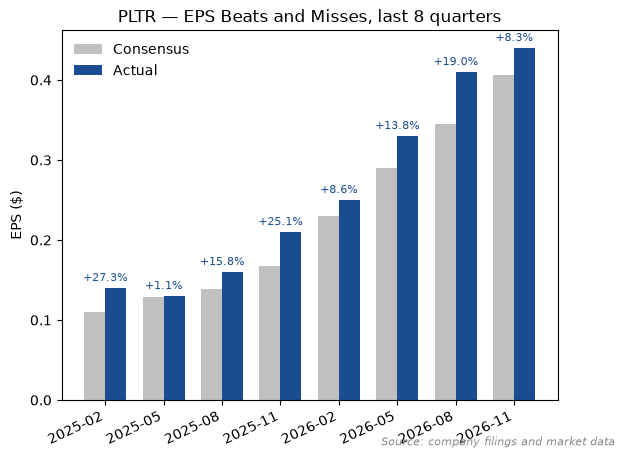
The beat history supports the faster path, though the margin is narrowing. Third-quarter earnings of $0.44 a share beat consensus by 8.3%, the smallest surprise since the second quarter of 2025.
The Competition: The Labs Sell Models, Palantir Sells the Workflow
Palantir's 10-K names no rival companies. It lists categories instead, among them customers' own software teams and "large enterprise software companies, government contractors, and system integrators." On this quarter's call the rivals that came up were the model labs.
Anthropic is the closest. Gil Luria of D.A. Davidson told the call that, as Anthropic's S-1 shows, "about half of their customers work directly with Anthropic." That is the bear's version of the AI market, where large companies buy the model straight from its maker. Karp called the relationship "symbiotic": "they're growing a market… we're taking advantage of the market where you really need delivery."
Sankar argues that customers buy the workflow, and that the labs misread this. "The fundamental unit of the enterprise is the workflow," he said, and his evidence is that small models post-trained on a customer's own data can beat frontier ones. At a PACOM military exercise, he said, Palantir ran a 30B-parameter post-trained model on compute limited by space, weight, power and cooling. It beat "GPT 5.6 Sol, a 3 trillion parameter model" on task-specific performance.
In defence the comparable firms are contractors such as CACI and Booz Allen. Palantir's advantage there is incumbency: Maven across every service, the Army agreement, and DORA. Short for Disconnected Ontology Resilient Architecture, DORA is an embedded compute device that brings Maven to disconnected operations.
I see two moats. The first is lock-in through the Ontology, and Palantir's top three customers have stayed an average of ten years. Karp's line that "once you go Palantir, you don't go back" is management's claim, and 165% net retention is the evidence for it. The second is defence incumbency, which a model lab cannot buy quickly. The risk is that the labs own the models and the hyperscalers own the compute, while Palantir rents its cloud hosting from third parties.
What Could Go Wrong: Palantir Lists the Bookings Risk Itself
Palantir's own filing flags the risk this article turns on. Its first risk factor reads: "We may not be able to sustain our revenue growth in the future." The fourth is closer still: "We may not realize the full deal value of our customer contracts, which may result in lower than expected revenue." It adds: "Many of these contracts are subject to termination for convenience provisions."
The filing even anticipates the duration shift. Customers, it says, "sometimes enter into shorter-term contracts which may not provide for automatic renewal." That is the other side of my argument, because short contracts raise conversion only if they renew.
Concentration comes next: "Our top three customers together accounted for 16% and 17% of our revenue" in 2025 and 2024. The filing also flags dependence "particularly on the services of Alexander Karp." On China it says: "We do not work with the Chinese communist party and have chosen not to host our platforms in China, which may limit our growth prospects."
The bear case reads the same data differently, and I take it seriously. U.S. commercial TCV fell 31% on the quarter, and the largest deals fell too. U.S. commercial remaining deal value now covers 1.66 years of revenue, down from 2.29 a year ago. A company whose deals were getting harder to sign would also say its contracts were getting shorter.
The assumption most likely to be wrong is the booking pace, and at the third quarter's own rate the requirement is already 82%. Net retention is the other weak point, because a sharp fall would weaken the expansion behind conversion. I have no sourced threshold for where that starts to bite.
My answer is the cash. Prepaid balances rose 13.2% in the quarter, deals of $5M or more rose, and net retention climbed eight points. Customers who were hesitating would not be prepaying more.
What I Am Watching
The test is fourth-quarter bookings, reported on February 1, 2027. If TCV returns to $3.15B or more and U.S. commercial remaining deal value grows on the quarter, the flat-bookings case holds. If TCV stays near $2.9B and the first 2027 guide falls short of consensus, I have the duration story wrong. Before that, the December 11 funding deadline reported by cantechletter.com will show whether Maven and the Army agreement can start new work in early 2027.
Takeaway
The market sold Palantir on a bookings number that the 2028 forecast does not need to grow. At today's booking pace, about 76% of what Palantir signs must become revenue by the end of 2028, which short contracts make reachable as long as customers renew. At 42.8 times 2028 earnings the stock prices the consensus path in full. February's bookings print will show whether the faster path, which the price does not carry, is still open.
Sources
- Palantir Form 10-K for fiscal 2025 (Item 1, Item 1A, Item 7), filed February 17, 2026
- Palantir Q3 2026 earnings release (Form 8-K, Exhibit 99.1), November 2, 2026, and Q2 2026 earnings release
- Palantir Form 10-Q for Q3 2026, filed November 3, 2026
- Palantir Q3 2026 earnings call, November 2, 2026 (Alexander Karp, David Glazer, Shyam Sankar, Ryan Taylor; analysts Gil Luria of D.A. Davidson and Brad Zelnick of Deutsche Bank)
- U.S. Army release on the Palantir enterprise agreement, army.mil, July 31, 2025
- Gartner press release on worldwide IT spending, October 21, 2026
- CNBC, "Palantir is dropping on earnings. Wall Street analysts remain bullish," November 3, 2026
- TIKR, "Palantir's Revenue Grew 96%. Its New Contract Value Grew 6%. Alex Karp Explains Why," November 2026
- Motley Fool, "Why Palantir Technologies Stock Dropped Today," November 4, 2026; "Is Palantir Stock a Buy on the Dip as Revenue Continues to Surge?," November 5, 2026; "The Biggest Takeaway From Palantir Technologies' Latest Quarterly Report Is a Potential Warning Sign…," November 6, 2026
- Trefis, "Is Palantir Stock Ready For Slower Growth?," November 5, 2026; "Why Is Palantir Stock Falling?," November 6, 2026
- 247 Wall St, "Palantir Grew Revenue 96% and the Stock Still Fell," November 6, 2026
- Seeking Alpha, "Palantir: Great Business, Wrong Time (Rating Downgrade)," November 7, 2026
- Crypto Briefing, "Palantir CFO reports shorter contract durations amid AI adoption," November 2026
- Company filings, reported results, analyst consensus and market price data
- Full working, including the growth paths, the bookings-conversion test and the valuation:
research/2026-11-08_PLTR.md
Research, not a recommendation. Figures are sourced as cited and were current at publication; nothing here is personalized investment advice.