NVIDIA Lost $440 Billion in a Day Over Permits. It Has $279 Billion of Supply Booked.
November 8, 2026 · NVIDIA Corporation (NVDA)
profitmonk
Summary
- NVIDIA fell 9.3% on November 5 and lost more than $440B of value on fears that the midterms will slow data-center construction. Nothing NVIDIA reported caused it.
- Management calls next year's 70% growth guide "a supply-constrained outlook." Supply commitments more than doubled in one quarter to $279B. The $87B falling due next fiscal year covers nearly half of next year's cost of revenue.
- My model lands on consensus: about $694B of revenue and $15.81 of adjusted earnings a share for fiscal 2028. Contracted supply covers the guide, so I see no reason to sit below it, provided gross margin holds near management's 72% to 73%.
- My disagreement is with the price. At $186.64 the stock trades at 11.8 times fiscal 2028 adjusted earnings, and on trailing earnings it is near its cheapest in a decade.
- The political risk the market is pricing falls mostly on fiscal 2029. The November 17 report is the first test of whether the supply book keeps growing.
A $440 Billion Day, Twelve Days Before the Report
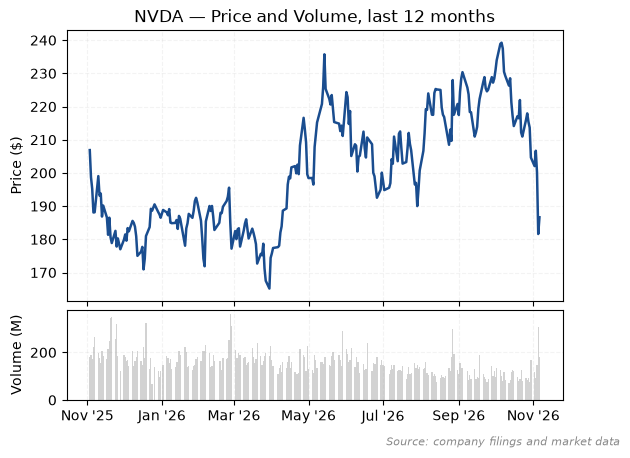
The sell-off followed a Democratic sweep of Congress and governor races, and NVIDIA's own numbers played no part in it. CNBC reported that the shares fell 9.3% on November 5, erasing more than $440B of value on fears that data-center construction will slow. Bank of America read the drop as a shrinking multiple with earnings estimates untouched. Barclays argued that opposition to data centers is local, so the buildout gets more expensive without stopping.
The rest of the week made it worse. NVIDIA has now lost five weeks in a row, and 24/7 Wall St relayed a UBS warning that about 30% of planned 2028 US data-center capacity additions are at risk. Bloomberg reported that a Democratic House is expected to question Jensen Huang about chips leaking into China. The shares closed the week at $186.64.
What brought me to the stock was something said ten weeks before the sell-off. On August 26 chief financial officer Colette Kress gave a full-year-ahead guide, which Huang said NVIDIA had never done before. "We expect to grow revenue by approximately 70% in fiscal 2028," she said. "This is a supply-constrained outlook."
So the market is asking whether data centers can be built, while management says the limit is supply, and it has committed to buy $279B of it, mainly memory. The third-quarter report on November 17 is the first test of which side is right.
The Company That Sells AI Factories
NVIDIA designs the chips, networking, computers and software that train and run artificial-intelligence models. Jen-Hsun Huang co-founded it in 1993 as a graphics-chip company and has run it ever since from Santa Clara, California. Its annual report lists its customers as "all major cloud service providers," AI model makers and enterprises.
The product line now goes far beyond the graphics card. NVIDIA sells GPUs (graphics processing units, the chips that do the parallel arithmetic AI needs), its own CPUs, the networking that ties thousands of chips together, complete rack-scale computers and a deep layer of software. The best-known piece is CUDA, the programming platform that more than 7.5 million developers use to write code for NVIDIA chips.
NVIDIA makes none of its chips itself, and that dependence shapes everything below. TSMC and Samsung fabricate the wafers, SK Hynix, Micron and Samsung supply the memory, and Hon Hai, Wistron and Fabrinet assemble the systems. At $186.64 a share the company is worth about $4.5T.
One Segment Has Swallowed the Company
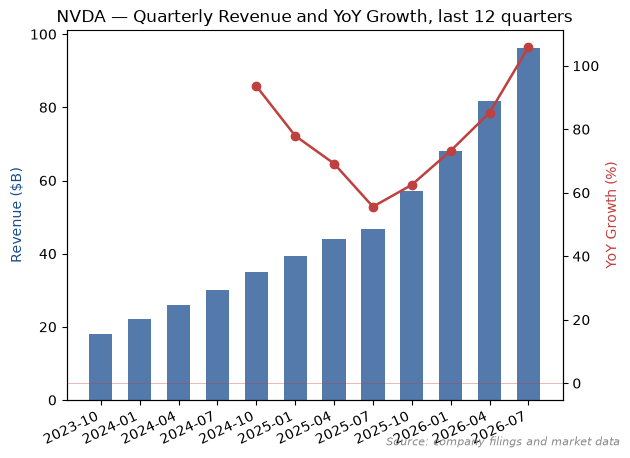
NVIDIA reports two segments, and Compute & Networking, which holds the data-center business and automotive, is now almost all of it. Graphics holds GeForce gaming cards and RTX PRO workstations. Below, the latest quarter's revenue sits beside full-year operating income for the fiscal year that ended in January 2026.
| Segment | Q2 FY27 revenue | Q2 FY26 revenue | Change | FY26 operating income | FY25 operating income | Change |
|---|---|---|---|---|---|---|
| Compute & Networking | $88.3B | $41.3B | +114% | $130.1B | $82.9B | +57% |
| Graphics | $7.9B | $5.4B | +46% | $9.2B | $5.1B | +80% |
| NVIDIA total | $96.2B | $46.7B | +106% |
Data center brought in $89B in the July quarter. Management splits it between the hyperscalers (the giant clouds such as Amazon, Microsoft and Google) and a group it calls ACIE, for AI clouds, industrial, enterprise and sovereign. ACIE is growing faster and is up 138% in a year, while NVIDIA gave only a sequential rate for hyperscale.
| Data-center customers, Q2 FY27 | Revenue | Growth from prior quarter |
|---|---|---|
| Hyperscale | $49B | +13% |
| ACIE | $40B | +25% |
NVIDIA also sells more into each system. In fiscal 2026 compute grew 59% on the Blackwell generation, but networking grew 142% on the NVLink fabric that links GPUs inside a rack. Graphics is the old NVIDIA and still healthy, with Blackwell-based cards driving gaming growth of 41% that year.
How NVIDIA Makes Money: Gigawatts Times Dollars per Gigawatt
Management now prices its opportunity in units of power, and that framing explains the growth. Huang said on the August call that each gigawatt was worth about $18B of NVIDIA revenue in the Hopper generation and $25B with Grace Blackwell. With Vera Rubin, which began production shipments in August, it is about $40B. So the same power plant is worth more than twice as much to NVIDIA as it was two generations ago.
Gross margin is the second lever, and it is near a peak. Memory is the reason. Kress said its prices have "exceeded our prior expectations and are headed even higher," and she reset the margin guide on the call.
| Period | Gross margin |
|---|---|
| Q2 FY26 (a year ago) | 72.4% |
| Q2 FY27 (July quarter) | 75.0% |
| Q3 FY27 guide | 74% |
| Q4 FY27 guide (trough) | 71% to 72% |
| FY28 guide | 72% to 73% |
The third lever is the supply book, and my argument turns on it. Lead times run past 12 months, so NVIDIA buys ahead, and inventory reached $32B in July ahead of the Rubin ramp. Customers also take about 60 days to pay, which the company puts down to "extended payment terms for large purchases by certain investment-grade customers."
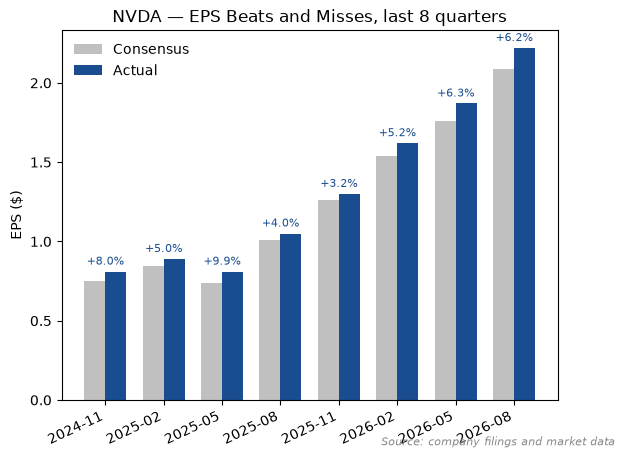
The track record completes the picture. On adjusted earnings, the basis I use throughout, NVIDIA has beaten consensus for eight straight quarters, most recently with $2.22 a share against $2.09 expected.
What Changed: NVIDIA Now Underwrites Its Own Market
Three years ago NVIDIA sold chips into a market that others paid for, and today it helps pay for that market. Its August 10-Q discloses maximum guarantee exposure of $108.5B. $105B of that covers land, power and the building shell at the SB Energy site in Pike County, Ohio, which OpenAI will use. Kress said labs where NVIDIA expects to "leverage our balance sheet" will be "roughly a quarter of our business next year."
The forecast itself is the other change. "We've never forecasted or never guided to a year in advance," Huang said, so guiding now shows how much of next year NVIDIA believes it can see. Keep the calendar in mind for what follows: NVIDIA's fiscal 2028 runs from late January 2027 to late January 2028, so it is essentially calendar 2027.
The Demand Story: Every Buyer Wants More Than NVIDIA Can Ship
By management's account, demand is running well ahead of what NVIDIA can ship. "Customers forecasts point to our growth, doubling next year," Kress said, and NVIDIA guided to 70% because that is what supply allows. When Bernstein's Stacy Rasgon asked what growth would be without the constraint, Huang answered, "The unconstrained would be a lot higher."
The named buyers make that concrete. Neoclouds, in the table, are specialist AI rental clouds such as CoreWeave, Nebius and Nscale.
| Buyer | Commitment, per the August call |
|---|---|
| Amazon Web Services | An additional 2 million GPUs from the October quarter through the middle of 2028, plus Vera CPUs |
| OpenAI | About 12 gigawatts of NVIDIA compute through 2030; the Ohio site alone is about 4.25 gigawatts |
| Unnamed "frontier AI lab" | Selective credit support for nearly 2 gigawatts |
| Neoclouds | 8 gigawatts installed by the end of this year, up from about 3 at the end of 2025 |
The smaller customers are growing fastest. Sovereign customers, meaning national governments building their own AI capacity, more than tripled from a year earlier, and management expects ACIE to be "roughly half of our data center business" next year.
The orders show up on the balance sheet too. Deferred revenue more than tripled to $6.4B since January, growth accelerated for a fourth straight quarter, and 24/7 Wall St noted that through the sell-off no customer had been reported cancelling.
Consensus needs no share gain. NVIDIA takes about a quarter of what the top five hyperscalers spend on capital projects, which Kress put at about $800B in 2026 and $1.3T in 2027. Fiscal 2028 consensus only assumes NVIDIA keeps that quarter.
The Constraint: Memory, Packaging and Land
NVIDIA cannot ship faster than three inputs allow, and it is buying all three years ahead. "Our entire supply chain is challenged," Huang said. "At this moment, we have supply for 70%… Our demand is much higher than that."
Memory is the first limit. Each AI GPU sits beside stacks of HBM (high-bandwidth memory, DRAM chips stacked vertically so data reaches the processor faster). Korea JoongAng Daily reports that SK Hynix holds about two-thirds of NVIDIA's 2026 HBM4 volume, and TrendForce reported in March that Samsung had qualified its HBM4. Huang recalled that "a long time ago, people asked me why is it that we're working with memory suppliers when we're a chip company." Memory is now the input that reset the margin guide.
Packaging is the second. CoWoS (chip-on-wafer-on-substrate) is TSMC's process for mounting a GPU beside its memory on one base, and a chipmaker without a CoWoS slot cannot ship. KGI forecast in March that TSMC's CoWoS capacity will reach 170,000 wafers a month by the end of 2027, and every rival accelerator draws on those same lines.
Land, power and buildings are the third limit and the slowest to fix. Huang said securing them is "oftentimes… a couple 2, 3 years out," which is why NVIDIA now secures sites itself, as in Ohio.
NVIDIA's answer to all three is to buy early. The $279B book more than doubled in a single quarter, from $119B, and Kress said "the biggest parts of them are in the first 3 years… This also gives us the confidence in terms of our growth in revenue." Any rival that wants the same memory and packaging has to outbid it.
| Supply & capacity commitments, by fiscal year | Amount |
|---|---|
| Rest of fiscal 2027 | $92B |
| Fiscal 2028 | $87B |
| Fiscal 2029 | $88B |
| Fiscal 2030 | $6B |
| Fiscal 2031 and later | $6B |
| Total | $279B |
What It Is Worth: The Model Lands on Consensus
The supply NVIDIA has bought covers what the Street expects, so my numbers match consensus. Three things support that, and none of them is heroic. The January quarter needs about $122B of revenue, in line with recent growth. Nearly half of next year's cost of revenue, the direct cost of the products sold, is already contracted. And the implied net income of about $384B already absorbs a lower margin.
Consensus for fiscal 2028 is, in effect, management's guide. Divide the $694B consensus by 1.7 to get the fiscal 2027 base it implies, and NVIDIA needs about $122B in the January quarter, 13% above the October-quarter guide.
The revenue needs only 16 to 26 gigawatts of new builds, and known commitments already cover that. About $642B of fiscal 2028 revenue is data center, and dividing it by $40B a gigawatt for Vera Rubin gives 16, while dividing by $25B for Grace Blackwell gives about 26. Where it lands depends on how fast Rubin takes over, and Rubin was about a fifth of data-center revenue in the October-quarter guide. The OpenAI, neocloud and Amazon commitments fill that range without any new customer.
The supply check matters most, and it holds. Commitments falling due in fiscal 2028 cover 46% of next year's cost of revenue at the guided margin. The whole $279B book is big enough to support roughly $1T of sales, close to the $1T of Blackwell and Rubin orders Huang cited at GTC in March. The match is rough, because the book includes factory capacity and prepayments as well as parts.
The earnings already absorb the margin squeeze. Consensus implies a net margin of about 55%, against 62% in the July quarter, which builds in the memory hit and faster spending growth. A margin reset on November 17 would not be news to the estimates.
My anchor is management's own "approximately 70%" guide. Wells Fargo's Aaron Rakers has gone further and argued for data-center revenue upside to consensus.
Three assumptions carry the model, and I trust gross margin least. For each, I ask what happens to fiscal 2028 consensus if it comes in 20% worse than I have it.
| Assumption | What 20% worse means | Effect on fiscal 2028 consensus |
|---|---|---|
| Gross margin of 72% to 73% | Margin of about 58% | Earnings down roughly a fifth or more |
| Balance-sheet-backed lab demand at about a quarter of the business | Those labs take 20% less | Revenue down about 5% |
| Hyperscaler capex of $1.3T in 2027 | Capex of $1.04T at a constant share | Revenue down about 9% ($65B) |
On margin, 20% worse means a fifth off the margin itself, from about 72.5% to about 58%. Revenue would be unchanged, but earnings per share would fall by roughly a fifth or more.
What the Market Is Paying: Near the Cheapest in a Decade (10th percentile of ten years)
The model says NVIDIA will earn what the Street expects, and the price says the market doubts it. My valuation call rests on one number: at $186.64 the stock trades at 11.8 times fiscal 2028 consensus adjusted earnings, and 8.7 times fiscal 2029.
NVIDIA's own history and its peers' multiples are available only on trailing earnings, meaning the past twelve months, so I compare on that basis. At 23.5 times trailing earnings, NVIDIA is as cheap as it has been in a decade, bar 2019, when it fell to 20 times. Against the peers I chose, AMD, Broadcom and Marvell, it trades at a similar price/sales ratio (market value divided by a year's revenue). Its earnings multiple is a fraction of theirs, because it keeps far more of each sales dollar.
| Company | Trailing P/E | Price/sales |
|---|---|---|
| NVIDIA | 23.5 | 14.8 |
| AMD | 96.4 | 16.1 |
| Broadcom | 36.4 | 15.7 |
| Marvell | 46.3 | 13.1 |
On my numbers the stock is cheap. Paying 11.8 times for a year whose supply is already contracted means the market expects one of two things: a large cut to fiscal 2028 that analysts have not made, or a sharp fall in earnings after it. The analysts have not moved, and 59 of 62 rate the stock a buy or strong buy, unchanged since August. The cut the coverage describes, slower US permitting, lands mostly on capacity added in calendar 2028, which is NVIDIA's fiscal 2029.
That is also where the analysts split. For fiscal 2028 the highest and lowest revenue estimates differ by 35% of the average, and for fiscal 2029 by 64%, so the Street disagrees far more about the later year. The debate belongs to 2029, and the price is charging it to 2028 as well.
The Competition: Rivals Are Winning Gigawatts, NVIDIA Is Winning the Supply
NVIDIA wins on two things. The first is full-stack design: it is on its third generation of NVL72, a rack that acts as one large computer, and that co-design is what lifted revenue per gigawatt from $18B to $40B. The second is resale value. Kress calls its compute "productive, fungible, rentable and durable," so lenders will finance an NVIDIA cluster that can be rented to anyone, and ACIE customers "don't buy custom chips," Huang said.
AMD is the strongest merchant rival, and it is winning real business. Its MI450 has commitments from OpenAI for up to 6 gigawatts, and Anthropic is also signed. Scale still separates the two, because AMD's latest quarter put its data-center revenue at about $8.5B against NVIDIA's $89B.
The benchmarks tell a similar story. In MLPerf, the industry's standard test, AMD skipped DeepSeek-R1 in April's inference round and came within a few percent of Blackwell where it competed in June's training round.
Custom chips are the other threat. An aggregator's summary of a September Broadcom announcement, which I could not verify, describes a 10-gigawatt OpenAI deal deploying from late 2026 through 2029. The Information reported that Anthropic signed for up to 1 million of Google's Ironwood TPUs. Huang told analysts that many of these XPUs are inference-specific chips for one cloud or one service.
Every one of these chips draws on the same TSMC packaging and the same HBM, and NVIDIA's $279B book is an earlier claim on that pool. The threat is real at the margin, because Anthropic now runs NVIDIA, TPU, Trainium and AMD, so the largest buyers can move share. Fiscal 2028 consensus needs only a steady share of hyperscaler spending, though.
What Could Go Wrong
NVIDIA's own annual report names the risk that matters most for my thesis, third on its list: "long manufacturing lead times and uncertain supply and capacity availability." It says "we have paid premiums, provided deposits, and entered into long-term supply agreements," and warns that "these risks have increased… as our purchase obligations and prepaids have grown." The supply book is my bull case, and the company itself flags it as a risk.
The trouble is that the obligations bind mainly one side. The same report says "because most of our sales are made on a purchase order basis, our customers can generally cancel," while NVIDIA's supplier commitments are much harder to exit. The last time demand vanished, with the H20 China chip, NVIDIA took a $4.5B charge, and a $279B book raises the stakes. Concentration adds to it, because two direct customers accounted for 36% of fiscal 2026 revenue.
The risk the company does not spell out is circular demand. About a quarter of next year's business leans on NVIDIA's balance sheet, including the Ohio guarantee and credit support for a second lab. Kress raised it herself: "we know some will call this circular financing." If lab revenue disappoints, those guarantees become NVIDIA's liabilities.
China and the new Democratic House add more. Reuters reported on November 5, in a story I could read only in syndication, that about 600,000 H200s are sitting in Hong Kong awaiting Beijing's approval. The guide already assumes no Chinese data-center revenue. Bloomberg expects the new House to question Huang on chip leakage after it convenes in January.
The assumption most likely to be wrong is gross margin. Memory has already beaten management's expectations once, and if the January-quarter trough comes in below 71%, consensus earnings will fall even with revenue on plan. I still think the price overstates that risk, because consensus already builds in about seven points of net-margin compression and NVIDIA's price increases take effect in the first quarter of fiscal 2028.
What I Am Watching
The November 17 report is the test, and I know what would prove me wrong. I want the fiscal 2028 column of the commitment table to hold or grow from $87B, a January-quarter guide near the roughly $122B consensus implies, and the 70% guide restated. A cut to that guide, or a shrinking commitment book, would break my thesis. The hyperscalers' 2027 capex guides in late January and early February then test Kress's spending figure.
Takeaway
The market spent the week arguing about whether data centers will get built in 2028. Management says fiscal 2028 is limited by supply, and $87B of the book falls due in that year. I agree with consensus on the earnings and disagree with a price of 11.8 times them. The permitting risk is real, and it belongs to fiscal 2029, where analysts already disagree most.
Sources
- NVIDIA Q2 FY27 earnings release and call, August 26, 2026 (Jensen Huang, Colette Kress; analysts Stacy Rasgon of Bernstein, Vivek Arya of BofA)
- NVIDIA Form 10-Q for Q2 FY27, filed August 26, 2026 (supply commitments, guarantees, inventory, deferred revenue)
- NVIDIA Form 10-K for fiscal 2026, filed February 25, 2026, Items 1, 1A and 7
- NVIDIA press release setting the Q3 FY27 conference call, October 28, 2026
- Meta Q3 2026 earnings exhibit 99.1, October 2026
- CNBC on the November 5 sell-off, November 5, 2026
- Bloomberg on export scrutiny in a Democratic Congress, November 6, 2026
- Reuters on H200s held in Hong Kong, November 5, 2026, via syndication
- 24/7 Wall St on the fifth losing week and the UBS capacity warning, November 7, 2026
- Motley Fool on NVIDIA's forward multiple, November 5, 2026
- Korea JoongAng Daily on SK Hynix HBM4 share, 2026
- TrendForce on Samsung HBM4 qualification, March 9, 2026
- KGI on TSMC CoWoS capacity, March 9, 2026
- CNBC on Huang's GTC keynote, March 16, 2026
- AMD third-quarter coverage, November 3, 2026; Broadcom announcement, September 2, 2026
- MLCommons MLPerf Inference v6.0 (April 1, 2026) and Training v6.0 (June 16, 2026) results
- The Information via SiliconANGLE on Google TPUs, February 26, 2026
- Wells Fargo (Aaron Rakers) via Yahoo Finance, 2026, date not captured
- Company filings, reported results, analyst consensus and market price data
- Full working, including the model, the anchor and the supply reconciliation:
research/2026-11-08_NVDA.md
Research, not a recommendation. Figures are sourced as cited and were current at publication; nothing here is personalized investment advice.