Magic Took Hasbro Up 35% in a Month. The Stock Is Fair on Management's Numbers, and Cheap Only if Magic Beats Them
October 25, 2026 · Hasbro, Inc. (HAS)
profitmonk
Summary
- Magic: The Gathering topped $600M of revenue in a quarter for the first time, and Hasbro raised its 2026 guidance for the second time this year.
- Games now earn almost all of Hasbro's profit. The Wizards gaming segment made roughly $0.9B in the first nine months, close to the whole company's $1.1B of adjusted operating profit.
- On management's own planning rates, my 2028 base case is $7.21 a share of adjusted earnings, 7% below the $7.78 consensus. It counts no revenue from the new video games.
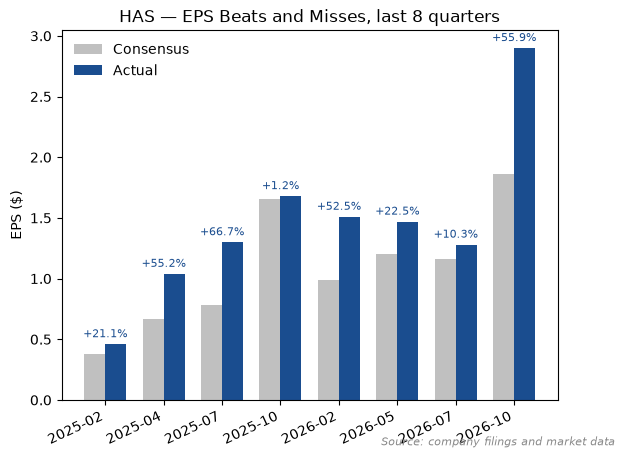
- The upside rests on one assumption: that management plans Magic low. The record supports it. Hasbro has raised its 2026 guide twice and beaten adjusted consensus in each of the last eight quarters.
- At $117.44 the stock is 16.3 times my base-case 2028 earnings. That is fair on management's numbers, and cheap only if Magic beats the plan again.
The Quarter a Card Game Carried a Toy Company
Magic sold $616M in a single quarter for the first time, up 34% on a year earlier. Its August set, The Hobbit, became "the fourth best-selling set in Magic's history," chief executive Chris Cocks told analysts on 20 October, even though it shipped with a leaner product lineup.
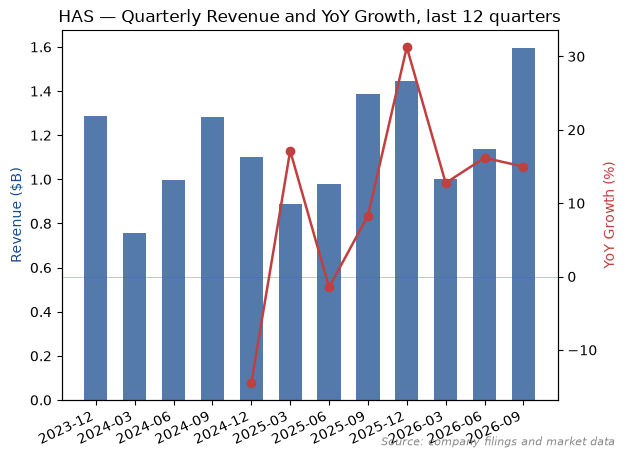
The card game pulled the whole company up with it. Revenue rose 15% to $1.60B, and adjusted earnings came in at $2.90 a share against a consensus of $1.86. Adjusted means before one-off items such as impairments, and I use that basis throughout because consensus does too.
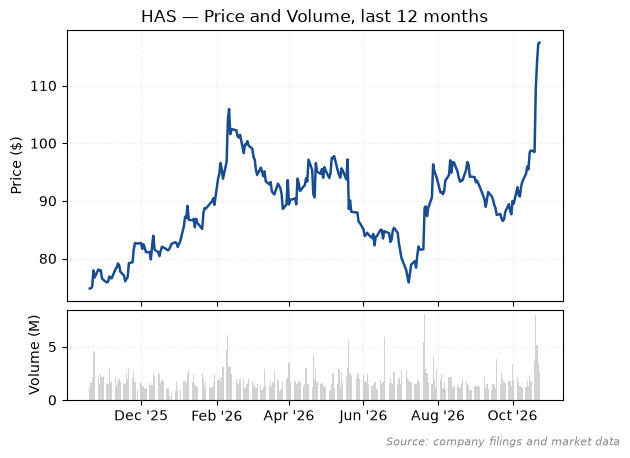
Hasbro raised its guidance for the year a second time and doubled its buyback target to $400M, and in a month the stock gained 35%, to $117.44. The rest of this piece argues that the price is fair on management's plan and cheap only if Magic beats it.
Two items flatter the quarter, and the beat holds up after I take both out.
| Q3 one-off | Size | The quarter without it |
|---|---|---|
| Tariff refunds for duties paid in earlier periods | about $55M | Adjusted EPS of about $2.61, still about 40% above consensus |
| Magic product meant for Q4 that shipped early | about $40M | Magic growth of about 25% |
A Century-Old Toy Company Whose Profit Comes From Games
Hasbro owns Magic, Dungeons & Dragons, Monopoly, Play-Doh, Transformers, Nerf and Peppa Pig, and it makes Marvel and Star Wars toys under licence from Disney. It now calls itself "a game, IP, and toy company," IP meaning intellectual property, and the games are where the money comes from.
Third-party factories make its products, so the business needs less capital than its brands suggest. The annual report calls the China share of that production "substantial but decreasing" without giving a figure, and that gap matters whenever tariffs change.
A few customers and one season carry a lot of weight. Amazon and Walmart together bought about a fifth of 2025 sales, and about 60% of revenue lands in the second half, so a weak holiday at a few big retailers would hurt the whole year.
At $117.44 Hasbro is worth about $16.6B, and its $0.70 quarterly dividend yields 2.4%.
Three Segments, and One Earns Nearly All the Money
Last year settled which business matters. Wizards of the Coast & Digital Gaming holds Magic, Dungeons & Dragons, digital games and digital licensing such as Monopoly GO!. Consumer Products sells toys and games to retailers and licenses brands to other companies. Entertainment is what is left of film and TV. The annual report shows how far apart they have drifted.
| Segment | FY2025 revenue | Change on FY2024 | FY2025 operating profit |
|---|---|---|---|
| Wizards & Digital Gaming | $2.19B | +45% | $1.01B |
| Consumer Products | $2.44B | −4% | −$943M |
| Entertainment | $77M | −4% | $0.4M |
| Total | $4.70B | +14% | $11M |
Magic did the growing. Management credits the Universes Beyond sets, which put outside franchises such as The Lord of the Rings onto Magic cards. The momentum has carried into this year: in the third quarter Wizards revenue rose 31% at a 49% adjusted margin.
Consumer Products shrank in 2025 on lower volume, weak industry trends and North American tariffs. Its loss came from a $1.02B non-cash goodwill impairment, which the 10-K ties to tariffs and macro conditions.
The toy business is now mending, though the best evidence comes from a single strong quarter. Excluding its share of the tariff refund, the segment's third-quarter adjusted margin was about 15.7%, against 11.2% a year earlier. Toy sales are weighted to the second half, so over the first nine months the margin was lower, about 7.7% even with the refund included. "The underlying improvement is the durable part of the story," said chief financial officer Gina Goetter.
How a Hobby Game Business Is Measured
Investors trade Hasbro on four numbers that come from the hobby-game world more than the toy aisle. The first is Magic revenue, which rose 59% in 2025 to $1.72B and another 34% in the first nine months of 2026.
The second is engagement, meaning how many people actually play. Cocks said this year's participants in organized play at sanctioned store events already exceed all of 2024 by more than 40%, and more than 13,000 stores now belong to the Wizards Play Network.
The third is the backlist, the older sets that keep selling, which shows whether players stay. Goetter said backlist sales this year "has already surpassed what we saw in 2025," and the backlist is growing faster than new releases.
The fourth is the gap between shipments and what shoppers buy at the till. Hasbro books revenue when it ships to distributors, who take product "on the low side 2 weeks, on the high side, 6 weeks" before a release, Cocks said. In the quarter, trading-card till sales were "up high single digits, low double digits" while Magic shipments rose 34%, a gap I come back to under the risks.
Margins explain why the mix between segments decides the earnings.
| Segment margin | 2024 | First nine months of 2026 |
|---|---|---|
| Wizards & Digital Gaming | 41.8% | 46.9% |
| Consumer Products | 4.5% | about 7.7% (adjusted, refund included) |
Wizards keeps roughly 46 cents of each revenue dollar as profit and Consumer Products under 8, so every dollar of Wizards growth lifts the whole company.
What Changed: Magic Doubled in Three Years
Magic's size is the reason to look at Hasbro now. In 2023, the year the first big Universes Beyond set came out, Magic was roughly a $1B business, and this year it is tracking about $2.1B. Over the same stretch the toy business took its $1.02B impairment, so Hasbro has become a games company with a toy company attached.
The outside pressures land mostly on the toy side, and management named three. Tariffs cost about $45M in 2025, and the $55M third-quarter refund returned duties paid in earlier periods, so that boost will not repeat. Oil-linked input costs "are now flowing through the P&L," Goetter said. As for the shopper, Cocks sees "nothing … that has us concerned about the consumer."
The Demand Story: Cards Became the Biggest Toy Category
Cocks argues the demand is structural. "Trading cards, you know, over the last year have emerged as the number 1 category in toys and games," he said. "I think they are actually bigger than building blocks now." That second claim is his alone, and I could not check it. The industry tracker Circana does confirm the direction: US toy dollar sales rose 17% in the first half of 2026, "fueled primarily by trading cards, collectibles and sports-related products."
Universes Beyond is how Magic finds new players, because "fans come in through IP they already love," Cocks said. Goetter says the 2023 Lord of the Rings set is still among the best backlist sellers, and Hasbro expects The Hobbit to match or beat it over its life with fewer products. Owned sets are working too: Cocks called Reality Fracture, released in October, "1 of the best performing premier sets we have ever done."
The players who arrive tend to stay. A typical player is active for "a 5 to 7 year period," Cocks said, and new Universes Beyond players are "just as engaged as and just as valuable." A Star Trek set comes in November, and a Marvel set built around a new character, Darkhold Destiny, follows in 2027.
The biggest 2027 lever is that every major set will be complete. Some 2026 sets, The Hobbit among them, shipped without the full range of Commander decks and collectible products. Next year all six major sets get that full range, and Cocks said Hasbro sees "upwards of a 50% or even greater difference in sales per set" when they do. If he is right, the same number of releases should bring in noticeably more Magic revenue in 2027.
Toys have a 2027 slate of their own, led by Harry Potter, a new Legend of Zelda licence and a new Spider-Man film. On that slate Cocks bases his view that Consumer Products "can do better than low single digits," and his goal of getting its margin "into the double digits" as extra sales spread fixed costs.
Digital is the open question. Monopoly GO! earned Hasbro $127M in the first nine months. Exodus, a video game from Hasbro's Archetype Entertainment studio, launches on 7 April 2027 and is "approaching a million wish lists," Cocks said.
The Constraint Was the Printing Press, and Hasbro Chose to Lift It
Magic was held back by supply, because sets sold out at launch. In mid-2026 Hasbro raised its initial print and distribution runs, which Goetter said "has given us the capacity to meet demand at launch, reduce costs, plan our manufacturing network more efficiently."
The result is on the shelves. "We are producing more products than at any point in the brand's history," Goetter said, "and sell through is confirming the demand is there." For 2027 Cocks said, "We are scaling production capacity to meet demand." Hasbro does not name its printers, so I cannot judge how much headroom remains.
Consumer Products faces a slower constraint in tariffs and sourcing. Guidance now assumes "the lower China tariff rate of 12.5%," and Hasbro is "taking a more measured and flexible approach to our sourcing footprint." The cost programme helps, with $105M saved through nine months against a $150M commitment for the year.
What It Is Worth: Close to Consensus on Management's Own Numbers
I built 2028 from management's stated rates and nothing else. Cocks said Magic grows "mid to high single digits" in 2027, and I hold that rate for 2028. The rest of Wizards stays flat, with no revenue from Exodus or the second game, Warlock: Dungeons & Dragons.
The margin is where my model gets more cautious than today's results. Wizards earns 46.9% now, but Goetter guided it to the high 30s in 2027 because of game amortization, the accounting charge that spreads a game's development cost over its life. Over time she expects the high 30s to low 40s, and my cases use that range. Royalties add pressure too, because Universes Beyond sets pay the franchise owners, and management cites them as a margin offset almost every quarter. Consumer Products grows a little faster than this year and moves toward the double-digit margin Cocks wants.
The starting point is 2026 as guided, which puts Magic near $2.11B and adjusted earnings near $7.15 a share. Buybacks of $400M a year shrink the diluted share count to about 135.6M by 2028.
| 2028 case | Magic growth a year | Wizards margin | Revenue | Adjusted EPS |
|---|---|---|---|---|
| Low | 5% | 38% | $5.49B | $6.21 |
| Base | 7% | 41% | $5.63B | $7.21 |
| High | 10% | 43% | $5.82B | $8.30 |
| Consensus | $5.68B | $7.78 |
My base case matches consensus on revenue, so the 7% earnings gap comes from profitability. My Wizards margin carries the full game amortization management has guided to, and I count none of the profit the games might earn. Closing the gap takes either Magic growing about 9% to 10% a year at low-40s margins, or profit from Exodus that my build leaves out.
So the bull case rests on one named assumption: that management plans Magic low. Goetter as good as said so: "we are not going to plan for that business to grow at the double digit rate we are guiding to now."
The record backs that reading. Playing to Win, the strategy Hasbro set out in February 2025, promised mid-single-digit revenue growth through 2027, and 2025 delivered 14%. With the 2026 guide raised twice and eight straight beats, I expect the 2027 Magic plan to prove low as well.
Exodus adds a cushion. The guided 2027 and 2028 margins already include its amortization, most of which lands within a year of launch. My model therefore bears the game's costs and counts none of its sales. Goetter also said digital development spending will be "down 20% to 25%" by 2028, freeing cash for buybacks and debt.
Two assumptions carry the result. If Magic is flat in 2027 and 2028 instead of growing 7%, earnings fall by about $0.60 a share. Each point of Wizards margin is worth about $0.15.
What the Market Is Paying: a Toy Multiple for a Games Business
Against its own past, the stock is cheap on trailing earnings. Its P/E, the share price divided by earnings per share, is 17.3, and in eight profitable years since 2016 Hasbro's year-end P/E never fell below 18. The shares sit near their 12-month high while the multiple sits below that historic floor.
Against peers on the same trailing basis, Hasbro sits in the middle, at 17.3 times earnings and 12.9 times EV/EBITDA, which compares enterprise value with operating earnings before depreciation. I chose three comparisons.
| Peer | Why it is here | P/E | EV/EBITDA |
|---|---|---|---|
| Mattel | Direct toy rival | 12.2 | 8.5 |
| Bandai Namco | Publishes the One Piece and Dragon Ball card games | 26.3 | 13.8 |
| Games Workshop | Closest hobby-company comparison | 25.8 | 16.0 |
On forward earnings the multiple depends on whose numbers you use.
| Forward basis | Adjusted EPS | P/E at $117.44 |
|---|---|---|
| 2027 consensus | $6.87 | 17.1 |
| 2028, my base case | $7.21 | 16.3 |
| 2028 consensus | $7.78 | 15.1 |
Consensus has 2027 earnings falling about 4%, which on my reading fits the tariff refund not repeating and game amortization beginning. MarketBeat reported that Citi raised its target to $137 on 21 October, which works out to 17.6 times consensus 2028 earnings.
My call is on 2028 earnings: at 16.3 times my base case the stock is fair, and it becomes cheap only if Magic beats management's plan again. The trailing multiple prices Hasbro closer to Mattel than to Games Workshop. With Wizards earning most of the profit at mid-40s margins, that discount looks too wide to me, but closing it still depends on Magic.
Why Magic Keeps Winning Against Pokémon and One Piece
Magic's edge is a deep game with a 35-year history and a licensing engine that turns outside fans into players. On TCGplayer, a marketplace that mostly handles resale of single cards, Magic ranked first by sales value in both the second and third quarters of 2026, ahead of Pokémon. The Hobbit was the third quarter's second-best set, narrowly behind Pokémon's 30th Celebration. So Magic leads on resale enthusiasm, but by no great distance, and TCGplayer measures fans' spending more than Hasbro's own sales.
The two leaders win in different ways. Pokémon's strength is scale with children and collectors. Magic's is organized play in more than 13,000 stores, with players who stay five to seven years.
One Piece shows how fast this category can move. Bandai's game went from nothing to 17% of the activity tracked by the collecting app Collectr by mid-2026, while Pokémon's share fell from 81% to 65%.
Disney's own card game, Lorcana, ranked sixth on TCGplayer, yet Disney still licenses Marvel to Magic. In toys, Mattel shows the pressure Consumer Products faces: its second-quarter gross margin fell to 48.2% from 50.9% on tariffs, inflation and royalties.
What Could Go Wrong: Hasbro Lists the Risk First
Hasbro's annual report puts dependence on Magic and Dungeons & Dragons at the head of its strategic risks. "Our business will suffer if we are not successful in executing our business strategy," it says, warning that adverse trends in those brands could affect results "disproportionately."
Two other risks bear directly on my thesis. Digital comes next in the filing, and Hasbro took a $56M digital games impairment this year, so a weak Exodus would leave investors paying the amortization in the margin guide with no sales to offset it. The Disney licences carry minimum royalty guarantees, so Hasbro pays even if Marvel and Star Wars toys disappoint. The filing also flags tariffs and a pending securities class action over Magic growth statements. The Family Brands unit's goodwill has only about 15% headroom, and total debt is about $3.51B.
The risk I watch most is one the filing does not stress: retailers may be stocking Magic faster than shoppers are buying it. Magic shipments rose 34% in the quarter while trading-card till sales rose only high single digits to low double digits. Much of the gap looks like new shelves being filled, because Cocks said Wizards Play Network stores grew about 38% through the third quarter and mass-market doors about 28%. Once the store count stops growing, shipments will slow toward till sales. Citi's James Hardiman put the question on the call: "everybody is … rightfully just trying to understand what is signal and what is noise here."
I can only partly answer it. The backlist is growing faster than new sets, which suggests players are buying older product to play with. Owned inventory was $359M, down 10%, and management calls retail inventory clean. Cocks also said that without timing shifts, fourth-quarter Magic "would have been up around 8% to 10%."
The Wizards margin is the assumption most likely to be wrong, because it depends on when game costs land and on royalties.
What I Am Watching
The test is 9 February 2027, when Hasbro reports the fourth quarter and gives its first formal 2027 guide. If it guides Magic at or below mid-single digits and the Wizards margin below the high 30s, my bull case is wrong.
Two other dates matter. Mattel reports on 5 November, which gives a read on holiday toy demand. Exodus launches on 7 April 2027 and will show whether the revenue my model excludes is real.
Takeaway
Hasbro has become a games company priced like a toy maker, at 17.3 times trailing earnings against a floor of 18 in every profitable year since 2016. On management's own plan the stock is fair: my 2028 earnings sit 7% below consensus, and 16.3 times my base case is no bargain. Owning it is a bet that Magic beats that plan, as Hasbro's results have beaten its guidance all year. The trigger is 9 February. If the first 2027 guide again proves a floor for Magic, the discount should narrow, and if it disappoints, the bet is off.
Sources
- Hasbro Q3 2026 earnings release (Form 8-K, Exhibit 99.1), 20 October 2026
- Hasbro Q3 2026 earnings call, 20 October 2026 (Chris Cocks, Gina Goetter; analyst James Hardiman of Citi)
- Hasbro Q4 2025 earnings release, 9 February 2026
- Hasbro Form 10-K for fiscal 2025, Items 1, 1A and 7, filed 25 February 2026
- Hasbro Form 8-K on John Hight's transition, 27 July 2026
- Hasbro Playing to Win release, 20 February 2025
- Circana US toy industry release, 12 August 2026
- TCGplayer, "Best-Selling Trading Card Games, Q2 2026" and "Q3 2026"
- Collectr, State of the Hobby 2026 mid-year report
- Mattel Q2 2026 results, 4 August 2026, and Q3 date announcement, 15 October 2026
- MarketBeat on the Citi and BNP Paribas Exane target changes, 21 October 2026
- Yahoo Finance on the 20 October 2026 close
- Bloomberg Law and Reuters on the IEEPA ruling and Hasbro's refund suit, February 2026
- Company filings, reported results, analyst consensus and market price data
- Full working, including the three-case model, the anchor and the earnings bridge:
research/2026-10-25_HAS.md
Research, not a recommendation. Figures are sourced as cited and were current at publication; nothing here is personalized investment advice.