Gen Digital Ruled Out a Big Acquisition. Consensus Has Its Growth Engine at Half Speed
October 31, 2026 · Gen Digital Inc. (GEN)
profitmonk
Summary
- On 28 October Gen beat and raised for the second time this fiscal year, and chief executive Vincent Pilette said it is "not working on a transformative acquisition today."
- Trust-Based Solutions, the identity and money business, grew 26% last quarter. Management runs it for 20% growth at a 30% margin.
- Consensus revenue for fiscal 2028 implies that segment slows to about 11%. If it holds at management's 20%, my build gives $6.07B of revenue, above the highest estimate.
- On earnings the gap is small: my fiscal 2028 base case is $3.41 a share against a $3.32 consensus, because the fast segment earns the thinner margin.
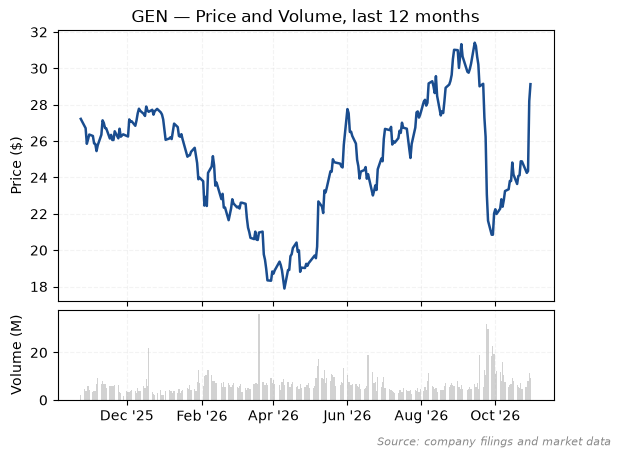
- At $29.13 the stock trades at about 9 times fiscal 2028 consensus earnings, so the case does not need my beat.
The Call That Ended a Month of Takeover Talk
In late September the Financial Times reportedly said Gen was in early talks to buy GoDaddy. Gen never confirmed the talks, and snippets of Benzinga and Yahoo Finance coverage suggested the shares fell, though I could not verify the fall or its date. On 28 September Gen filed a letter from Pilette with the SEC. "'Is Gen buying GoDaddy?' That is the question many of you have asked me since last week," he wrote. "I can't comment on rumors."
Instead he listed the tests any deal must pass, ending with a blunt one: "And is it better than buying back our own stock, all while maintaining a strong balance sheet?" Gen carries about $8.1B of debt.
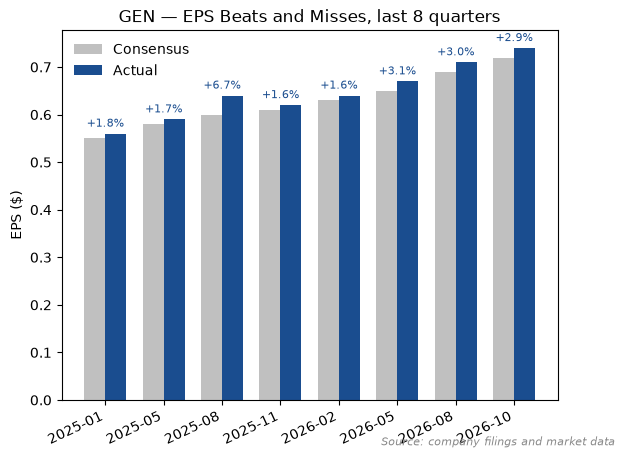
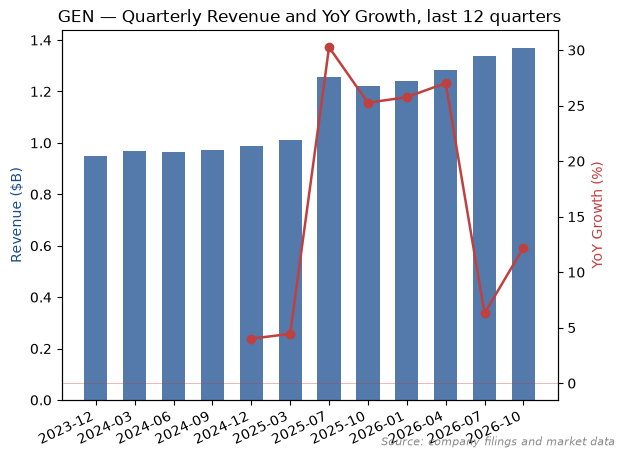
A month later the quarter answered the question better than the letter had. On 28 October Gen reported revenue up 12% and adjusted earnings of $0.74 a share, ahead of both consensus and its own guidance. Adjusted means non-GAAP, before acquisition amortization and stock compensation, and I use that basis throughout because guidance and consensus do. Gen also raised its full-year guidance for the second time.
Then Pilette closed the subject. "But to avoid any misunderstanding, let me be clear, we are not working on a transformative acquisition today," he said on the call. He added that "our organic plan stands on its own, and our outlook for this year and the next does not depend on an acquisition." Barron's headline the next day read: "Gen Digital Surges. It Kills M&A Speculation While the Cyber Boom Drives an Earnings Beat."
The market agreed. The stock rose 17% that week and 31% over the month, while the S&P 500 slipped.
Norton, Avast, LifeLock and, Since 2025, MoneyLion
Gen sells subscriptions that protect people's devices, identities and money. Its annual report calls it "a global leader in consumer Cyber Safety and Trust-Based Solutions," and its brands include Norton and Avast in security, LifeLock in identity protection, and MoneyLion in consumer finance, which it bought in April 2025.
The business is large and global. It has two headquarters, "in Tempe, Arizona, and in Prague, Czech Republic," and counts "approximately 500 million total users," of whom 83 million paid last quarter. At $29.13 the company is worth about $17.4B in the stock market.
Most subscriptions run on annual terms and renew automatically, so revenue arrives steadily even though orders peak in the holiday quarter and again at tax season.
Two Segments Growing at Very Different Speeds
Gen reports two segments, and they now behave like two different companies. Cyber Safety Platform holds Norton 360, Avast One and privacy tools such as VPN. Trust-Based Solutions holds LifeLock, MoneyLion's banking and cash-advance products, and Engine by Gen, a marketplace that matches consumers with loans, insurance and credit cards.
| Segment | Q2 FY27 revenue | Q2 FY26 revenue | Change | Q2 FY27 operating margin |
|---|---|---|---|---|
| Cyber Safety Platform | $858M | $814M | +5% | 62% |
| Trust-Based Solutions | $511M | $406M | +26% | 30% |
| Total | $1,369M | $1,220M | +12% | 50% |
Management gave the adjusted segment margins on the call, and together they rebuild the reported total of $686M. Corporate costs are therefore fully allocated between the segments, which keeps the model below simple.
Cyber Safety is the steady half. The annual report credits "growth across our cyber safety membership offerings," which means customers moving to higher tiers, and the 62% margin was a record. Chief financial officer Natalie Derse described the plan as "mid-single-digit revenue growth and a 60% plus operating margin."
Trust-Based Solutions is the engine. It more than doubled in fiscal 2026, "primarily due to the acquisition of MoneyLion," but even without the deal it grew about 10%. Organic growth is what matters now, and last quarter it ran at 26%. Pilette describes the segment's model as "Rule of 50 with 30% margin for 20% growth."
How a Consumer Subscription Business Is Measured
Investors trade Gen on a handful of subscription metrics, and the table shows where each stands.
| Metric | Latest | Year earlier |
|---|---|---|
| Bookings growth | +10% (sixth straight double-digit quarter) | |
| Paid customers | 83M | 77M |
| Monthly revenue per paid customer (my estimate) | about $5.50 | about $5.28 |
| Partner share of revenue | 21.5% | 12% (fiscal 2025) |
| Gross margin | 75.9% | 78.2% |
| First-half free cash flow | $753M | $512M |
Bookings, the value of new and renewed orders, lead revenue because subscriptions are recognised over a year. The customer count needs care, because Gen now counts a MoneyLion user as paid after "at least one revenue-generating transaction," which flatters comparisons with years before the deal. Gen does not disclose revenue per customer, so I divided revenue by paid customers; in Cyber Safety the rise is mostly customers moving up tiers.
The shift to partners is the metric with a cost attached. Telecom carriers, employee-benefit providers and banks take a revenue share, so as their channel grows, gross margin falls. The annual report blames "a $197 million increase in partner revenue share mainly in Trust-Based Solutions" for the pressure in fiscal 2026.
Cash conversion is strong, and stock compensation is low for a software company at about 4% of revenue. Gen does not publish retention as a percentage, but Pilette said this quarter had "the highest renewal rate" of the last four.
What Changed: A Security Company Bought a Money App
Pilette's September letter frames how far Gen has come: "Six years ago, Gen generated $2 billion in revenue and less than $1 of EPS. … Today, we generate more than $5 billion in revenue and nearly $3 of EPS." The MoneyLion purchase added a second business with a different growth rate. Trust-Based Solutions is now 37% of revenue and growing five times as fast as the security side.
The letter claims MoneyLion "is on track to deliver more than 30% return on invested capital in its second year." Management has also set a $100M revenue-synergy target between MoneyLion and Engine, which Pilette called "well on track," ramping in the second half and accelerating "through fiscal year '28."
The new business brings new exposure to the economy. Management cites "elevated inflation" and "slow growth and recession risks," with possible "negative impacts on customer renewals, customer collections." Rates matter directly too, since a 100 basis point move in SOFR changes Gen's annual interest bill by $58M.
The Demand Story: More Scams, More Stretched Households
Demand for Gen's products rises with fraud, and Gen says fraud is rising fast. "Our latest threat report found scams made up more than half of everything we blocked," Pilette told analysts, and "Breach notices to our members rose more than sixfold in the first half." Those figures are Gen's own telemetry, the best data it has, and nobody has checked them independently.
The second driver is household finances. Pilette said "nearly 1 in 4 American households spend almost all of its income on necessities," without naming the survey. Derse said Instacash, MoneyLion's cash-advance product, had "a record number of new users and increased usage measured as advances per user."
The new demand is landing in the partner channel. Derse said employee-benefits growth is "the highest it's been in 5-plus quarters," and Pilette said Norton Money Workplace, a benefits product launched on 22 October, already has a "qualified pipeline" that "exceeds $30 million ahead of the enrollment season." Engine is being sold to partners such as Equifax, and Derse said its inquiries "more than doubled versus last year."
Artificial intelligence is the newest surface, and I treat it as an option. Pilette said agent skills marked safe by Gen's technology "in the leading agent marketplace have been installed over 100 million times," but also that "We don't expect agentic capabilities to contribute materially to revenue in this fiscal year." My model counts none of it.
The market sizes explain why the growth must come from Trust-Based Solutions. Gartner puts consumer security at $9.7B in 2028, growing about 4% a year, and Gen's Cyber Safety revenue alone is about a third of that, though the definitions surely differ. Cyber Safety can only outgrow its market through price, mix and bundling. Javelin Strategy & Research sees the US identity-protection market reaching $18B by the end of 2027, which leaves LifeLock more room.
The Constraints Are Reach, Funding and Rules
Gen has no physical supply constraint, because it has no factory or component supply chain. Its capacity to grow is set by four other things: partner distribution, MoneyLion's funding, state regulation and a licence from Broadcom.
Distribution is the tightest. Most new growth comes through partners, and the annual report admits that partner agreements "impose no minimum sales or marketing commitments." A carrier or benefits broker can stop promoting Norton at any time, so the fastest-growing channel is also the one Gen controls least.
Funding constrains MoneyLion. Cash advances and loans rely partly on outside funders, who can pull back on "significant underperformance of the consumer receivables." Gen sells many Instacash advances to investors, and in fiscal 2026 it booked a "$205 million … loss on sale of Instacash Advances." Pilette said Gen is now "bringing more advances to our own spend accounts," which loosens that dependence but puts more credit on Gen's own balance sheet.
Regulation sets the pace of the money business. The annual report says states are still deciding "whether such products constitute extensions of credit," and Gen has had to "temporarily pause, limit or permanently cease" earned-wage access in some states. These limits cannot be fixed quickly, because they depend on state rules and on funders' appetite for consumer credit.
The fourth constraint sits under the security products. Gen depends on Broadcom for "certain engineering and threat response services, which are critical to many of our products," under "a license agreement with a limited term." I could not find when that licence expires.
Engineering capacity is the one constraint that is loosening. Derse said "75% of the code we shipped in the first half was AI written" and "productivity is up 20% since the beginning of our fiscal year," which helped push operating expenses down to 30% of sales.
What It Is Worth: The Street Has Halved the Fast Segment
I built fiscal 2028, the year ending March 2028, from management's own operating rates. My starting point is this year's guidance midpoint, which my segment build reproduces to within a cent. I grow each segment at the rate and margin management says it runs for, hold interest and tax at this year's levels, and let buybacks keep shrinking the share count at last year's pace.
| Fiscal 2028 step | Base case |
|---|---|
| Cyber Safety revenue (+5%, 62% margin) | $3.62B |
| Trust-Based Solutions revenue (+20%, 30% margin) | $2.45B |
| Total revenue | $6.07B |
| Adjusted operating income | $2.98B |
| Interest (held at this year's run rate) | $472M |
| Tax rate | 22% |
| Adjusted net income | $1.96B |
| Diluted shares (falling 3.4% a year) | 573M |
| Adjusted EPS | $3.41 |
| Consensus EPS | $3.32 |
| Consensus revenue | $5.89B |
My revenue is 3% above consensus and above even the highest single estimate. The gap comes from one assumption. Subtract my Cyber Safety line from consensus revenue and Trust-Based Solutions is left growing about 11%, roughly half the 20% management runs it for.
On earnings the gap is much smaller, because the fastest segment keeps the thinnest margin. Each five points of Trust-Based growth is worth about $102M of revenue but only about four cents a share. So my claim is narrow: the street's revenue line assumes a slowdown management has not guided to, while its earnings line sits close to mine.
The anchor is an aggregate consensus of $3.32. A Yahoo Finance page from around July showed a similar average from 11 analysts, but I could not retrieve a single named broker's fiscal 2028 forecast. Barchart has cited a figure near $3.08, which I could not reconcile and do not use.
The cases show how much room there is underneath.
| Fiscal 2028 case | Cyber Safety growth / margin | Trust-Based growth / margin | Revenue | Adjusted EPS |
|---|---|---|---|---|
| Bear | 3% / 60% | 12% / 30% | $5.84B | $3.19 |
| Bear, no buybacks | 3% / 60% | 12% / 30% | $5.84B | $3.03 |
| Base | 5% / 62% | 20% / 30% | $6.07B | $3.41 |
| Bull, with $100M synergies | 6% / 62% | 20% / 30% | $6.21B | $3.48 |
Three assumptions carry the result, and flexing each one shows where the case is fragile.
| Assumption flexed | Fiscal 2028 adjusted EPS |
|---|---|
| Trust-Based growth at the 11% consensus implies | about $3.33 |
| Cyber Safety margin at the 60% floor | $3.32 |
| Cyber Safety growth stalls at zero | about 19 cents lower |
| No fall in the share count | $3.24 |
| SOFR 100 basis points higher | about 8 cents lower |
The first line matters most: at the growth consensus implies, earnings barely move, so my revenue variant breaks while the equity case holds. A debt-funded acquisition would hit the share count and the interest bill at once, which is why the 28 October denial matters to the model. The full arithmetic is in the published research brief.
What the Market Is Paying: Nine Times Earnings for a 50% Margin
Whatever Gen earns, the market will pay very little for it. At $29.13 the stock trades at 8.8 times fiscal 2028 consensus adjusted earnings, and at 8.5 times my base case for the same year.
To compare Gen with peers and its own history I have to switch to trailing reported earnings, which carry heavy amortization from past acquisitions. On that basis the P/E is 14.6, around the 33rd percentile of Gen's nine profitable years.
I chose two comparables. Trend Micro is the closest, a security vendor Gen names as a competitor in its annual report. VeriSign is an internet-trust business with a similar cash-and-buyback model, though it does not compete with Gen. EV/EBITDA sets enterprise value against operating earnings before depreciation and amortization.
| Company | Trailing P/E | EV/EBITDA |
|---|---|---|
| Trend Micro | 27.1x | 8.9x |
| VeriSign | 33.0x | 24.0x |
| Gen | 14.6x | 10.3x |
On EV/EBITDA Gen is priced like Trend Micro. On earnings it trades at about half, because Gen's interest bill sits between those two lines. The discount is a debt discount, and the debt is being paid down.
Cash flow tells the same story. Pilette says Gen "generates nearly $2 billion in annual free cash flow," and the first half ran below that pace because the second half carries the holiday and tax-season orders. The free-cash-flow yield is 8.6% on the first-half pace and 11.5% on Pilette's figure.
On my numbers the stock is cheap. Nine times forward earnings assumes Trust-Based growth fades and the cash goes into deals. Management has now said both things it can say against that: it guided the segment to 20% and ruled out a transformative acquisition. Derse said "our current share price is not reflective of our actual performance and value," and with $1.8B left on the buyback programme the company has room to act on that view.
Why Norton Still Sells When Defender Is Free
The hardest question for Gen is why anyone pays for security that Microsoft gives away. In AV-TEST's June 2026 Windows 11 test, Microsoft Defender scored 17.5 out of 18 against Norton 360's 18, and both reached full protection. On detection, free is now close to par.
Gen's answer has been to sell a membership in place of antivirus. A Norton 360 or LifeLock plan bundles identity monitoring, a VPN and reimbursement "coverage limits of up to $3 million depending on the plan." It also includes Genie, an AI scam engine that reads "the meaning of words" across calls, texts and emails. The evidence that the bundle works is that Norton 360 "has scaled to over a $1.7 billion run rate, growing consistently at or above mid-single digit," while Defender sits on every Windows PC.
McAfee is the most direct rival on that strategy, because McAfee+ also adds identity theft protection, a VPN and data cleanup. It is private and discloses no growth figures. Aura, also private, competes in identity and privacy, and I found no metrics for it. Bitdefender, ESET, Kaspersky and Trend Micro are also named in Gen's 10-K competitor list.
The second moat is distribution. Pilette said Gen has "more than 1,300 partners across 25 verticals." In consumer finance, Chime and SoFi have far larger deposit bases than MoneyLion, so MoneyLion's edge is distribution through Gen's partners and Gen's 500 million users.
AI agents are the newest threat to this model. Evercore's Rob Coolbrith asked whether consumer agents that audit subscriptions were raising cancellations. "No, we have not seen any increase in subscription [cancellations]," Pilette answered, pointing again to the quarter's renewal rate.
What Could Go Wrong: Gen Lists the Platform Risk Itself
Gen's annual report opens its risks with the threat I worry about most. "Operating system and platform providers increasingly incorporate native security, privacy, and financial features," the second risk says. The first adds that OS and browser makers "have in the past and may in the future limit the interoperability of our solutions." Neither Apple nor Microsoft is named, but they are the companies described.
The next three risks are AI, including "emerging AI-enabled cyber threats"; acquisitions, which "create special risks and challenges that could adversely affect our financial results"; and retention. That last includes "changes in auto-renewal and other consumer protection regulations," a direct threat to a business built on annual auto-renewals.
Further down sit the risks to my thesis. "Many new customers on our MoneyLion platform have limited or no credit history and limited financial resources." Gen carries "$8,275 million of outstanding indebtedness that will mature in calendar years 2027 through 2033." It also warns that "we may be required to issue shares under our contingent value rights agreement," a leftover from the MoneyLion purchase.
The strongest case against Gen joins these. Trust-Based growth leans on MoneyLion's transactional revenue from stretched US consumers. A credit turn, a funder pulling back, or a state or CFPB ruling on earned-wage access could cut that growth to single digits. That would leave a 5% grower with $8.1B of debt and gross margin falling about two points a year, and fiscal 2028 earnings between $3.03 and $3.19, below consensus.
Governance adds a second worry. Shareholders rejected the pay plan on 9 September by 307 million votes to 210 million. The FT reported early takeover talks, which Gen did not confirm, and Pilette says "M&A remains part of our growth strategy." Barclays' Saket Kalia asked why the headline "was coming out, just given what seems like the healthiest organic growth that we've … seen in some time."
My answer is that the price already assumes the worst of this. Even the $3.03 bear case leaves the stock under 10 times earnings. The assumption most likely to be wrong is Trust-Based growth at 20%, followed by the falling share count, which needs buybacks to win over deals.
What I Am Watching
The first test is 4 February 2027, when Gen reports its fiscal third quarter. If Trust-Based growth falls toward the low teens while Cyber Safety holds near 5%, the street is right and my revenue variant is wrong. The bigger test is the fiscal fourth-quarter report, likely around May 2027, which brings the first fiscal 2028 guidance. Before then, refinancing $1.08B of debt due by about September 2027 will set the interest rate my model holds flat.
Takeaway
Gen spent September answering a press report of takeover talks and ended October ruling out a transformative acquisition, beating and raising guidance again. The market now pays about 9 times forward earnings for a company that keeps half of each revenue dollar as adjusted operating profit and is shrinking its share count. My model sits only about 3% above consensus on earnings, so the case does not rest on a beat. It rests on the street having priced in a halving of the fastest segment and cash going to deals, and on 4 February showing that neither is happening.
Sources
- Gen Digital Q2 FY27 earnings release (Form 8-K, Exhibit 99.1), 28 October 2026
- Gen Digital Q2 FY27 earnings call, 28 October 2026 (Vincent Pilette, Natalie Derse; analysts Saket Kalia of Barclays, Rob Coolbrith of Evercore, Joseph Gallo of Jefferies)
- Gen Digital Form 8-K, letter from the CEO, 28 September 2026
- Gen Digital Form 8-K, annual meeting results, 11 September 2026
- Gen Digital Form 10-K for fiscal 2026, Items 1, 1A, 7 and 7A, filed 21 May 2026
- Barron's, "Gen Digital Surges. It Kills M&A Speculation While the Cyber Boom Drives an Earnings Beat," 29 October 2026
- Financial Times report on Gen and GoDaddy, September 2026, as covered by Benzinga and Yahoo Finance
- AV-TEST Windows 11 consumer test, June 2026
- Gartner consumer security market forecast, as quoted by F-Secure investor relations
- Javelin Strategy & Research, 2026 US Identity Protection Services Market Report
- Yahoo Finance analyst estimates page, about July 2026
- Company filings, reported results, analyst consensus and market price data
- Full working, including the segment build, the three cases and the anchor:
research/2026-10-31_GEN.md
Research, not a recommendation. Figures are sourced as cited and were current at publication; nothing here is personalized investment advice.