HII Won $32.4 Billion of Navy Work in a Quarter. The Backlog Is Secure, and Labour Now Sets the Pace
October 31, 2026 · Huntington Ingalls Industries (HII)
profitmonk
Summary
- HII booked a record $32.4B of awards in the third quarter, taking backlog to $86.2B before a $5.1B carrier overhaul books in the fourth.
- Demand is settled. Management says about 90% of expected shipbuilding revenue through 2030 is already under contract, so the yards' labour sets the growth rate.
- At $316.88 the stock trades at 13.2 times 2028 consensus earnings, which pays for no more than management's 6% growth guide. 2027 free cash flow of about $700M would be a 5.6% yield.
- My 2028 base case of $23.70 a share sits on consensus of $24.03. The bull case of $26.52, about 10% above, holds only if throughput keeps growing at this year's 9%, margin repeats 2025's faster step and the tax rate stays at 17%.
- The risk is labour. Throughput is running at about 9% against a 15% target, and the 4 February results will show whether the yards are catching up.
A Quarter That Filled the Order Book to 2030
The question for an investor is whether HII is still worth buying after rising almost 16% in a week. I think it is, because at 13.2 times 2028 consensus earnings the price assumes the yards grow no faster than a guide the CFO himself calls conservative.
The third quarter is what moved the stock. HII won a record $32.4B of awards, taking backlog to $86.2B, mostly from the Navy's new Block VI Virginia-class and Build II Columbia-class submarine contracts plus long-lead material for the carrier CVN-82. The overhaul of the carrier Harry S. Truman, signed at the end of September, books in the fourth quarter on top of that.
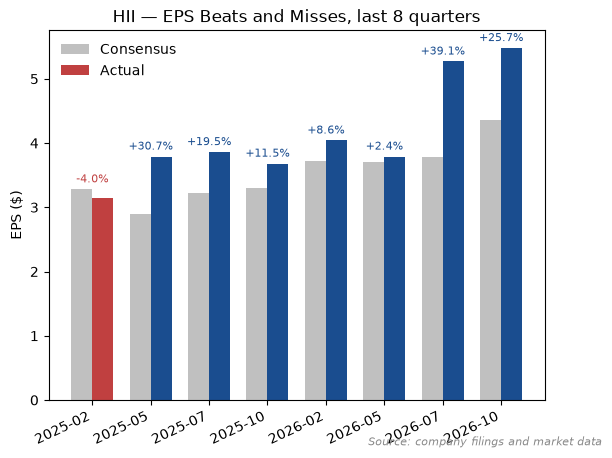
The earnings beat was large, but the guidance mattered more. Earnings of $5.48 a share beat consensus by 26%, and HII raised its 2026 shipbuilding revenue guidance for the second time this year, to $10.5B to $10.7B.
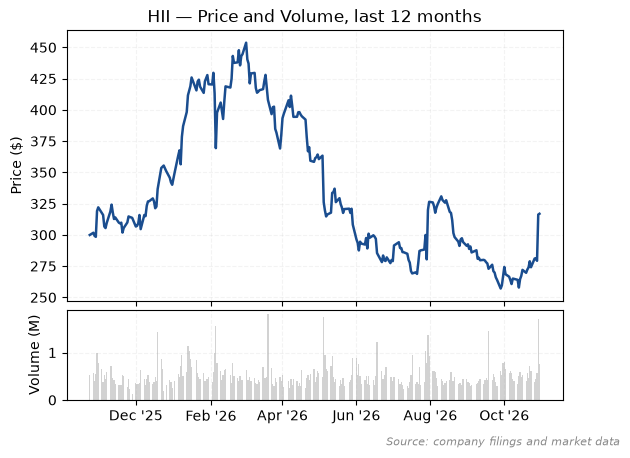
Cash was the real test. Before the report the shares were down about 18% for the year because the year's cash was back-loaded, meaning most of 2026's free cash flow depended on collections in the final quarter. Third-quarter free cash flow came in at $429M, and Stiehle, the chief financial officer, said the quarter "helped de-risk fourth-quarter expectations." The shares rose 15.6% in the five trading days to 30 October while the S&P 500 fell.
America's Largest Shipbuilder
Huntington Ingalls Industries builds the U.S. Navy's largest warships from its base in Newport News, Virginia, and calls itself "America's largest shipbuilder." The company is young but its yards are old: HII was spun off from Northrop Grumman in 2011, while Collis P. Huntington founded the Newport News yard in 1886.
The asset that matters most is the workforce. HII employs more than 44,000 people and is the largest private employer in Mississippi. It hired about 8,000 people in 2025 and more than 6,000 so far in 2026.
It has, in effect, one customer. The Navy provided about 81% of 2025 revenue, and "substantially all" of it came from the U.S. Government. At $316.88 a share, the company is worth about $12.49B.
Three Segments, and Newport News Earns Almost Half
HII reports two shipyards and a defence technology business. Newport News is the largest, and its margin rose a full point last year, about the same as Mission Technologies'.
| Segment | FY2025 revenue | FY2024 revenue | Change | FY2025 segment OI | FY2024 segment OI | Margin FY25 / FY24 |
|---|---|---|---|---|---|---|
| Ingalls | $3,078M | $2,767M | +11% | $233M | $211M | 7.6% / 7.6% |
| Newport News | $6,507M | $5,969M | +9% | $331M | $246M | 5.1% / 4.1% |
| Mission Technologies | $3,044M | $2,937M | +4% | $153M | $116M | 5.0% / 3.9% |
| Total | $12,484M | $11,535M | +8% | $717M | $573M | 5.7% / 5.0% |
Totals include intersegment eliminations of $145M in FY2025 and $138M in FY2024. Source: HII 10-K for fiscal 2025.
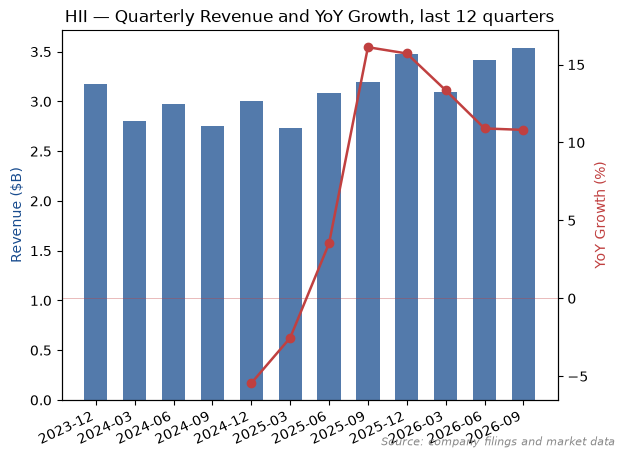
The thesis rests on Newport News. The annual report calls it "the only company currently capable of building, refueling, and inactivating the U.S. Navy's nuclear-powered aircraft carriers," and it is one of two U.S. companies that can design and build nuclear submarines. In the third quarter of 2026, higher submarine and carrier volumes lifted its revenue 18.1%. The yard is also where the costs run over. Management admits it "continues to experience performance challenges in the construction of aircraft carriers and the Virginia class," and the resulting write-downs on cost estimates help explain why its 5.1% margin trails Ingalls' 7.6%.
Ingalls, in Pascagoula, Mississippi, is "the sole builder of amphibious assault ships and one of two builders of surface combatants for the U.S. Navy." It produced the softest number in the report, because destroyer performance pulled its third-quarter margin down to 6.7% from 7.9%.
Mission Technologies maintains and modernises what HII calls "the vast majority of the U.S. Navy's fleet," and builds unmanned vessels such as the REMUS undersea vehicles and the ROMULUS surface drone.
How a Shipbuilder Is Measured
A Navy shipbuilder books revenue as it spends over builds that take years, so profit arrives through estimates. Almost all of 2025 revenue came from fixed-price incentive contracts (about 46%) or cost-type contracts (about 50%). Profit therefore moves through estimate-at-completion (EAC) revisions, the yard's running forecast of what a ship will cost to finish. A better estimate books profit on work already done, and a worse one reverses it.
| Measure | 2024 | 2025 | 2026 |
|---|---|---|---|
| Shipbuilding margin | 5.2% | 5.9% | 6.0% to 6.5% (guide) |
| Net cumulative EAC adjustments | –$126M | –$28M | +$87M (nine months) |
| Backlog, period end | $48.7B | $53.1B | $86.2B (Q3) |
Source: HII 10-K for fiscal 2025, Q3 2026 earnings release and 10-Q.
The table shows margin climbing and estimates turning in HII's favour, with margin still well short of where management wants it. Chief executive Chris Kastner says "this business should be 9%-10% return on sales and shipbuilding," return on sales being operating margin.
Backlog tells a separate story. It has grown by more than half in nine months, and the Truman overhaul takes it to about $91.3B.
Throughput, the volume of work the yards complete, is the number the bull case rests on. It is up about 9% so far in 2026 against a 15% target, and Kastner said it is "trending a bit south of that."
Cash is late this year. In 2025 HII's free cash flow exceeded its net earnings, but in the first nine months of 2026 it was negative $182M. The 10-Q blames "the timing of billings across programs on certain U.S. Navy contracts."
What Changed: Old Contracts Are Running Off
Three years ago HII's problem was its contracts. Many were priced before 2020 and then built with post-pandemic wages and material costs, which is why Newport News took $154M of net unfavourable adjustments in 2024.
Those contracts are now running off, so part of the margin climb is mechanical. Stiehle told analysts that by the end of 2027 slightly more than half of HII's work will be on post-pandemic pricing, with that share rising 8 to 10 percentage points a year toward the end of the decade. Each new contract carries today's costs in its price.
Washington is adding to the tailwind. The annual report says the 2025 reconciliation law provided "more than $29 billion for Shipbuilding and the Maritime Industrial Base." The same section names the limit: "Our ability to increase throughput and meet production schedules is directly impacted by labor availability and performance."
The Demand Story: Submarines, Carriers and a New Frigate
The Navy's own plan shows the demand. Its fiscal 2027 budget request asked for a record $65.8B of shipbuilding money for 34 ships, Naval News reported in April. USNI News and the Congressional Budget Office say the 30-year plan funds Virginia-class boats at two a year throughout.
Submarines are the largest pillar. On 29 July the Navy signed $76.6B of contracts for Block VI Virginia-class and Build II Columbia-class boats. General Dynamics' Electric Boat holds the prime contract and HII has not disclosed its share, though Breaking Defense says Newport News delivers six of the nine Virginia boats.
Carriers are the second pillar, and here HII has no rival. CVN-80 and CVN-81 carry $15.4B of awards, and the $5.1B Truman overhaul runs to November 2031.
Ingalls picked up a franchise by accident. The Navy cancelled Fincantieri Marinette's Constellation frigate in November 2025 and replaced it with FF(X), derived from the National Security Cutter that Ingalls had just stopped building. Ingalls is the lead yard, and Kastner said HII needs "to get under contract in Q1."
Mission Technologies is winning its own work, including a $2.2B surveillance contract for U.S. Southern Command in July and a Navy order for 10 ROMULUS vessels in September. Kastner put unmanned revenue "north of $200 million top line this year."
The result is that HII's yards are sold out to the end of the decade. Management says "approximately 90% of expected shipbuilding revenue through 2030" is under contract, and Stiehle put it plainly: "We know what we're building, when we're building it, and where we're building it."
The Constraint Is Skilled Labour, and It Is Hired Locally
HII can grow only as fast as two shipyards can staff skilled hours, and those hours come from nearby. "You draw from right around your shipyard for the most part," Kastner explained, so each yard grows at the pace its own region can supply and train workers.
The annual report admits what that has cost. It says staff on certain long-term contracts "failed to achieve expected performance improvements," which caused inefficiency and rework, and it cites "significant challenges hiring and retaining personnel."
HII is attacking the problem on four fronts:
- Wages. It has raised pay at both yards, and Ingalls' third-quarter net gain of 576 workers was its largest in ten quarters.
- Training. Enrolment at its two apprentice schools is over 800, up 14% on last year.
- Outside fabricators. Work sent to them is expected to grow by more than 30% this year.
- Geography. In January 2025 HII bought a metal fabrication yard in Charleston, South Carolina. "We opened that manufacturing yard to draw on a different labor pool," Kastner said.
Suppliers are the second constraint, and the annual report warns that "only one supplier may exist" for some components. The Government Accountability Office, as reported by 19FortyFive, says the lead Columbia boat is at least 18 months late, partly because of a late HII-built bow section. CVN-80 Enterprise is waiting on "late material."
The Congressional Research Service says industry-wide Virginia-class deliveries have run at 1.1 to 1.2 boats a year since 2022 against a goal of two. Kastner declined to promise a faster recovery: "there's so much work to do in front of us."
What It Is Worth: Throughput Sets the Number
More than 80% of consensus 2028 revenue is already in HII's backlog on the company's own conversion schedule, and the Truman overhaul lifts that to about 90%. That is before any new award.
So 2028 revenue depends on how fast the yards work. At management's medium-term guide of 6% a year, 2028 revenue lands almost exactly on consensus. If this year's 9% throughput continues for two more years, revenue clears the highest analyst estimate.
Margin is the second input, and I use the two annual steps HII has already shown: 35 basis points a year for the base case, the 2026 pace, and 70 for the bull, the 2025 pace. Mission Technologies' margin, the 17% tax rate and the share count stay at this year's levels.
| Case | 2028 revenue | Shipbuilding margin 2028 | 2028 EPS (17% tax) |
|---|---|---|---|
| Bear: 6% growth, flat margin | $15.2B | 6.25% | $21.92 |
| Base: 6% growth, slower margin step | $15.2B | 6.95% | $23.70 |
| Bull: 9% growth, faster margin step | $15.9B | 7.65% | $26.52 |
| Consensus | $15.3B | $24.03 |
The bear case grows revenue at the 6% guide but holds margin at this year's 6.25%, so every dollar of earnings growth has to come from volume. The base case lands within 1.4% of consensus, so the street is already pricing management's own guide. The bull case sits about 10% above it and needs two things: throughput holding at 9% instead of falling back to 6%, and margin repeating 2025's faster step.
Analysts are already pushing on that guide. Citi's John Godyn said on the call that "it is becoming hard to justify… the medium-term revenue growth that you guys have out there of 6%." Stiehle replied: "I think we're probably on the conservative side." HII refreshes the guide with its fourth-quarter results.
Cash is the other half of the case. Stiehle guided to $1.2B to $1.3B of free cash flow across 2026 and 2027, so with 2026 at its $550M midpoint, 2027 comes to about $700M. JPMorgan's Seth Seifman described the same bridge on the call, and Stiehle did not dispute it.
What the Market Is Paying: 13 Times 2028
My valuation call rests on 2028 earnings. I use trailing P/E only to compare HII with peers, because it is the one basis on which all of them are available.
| Company | Trailing P/E |
|---|---|
| General Dynamics | 21.6x |
| Northrop Grumman | 17.6x |
| HII | 17.0x |
| Eight-peer average | 14.6x |
| Hanwha Ocean | 7.9x |
| HD Hyundai | 4.8x |
Source: market data, 31 October 2026.
On that basis HII trades below both its U.S. peers. It is 21% cheaper than General Dynamics, its partner and rival in submarines and destroyers, and slightly below Northrop Grumman. It sits above the eight-peer average only because the Korean yards pull that average down, and they are not comparable on customer or contract structure, so I give them little weight. Against its own last ten profitable years, HII's trailing multiple sits at the 70th percentile.
The forward multiple is what makes the stock cheap. At 13.2 times 2028 consensus earnings, the price pays for growth no faster than a 6% guide its CFO calls conservative, on revenue that is largely contracted already. The 5.6% free cash flow yield on 2027 points the same way.
Why HII Wins, and Why the New Yards Do Not Reach It
HII's first moat is a monopoly. No other company can build, refuel or retire a nuclear carrier, which is why the Truman overhaul was awarded sole-source. The annual report names the only threat, a government-owned yard equipped to refuel carriers, in which case "our market position would likely be significantly adversely affected."
The second moat is the workforce. Kastner put it this way: "It is hard to set up a shipyard, but it can be done… more importantly, is really the talent to execute on the programs after it is set up."
General Dynamics matters to this thesis more than any other company, because its Electric Boat holds the prime contract on both submarine classes. HII builds sections of both, so its submarine economics depend on GD's contract terms. GD's Bath Iron Works is also HII's only rival on destroyers.
New entrants are building, but far from HII's yards. Anduril and the Navy announced $6.6B to expand the submarine industrial base. UPI reported that Hanwha, which bought Philly Shipyard, targets combatant certification by 2028. HD Hyundai plans a U.S. yard with Kiewit and is also helping HII automate welding at Ingalls. Asked about poaching, Kastner said shipbuilding "is… pretty local" and the new yards "are not really near our shipyards."
In unmanned vessels, HII's ROMULUS won one of three 10-hull Navy awards in September, alongside Galliano and Saronic.
What Could Go Wrong: HII Lists Its Own Weak Points
HII's own risk factors start where a bull should worry. The first reads "We depend on the U.S. Government for substantially all of our business." The second warns that "a full or partial federal government shutdown may occur, as occurred in October 2025," and that strategy reviews could cut demand, "including our aircraft carrier programs."
The third is the one I take most seriously. Estimates on new ships rest on designs "that are not completely designed," and with 46% of revenue on fixed-price incentive contracts, a bad estimate becomes a charge.
The filings say less about execution. Throughput is running well below target, Ingalls' margin fell in the third quarter, and Stiehle himself said Newport News' recent adjustments are "larger than the historical norm," warning against annualising them. A repeat of 2024's $154M of charges at Newport News would wipe out a year of margin gains.
The bull case depends on throughput, and the tax rate costs $1.40 to $1.60 a share in every case:
| Assumption | If it goes wrong | Effect |
|---|---|---|
| Bull-case throughput of 9% | Slips to about 7% | 2028 shipbuilding revenue lands near $12.14B, within 2% of the $11.91B base case, and the bull case collapses into the base |
| 17% tax rate, which includes an R&D credit | Returns to 2025's 22.1% | $1.40 to $1.60 off every case; the base case falls to about $22.20 |
The base case does not need the throughput assumption, because it uses management's own 6% guide.
Cash is the near-term test. Billings have lagged work all year, so the fourth quarter must deliver about $730M of free cash flow to hit the 2026 midpoint.
What I Am Watching
The fourth-quarter report on 4 February 2027 will settle this. I want to see the cash target met and the medium-term growth guide raised above 6%. If the guide stays at 6% and full-year throughput finishes below 9%, the bull case is wrong.
Takeaway
In 2024 HII was still building ships on contracts priced before wages and materials rose. It now has more contracted work than it can build, increasingly on contracts priced at today's costs. The market pays 13.2 times 2028 consensus earnings for that, a multiple that assumes the yards grow no faster than management's cautious guide. Labour is the risk, and it is also where the upside sits, because 9% throughput is already in the 2026 numbers.
Sources
- HII Q3 2026 earnings release (Form 8-K), 29 October 2026
- HII Q3 2026 earnings call, 29 October 2026 (Chris Kastner, Tom Stiehle, Andy Green; analysts John Godyn of Citi and Seth Seifman of JPMorgan)
- HII Form 10-Q for the quarter ended 30 September 2026
- HII Form 10-K for fiscal 2025, Items 1, 1A and 7, filed 5 February 2026
- HII proxy statement (DEF 14A), 20 March 2026
- HII Q4 2025 earnings release, February 2026
- HII Form 8-K (Item 5.02), 20 October 2026, on C. Michael Petters
- HII release on HD Hyundai welding automation, 4 August 2026
- HII company history, hii.com/our-history
- Breaking Defense on the Block VI Virginia and Build II Columbia awards, July 2026
- Naval News on the FY2027 shipbuilding request (April 2026), the FF(X) frigate, CVN-79 trials (September 2026) and the MUSV awards (September 2026)
- DefenseScoop on the FY2027 budget request, 3 April 2026
- USNI News on the 30-year shipbuilding plan, 11 May 2026
- Congressional Budget Office on the FY2027 shipbuilding plan, 5 August 2026
- Congressional Research Service reports R44972 (frigate) and RL32418 (Virginia class)
- Government Accountability Office on the Columbia program, April 2026, as reported by 19FortyFive
- Defense Daily on General Dynamics Marine Systems' Q3 2026 results
- UPI on Hanwha, HD Hyundai and foreign-yard proposals, 26 October 2026
- Anduril release on the submarine industrial base, October 2026
- MarketBeat on TD Cowen (9 October 2026) and Bernstein (14 October 2026)
- Investing.com on HII's pre-earnings setup (October 2026) and Goldman Sachs (30 October 2026)
- Company filings, reported results, analyst consensus and market price data
- Full working, including the backlog coverage, the three-case 2028 walk and the anchor:
research/2026-10-31_HII.md
Research, not a recommendation. Figures are sourced as cited and were current at publication; nothing here is personalized investment advice.