Intel's Data Center Grew 78%. The Stock Then Had Its Worst Day Since 1974
October 31, 2026 · Intel Corp. (INTC)
profitmonk
Summary
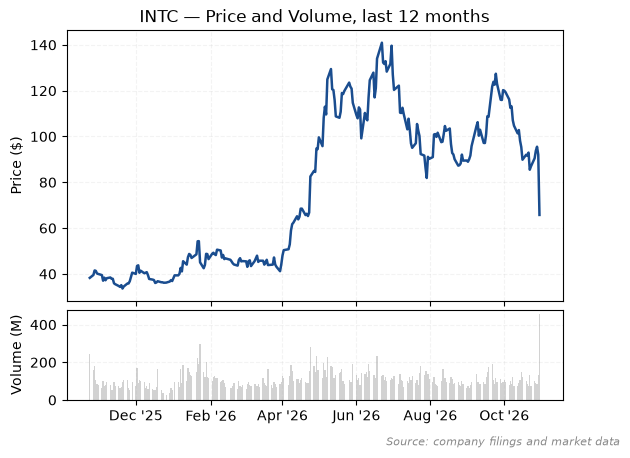
- Intel beat on every line in the third quarter, then guided the fourth quarter about $1.8B below the Street. The stock fell 45% in October.
- PCs and a fab accident in Israel caused the guide cut. In the same release, data-center revenue rose 78% and was guided up mid-teens again.
- My base case for 2028 is $2.59 a share of adjusted earnings, 17% below the $3.12 consensus. My bull case is $3.32, 6% above it, and it needs Intel to hold its server revenue share.
- Servers decide 2028. Between my bear and bull cases, data-center revenue moves by about $18B and PC revenue by about $5B. The market sold the stock on the smaller line.
- At $65.76 the stock is 21 times consensus 2028 earnings, which I call fair. It is 11 to 13 times the 2030 earnings power BofA still sees. If Intel holds its server share, that gap is the bull case.
The Best Quarter in Years, Then the Worst Day in Five Decades
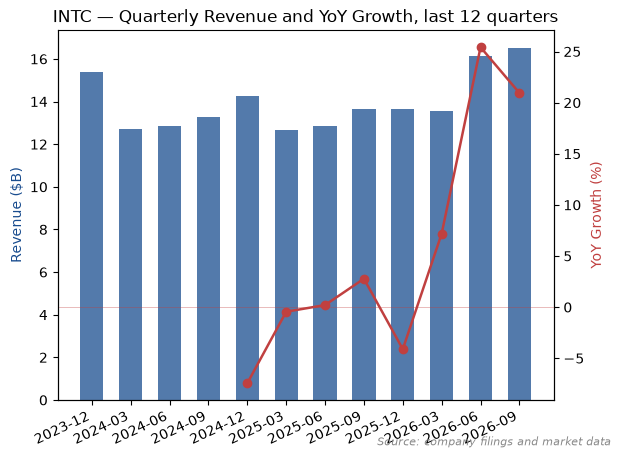
On 29 October, after the close, Intel reported a quarter that beat on every line. Revenue rose 21%, and adjusted earnings of $0.52 a share beat Intel's own guide of $0.38. Adjusted means before one-off items, and I use that basis throughout because guidance and consensus do too. Chief financial officer David Zinsner called it "the eighth consecutive quarter of exceeding our financial expectations."
Then came the guide, and it broke the stock. CNBC, citing LSEG, had the Street well above Intel's range on both revenue and earnings. Melius analyst Ben Reitzes put the gap on the call at "about $1.8 billion below the Street."
| Q3 2026 actual | Q4 2026 guide | Street for Q4 | |
|---|---|---|---|
| Revenue | $16.51B | $15.0B to $16.0B | about $17.1B |
| Adjusted gross margin | 44.1% | 38.0% | |
| Adjusted EPS | $0.52 | $0.25 | about $0.43 |
Intel named all three causes of the shortfall on the call. The biggest is PC makers cutting stock: Zinsner said client revenue would "decline greater than 20% sequentially as customers move quickly to reduce weeks of inventory," which comes to about $1.6B. The second is in Israel. Chief executive Lip-Bu Tan said "an unfortunate and tragic accident led to an extended shutdown in our Israel factory," which cost about $300M of revenue and two points of margin. The third is underloading: as Intel cuts client production, the same fixed costs are spread over fewer wafers.
Data center moved the other way in the same guide. Zinsner said it would "grow mid-teens percent sequentially," which puts it near $8.4B for the quarter, and that it "is on track to finish 2026 nearly $10 billion above expectations entering the year."
The market did not wait for the detail. MarketBeat reported that the stock closed down about 28.6% the next day, its worst session since 1974. Benzinga put the loss across chip stocks that day at about $1T, with the SOX chip index down 7.2%.
A Chipmaker That Still Makes Its Own Chips
Intel is a Santa Clara company that has made semiconductors for more than 50 years. Its annual report describes it as "a global designer and manufacturer of semiconductor products." It designs the x86 processors inside most of the world's PCs and, by units, a majority of its servers. It sells them to PC makers such as Dell, Lenovo and HP and to cloud operators.
Owning its factories is what sets Intel apart. It calls itself "the only company undertaking research, design and development of leading-edge… [and] high-volume manufacturing of logic semiconductors utilizing leading-edge nodes in the U.S." That claim rests on more than $100B of plant and equipment.
Intel sells all over the world, and customers billed in China accounted for 24% of 2025 revenue. Its shareholder base has changed too. The US government now owns about a tenth of the company, and NVIDIA and SoftBank both bought in during 2025.
Two Product Businesses, One Factory Business, and the Mix Has Flipped
Intel reports three main segments. Client Computing and Physical AI (CCPG) sells PC processors such as Core Ultra. Data Center and AI (DCAI) sells Xeon server processors, network chips and custom chips designed for single customers. Intel Foundry runs the factories, and nearly all of its revenue comes from making chips for Intel's own product groups. The table, from the earnings release, compares the third quarter with a year earlier.
| Segment | Q3 2026 revenue | Q3 2025 revenue | Change | Q3 2026 operating income | Q3 2025 operating income |
|---|---|---|---|---|---|
| Client (CCPG) | $8.10B | $8.54B | −5% | $2.29B | $2.69B |
| Data Center and AI | $7.32B | $4.12B | +78% | $3.04B | $0.96B |
| Intel Foundry | $6.70B | $4.24B | +58% | −$1.85B | −$2.32B |
| All Other | $0.69B | $0.99B | −30% | $0.18B | $0.10B |
| Intel (consolidated) | $16.51B | $13.65B | +21% | 15.3% margin | 5.0% margin |
Management blamed the drop in client revenue on expensive memory and tight IT budgets, with PC makers cutting stock late in the quarter. Sales of AI PCs, laptops with a chip built to run AI models locally, still rose 35%. Stacy Rasgon of Bernstein called it "probably the worst Q3 I've seen for PCs in at least 20 years" on a sequential basis.
Data center grew because Intel and its suppliers produced more, and Intel says demand was broad across cloud, enterprise and newer AI cloud operators. Its custom chips grew 50% from the second quarter. The segment now earns a 42% operating margin, against 28% in client.
Foundry lost less as volumes rose on Intel 3 and Intel 18A, its two newest manufacturing processes, and Intel says 18A wafer cost has fallen 40% since the first quarter. Revenue from outside customers looked better than it was, because Intel said a "nonrecurring customer program" flattered it. All Other shrank because Intel sold a majority of Altera, its programmable-chip unit.
The mix is the story. A year ago data center was a third of Intel's product revenue, and now it is 47.5%. On the fourth-quarter guide it reaches about 57%, which means data center outsells client for the first time in the segment history I read. In 2024 and 2025 client was about twice its size.
The Four Numbers That Move Intel
Investors trade Intel on four numbers. The first is data-center revenue, because it carries the highest margin and the fastest growth. It was $16.9B in 2025, and on the fourth-quarter guide 2026 comes to about $27B, up 60%.
The second is the adjusted gross margin, which moves with mix and with how full the factories run. It climbed four points in the year to the third quarter, and the guide takes it below where it started. Zinsner's rule of thumb is that 40% to 60% of each extra dollar of revenue falls through to gross profit.
The third is Intel's share of the x86 market, the chip design used in PCs and most servers. Mercury Research says AMD held 46.4% of server CPU revenue in the second quarter, which leaves Intel about 53.6%. Intel held about two thirds of server units.
The fourth is the PC market itself. IDC counted third-quarter PC shipments down 20% on a year earlier. In February Gartner said memory had risen to 23% of a PC's bill of materials. Higher memory prices and limited IT budgets are weakening PC demand, and PC makers are cutting inventory.
What Changed: AI Made the CPU Scarce Again
Three years ago the consensus was that AI would make the server processor, or CPU, irrelevant, because graphics chips did the AI work. Agentic AI, software that plans and acts across many steps, has turned that around. Tan made the energy case on the call: "While a GPU reasoning query can run as high as multiple watt-hours of energy, a single CPU query could cost only joules of energy."
He also sized the prize. He put the server CPU market at $40B today and said it could pass $200B within five years, which works out to about 38% a year.
Management says supply has been the limit since 2025. The annual report says "market demand exceeded our available supply of products," mainly on the older Intel 7 process. On the PC side, though, memory prices are squeezing customers, and that is where the damage is. Zinsner said "we are not optimistic about next year in terms of memory," and IDC does not expect the shortage to ease "before end-2027 or early 2028."
The Demand Story: Clouds Are Signing Up for CPUs
The deals behind the data-center number are only starting to be named. On the call Intel said Oracle Cloud Infrastructure had agreed to deploy its latest CPUs for its AI build-out. Tan said "multiple customers, they are all interested to sign up the LTA agreement with us," meaning long-term supply contracts. The quarterly filing shows $1.2B of deposits "received to secure product supply in future periods," and names no customer.
The industry numbers point the same way. Zinsner said "we now expect industry server CPU units to grow more than 30% in both 2026 and 2027." TrendForce, a market researcher, forecast in October that 2027 server CPU shipments would rise 40%. Outside estimates of the 2030 market run from AMD's more than $120B to Mizuho's roughly $209B.
Intel's product line is lined up for that demand. Clearwater Forest is a server chip built on Intel 18A, a process with a new transistor design that delivers power from the back of the chip. At the OCP Global Summit in October, Intel showed more than 46,000 cores in a single rack. On the call it said Clearwater Forest "demand for 2027 is significant." It also said its custom-chip business is "poised to triple again over the next few years."
NVIDIA is a partner as well as a rival. Alongside its $5B investment, the annual report says, it agreed to co-develop products "combining our x86 CPU technologies with NVIDIA's AI and accelerated computing capabilities" across "multiple generations."
Foundry has early names but no contracts in the filings. Reuters reported in April that Tesla plans to use Intel 14A, the process after 18A, at its Austin chip facility. The Wall Street Journal reported in May a preliminary manufacturing deal with Apple, which neither company has confirmed. For advanced packaging, Tan said Intel would have "a couple of customers ready to announce in the next 2 quarters."
The Constraint: Substrates, Yields and One Factory in Israel
What Intel can build caps its data-center growth, and the tightest limit is a part most investors have never heard of. Intel's server chips are built from several pieces linked by EMIB, a small silicon bridge buried in the package. EMIB needs advanced organic substrates, the multi-layer base each chip sits on. Tan said "an industry-wide shortage of advanced organic substrates for our EMIB packaging is also impacting our ability to scale output."
The fix is under way but slow. Zinsner said Intel is "putting 40% more capacity in substrates, but a lot of that doesn't hit until the back half of the year."
The second limit is Intel 3, the process for Granite Rapids, Intel's current Xeon. Output rose by mid-teens from the second quarter, yet Tan still said "I am demanding significant execution from the team" on yield and speed. Intel is converting some 18A capacity in Oregon to Intel 3, but that only reaches production in the second half of 2027.
The third is the Fab 28 accident in Kiryat Gat, Israel. Intel said the lost revenue was "almost all … 10-nanometer server products." Zinsner expects a similar $300M hit in the first quarter of 2027 but no further scrapping. The annual report had already warned that much of Intel's revenue comes from Intel 7 chips made at its Israel plant.
Fixing all this costs money. Gross capital spending is on track for $20B in 2026, and Zinsner said 2027 will be "up strongly." Asked whether free cash flow would be positive in 2027, he said "probably not."
The 2028 Model: Data Center Decides It
Data center decides Intel's 2028 earnings, and consensus already assumes a strong data-center year. I built the numbers from the segments up, using only rates that management or named forecasters have given. The research brief that publishes alongside this article carries the full arithmetic.
The starting point is 2026. Adding the fourth-quarter guide to the first nine months gives revenue of about $61.7B, with data center at about $27B and client at about $31B. The three cases then apply these rates:
| 2028 case | Data center | Client |
|---|---|---|
| Bear | Stays at its Q4 2026 run-rate | Stays at its Q4 2026 run-rate |
| Base | Grows 30% a year, Zinsner's server unit growth for 2027 | Falls 10% in 2027 with Intel's PC market forecast, then flat |
| Bull | Grows 38% a year, Tan's market path | Recovers to its 2026 level |
To turn revenue into earnings I apply Zinsner's 50% midpoint fall-through, hold operating costs at the 2026 level of $16.3B, and use the 11% tax rate he guided and 5.44B shares.
| 2028 | Bear | Base | Bull | Consensus |
|---|---|---|---|---|
| Data center revenue | $33.7B | $45.7B | $51.5B | |
| Client revenue | $25.9B | $28.1B | $31.2B | |
| Total revenue | $63.6B | $77.8B | $86.7B | $84.49B |
| Adjusted EPS | $1.43 | $2.59 | $3.32 | $3.12 |
My base case sits 17% below consensus on earnings and 8% below on revenue, while the bull case is 6% above. Before the print, JPMorgan's Harlan Sur was more optimistic and put 2028 earnings about 15% above consensus.
Consensus sits near my bull case because of data center. With client at my base level, data center needs about $52B in 2028 for revenue to reach the $84.5B consensus. That means matching or beating Tan's own 38% market path while losing no share to AMD. The 2028 consensus is a hard bar, and I do not expect Intel to beat it.
What matters more is where the risk sits, and the sensitivities show it is in data center.
| Change to base case | Base 2028 EPS ($2.59) becomes |
|---|---|
| Data center revenue 20% lower | about $1.90 |
| Client revenue 20% lower | about $0.46 lower |
| Fall-through 40% instead of 50% | $2.33 |
| Each extra $1B of operating cost | about $0.16 lower |
The same cut costs more on data center than on client, and the data-center figure depends on substrates, Intel 3 yields and share against AMD. Fall-through could slip as heavier capital spending raises depreciation. The market sold Intel on the client line, the smaller of the two.
What the Market Is Paying: Fair for 2028, Cheap for 2030
The usual valuation tools don't work on Intel this year. Its trailing P/E is negative, at −27.6 times, because of an accounting quirk. Intel carries the government's escrowed shares as a liability marked to the stock price. When the stock rose, it booked a $12.6B loss on them over nine months. That also makes Intel's P/E history useless as a benchmark, so I do not quote one.
Sales give a clearer picture. I compare Intel with its two main rivals, AMD and TSMC, and with Qualcomm, a chip designer.
| Price to trailing sales | |
|---|---|
| AMD | 20.0x |
| TSMC | 12.4x |
| Intel | 5.8x |
| Qualcomm | 4.0x |
Intel trades much nearer Qualcomm than its rivals. According to indmoney, it traded at about 11 times sales at its June peak, so the multiple has roughly halved in four months.
My valuation call is on 2028 earnings. Intel trades at 21.1 times consensus, 25.4 times my base case and 19.8 times my bull case. That is fair for a business whose 2028 consensus already needs a strong data-center year.
The stock looks cheap only further out. BofA's Vivek Arya downgraded Intel to Neutral on 30 October but still put its 2030 earnings power at $5 to $6 a share, and the stock trades at 11 to 13 times that. To get from fair to cheap, data-center growth has to carry on past 2028, and that is what I expect.
The balance sheet is close to neutral, with about $54B of cash and short-term investments against $50.1B of debt. Analyst price targets published after the print average $89.9.
The Competition: AMD Has the Better Chip, Intel Has the Factories
AMD is the competitor that matters, and its product is ahead. Mercury Research says it held 46.4% of server CPU revenue in the second quarter. Its next EPYC chip, Venice, uses TSMC's 2-nanometer process and offers up to 256 cores. On the call, Morgan Stanley's Joseph Moore noted that AMD "has guided to 70% revenue growth" in servers.
Tan did not claim the lead. He said Coral Rapids, Intel's 14A server chip due in 2028, "will be competitive to AMD," and that the generation after it would be "ahead." Until then, Intel's case rests on supply. AMD builds at TSMC and competes for TSMC capacity, while Intel owns its factories. Zinsner put the consequence plainly: "I really see market share next year being a function of supply."
Arm-based chips are the second threat. AWS Graviton, Google Axion and Microsoft Cobalt are server CPUs the clouds design for themselves. NVIDIA's own CPU, Vera, arrives in 2027, and Futurum reports that Meta's multiyear NVIDIA deal includes it. Wolfe Research has said Arm could take 50% to 75% of the agentic AI CPU market. Intel's answer, it said on the call, is to sell "fully modular, verified instances of our x86 CPUs" and to build "any CPUs at scale for our customers, fully agnostic to underlying ISA."
In foundry, TSMC is the primary competitor. Intel's advantage there is location: of the three advanced-node foundries, alongside TSMC and Samsung, it calls itself "the only one domiciled in the United States." In PCs, Qualcomm's Snapdragon X2 and Apple's M-series use Arm designs, and AMD's Ryzen holds about 30% of x86 client units.
What Could Go Wrong
Intel's own annual report puts competition first. "We have lost market share in recent years, including in both client and data center markets," it says, and in AI accelerators "we have been unsuccessful to date in becoming a meaningful participant." Second comes the foundry, where Intel admits "limited experience" and calls its success "highly uncertain."
The fourth risk on its list is new and the most specific. "If we are unable to secure a significant external foundry customer for Intel 14A… we may pause or discontinue our pursuit of next generation leading-edge process technologies." Intel says that decision "may be effectively irreversible" and would likely end the Ohio factories. It also admits it has "been unsuccessful to date in securing any significant external foundry customers for any of our nodes."
The sixth concerns the government. Its stake could be found "unauthorized, void or voidable," and "the U.S. government's interests in us may not be the same as those of other stockholders." A warrant for 241M more shares becomes exercisable if Intel's stake in its foundry falls below 51%, which in practice blocks a foundry spin-off. The eighth risk, on geopolitics, warns that Intel is "not insured for business interruptions resulting from war or political violence" in Israel. October's accident was a different kind of event, but it showed how much rides on that one site.
Three risks go beyond the filing. Memory could keep PCs down, and Zinsner expects "it does not improve in '27." Foundry lost $1.85B this quarter, and in September TIKR quoted Zinsner saying breakeven could slip to "the end of '28." Shareholders have also been diluted 8.9% in a year, mostly by the August share sale.
The assumption most likely to be wrong is mine: that Intel holds its server revenue share while the market grows. Suppose AMD and Arm take most of the growth while substrates cap Intel. Then data center flattens at its fourth-quarter run-rate and earnings land near my $1.43 bear case. My answer is that Intel's data-center revenue rose 78% in the third quarter, while Morgan Stanley's Joseph Moore noted on the call that AMD has guided to 70% server revenue growth, over a period he did not specify. Both are growing because the market is short of chips. In a shortage, share follows capacity, and Intel is adding substrate capacity and Intel 3 output through 2027.
What I Am Watching
Three dates will show whether the server thesis holds, and the table says what would prove my bull case wrong.
| Date | Event | What would break the bull case |
|---|---|---|
| 3 November | AMD third-quarter results | AMD taking most of the server growth |
| By late November | Mercury Research third-quarter share data | Intel's server revenue share falling again |
| 28 January 2027 | Intel fourth-quarter results | Data center below the third quarter's $7.3B, or Fab 28 scrap spilling past the quarter |
The January report should also give Intel's first figure for 2027 capital spending.
Takeaway
Intel's data center grew 78% in a quarter that ended with the stock losing almost half its value in October, because PC makers are cutting stock and a factory in Israel stopped. My numbers sit below consensus, so the case rests on price and on Intel holding its server share. The market sold Intel on client, its smaller swing line, and ignored the bigger one. BofA still sees 2030 earnings power that puts the stock at 11 to 13 times, even after downgrading it, and at that multiple the price already pays for the PC slump.
Sources
- Intel Q3 2026 earnings release (Form 8-K), 29 October 2026
- Intel Q3 2026 earnings call, 29 October 2026 (Lip-Bu Tan, David Zinsner; analysts Ben Reitzes of Melius, Stacy Rasgon of Bernstein, Joseph Moore of Morgan Stanley)
- Intel Form 10-Q for Q3 2026
- Intel Form 10-K for fiscal 2025, Items 1, 1A and 7, filed 23 January 2026
- CNBC on the Q4 guide against LSEG consensus, 29 October 2026
- Benzinga on the analyst actions and the chip-stock selloff, 30 October 2026
- MarketBeat on the 30 October close, 31 October 2026
- Mercury Research x86 share data for Q2 2026, via Wccftech and Tom's Hardware
- IDC on Q3 2026 PC shipments, October 2026, and on the memory shortage, 2026
- Gartner press release on memory and PC prices, 26 February 2026
- TrendForce on 2027 server CPU shipments, 22 October 2026
- Reuters on Tesla and Intel 14A, April 2026
- The Wall Street Journal on Apple and Intel, 8 May 2026
- Futurum on Meta and NVIDIA Vera
- indmoney on Intel's June 2026 peak and multiples
- Placera on JPMorgan's 2028 view, 19 October 2026
- Company filings, reported results, analyst consensus and market price data
- Full working, including the three-case model, the anchor and the earnings bridge:
research/2026-10-31_INTC.md
Research, not a recommendation. Figures are sourced as cited and were current at publication; nothing here is personalized investment advice.