Norwegian Cruise Sells a $25,000-a-Night Suite. Its Stock Trades at 9.7 Times Trailing Earnings
October 31, 2026 · Norwegian Cruise Line Holdings (NCLH)
profitmonk
Summary
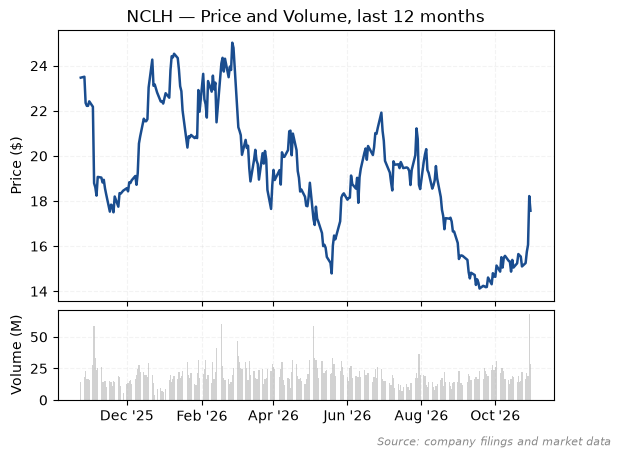
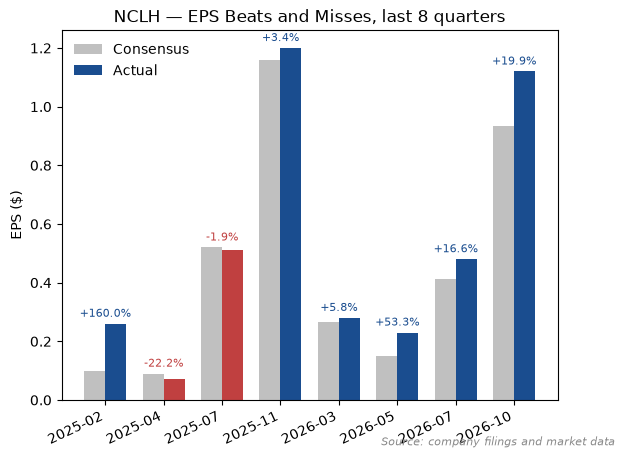
- Norwegian Cruise Line Holdings beat its third-quarter guidance by $0.22 a share on 29 October and gave a first 2027 outlook that calls for yield growth after a year of decline. CNBC put the day's gain at 13%.
- The problem is fares, and the company blames its own execution missteps. Company-wide, ticket revenue per guest per day fell 10% in the quarter while onboard spending rose 7%. Management says most of the improvement has to come from the Norwegian brand.
- The Street's 2027 estimates, $1.33 at Jefferies and $1.35 at Susquehanna, sit well below the $1.56 my model gives on the company's own guide. They match my no-recovery case. Both brokers blamed costs for their cuts, though, so they may be assuming heavier costs and not flat prices.
- My 2028 base case is about $1.70 a share, a little below consensus of about $1.80. The bull case, at about $2.20, assumes yield returns to its 2025 level. Yield here means what the company earns per berth per day after direct costs.
- At $17.57 the stock trades at 10.3 times my 2028 base case, and its trailing multiple of 9.7 is the lowest of any profitable year. Debt is about 65% of enterprise value, so a small change in yield moves the equity hard either way.
The Quarter That Beat and the CFO Who Left
On 29 October Norwegian Cruise Line Holdings beat its own third-quarter guidance on every line it reports. CNBC's headline that day read "Norwegian shares surge 13% on earnings beat, guidance raise." The line that matters is Net Yield, which is roughly what the company earns, after direct costs, for each berth sold for a day. The industry calls that berth-day a Capacity Day: one double-occupancy berth for one day.
| Q3 2026 | Company guidance | Actual |
|---|---|---|
| Adjusted EPS | $0.90 | $1.12 |
| Adjusted EBITDA | $874M | $937M |
| Net Yield, constant currency | −8.9% | −6.7% |
Even the yield beat was a decline. Still, it let management raise full-year guidance to $2.55B of adjusted EBITDA and $1.70 of adjusted EPS. The more important number came in the same release. For 2027 the company guided Net Yield up 1% to 2%, "with a meaningful acceleration in the second half." The turnaround began in February, and this is the first figure anyone can test it against.
The call also brought a departure. Mark Kempa, CFO and with the company since 1999, is stepping down. Meghan Montana, a former American Airlines executive who became Chief Strategy Officer in January, takes over on 1 January 2027, and Kempa stays on as an adviser through June.
The stock went into the print with a fresh critic. On 23 October JPMorgan's Matthew Boss cut it to Underweight with an $11 target, modelling flat Net Yield for 2027. Six days later the company guided to growth, and I think the opportunity sits in the gap between those two views.
The Company That Says It Launched Modern Cruising
Norwegian Cruise Line Holdings is a Miami-based cruise company with three brands. Norwegian Cruise Line is the big-ship line for families and contemporary travellers, Oceania Cruises is premium and Regent Seven Seas Cruises is all-inclusive luxury. The annual report says "Norwegian commenced operations from Miami, Florida in 1966, launching the modern cruise industry." The holding company listed in New York in January 2013 and bought Prestige Cruises, owner of Oceania and Regent, in November 2014. It also owns two private destinations, Great Stirrup Cay in the Bahamas and Harvest Caye in Belize.
| Scale at 30 September 2026 | |
|---|---|
| Ships in service | 33 |
| Berths | ~72,000 |
| Ships on order, 2026 to 2037 | 16 (~43,000 berths) |
| Market value at $17.57 | $8.07B |
| Net debt | $14.8B |
The last two rows matter most, because the debt is why this equity moves so hard. Export credit agencies fund about 80% of the contract price on new ships, which is how a company this size carries an orderbook this large.
Where the Money Comes From: Fares Fell While Guests Spent More Aboard
The fare is the problem. The company reports a single segment and discloses nothing by brand, so the useful split is between what guests pay for the ticket and what they spend once aboard. This quarter the two went in opposite directions.
| Q3 (to 30 September) | 2026 | 2025 | Change |
|---|---|---|---|
| Passenger ticket | $1.95B | $2.05B | −5% |
| Onboard and other | $1.00B | $0.89B | +13% |
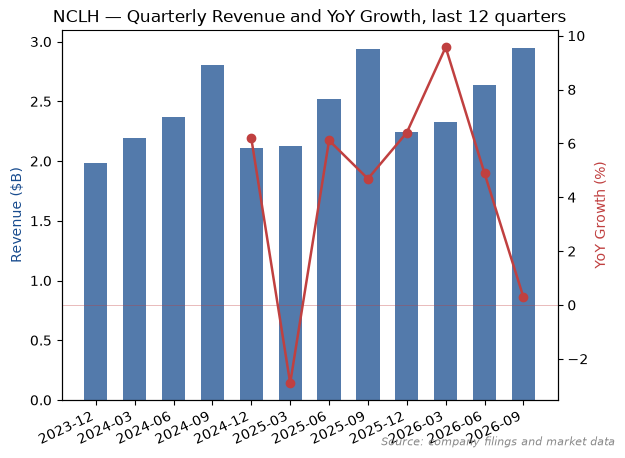
| Total revenue | $2.95B | $2.94B | +0.3% |
Ticket revenue fell and onboard spending rose, so total revenue barely moved, but operating income dropped about 17%. Per guest the gap is wider. Company-wide, ticket revenue per Passenger Cruise Day (one guest for one day) fell 10%, while onboard revenue per day from the casino, drinks, excursions and spa rose 7%. That split matters because tickets made up about two-thirds of revenue in 2025.
Brand-level fares are not disclosed, so the brand reading comes from management. Chief executive John Chidsey told analysts that "Oceania and Regent continue to perform very well" and that "the most of the improvement is obviously coming from the Norwegian brand." The 10-K adds that demand "has been particularly strong across the Company's luxury brands which benefit from longer booking curves." Chidsey was blunt about Norwegian's old habit: "Traditionally, again, if you wait with Norwegian, you've gotten a better deal over time."
How a Cruise Line Is Measured
A cruise line is a hotel that moves, and investors read it with hotel arithmetic: how many berth-days it sells, what each earns and what each costs. NCLH expects about 26.2 million Capacity Days in 2026. Unit cost below means the cost of running each berth for a day, excluding fuel.
| Measure | 2025 actual | 2026 guide |
|---|---|---|
| Net Yield per Capacity Day | $301, up 2.3% | down 4.4% in constant currency |
| Occupancy | 103.5% | 103.2% |
| Unit cost ex fuel per Capacity Day | $162, up 1.0% | down 0.4% |
Of the three big listed cruise lines, NCLH is the only one whose Net Yield is falling. In their third quarters Royal Caribbean grew it 0.6% and Carnival 2.4%.
Occupancy is the first lever, because NCLH used to run fuller ships. The measure is set against double-occupancy berths, and Chidsey recalled quarters of 111% and higher. He said he expects to "clearly get back to 110 and above," against 103.2% guided for this year.
Cost is working, and the forward book is not. Kempa said the company has "delivered three straight years of sub-1% unit growth," and this year's guide has unit cost falling. Advance ticket sales, the deposits guests pay before they sail, slipped to $3.14B at 30 September from $3.20B at the end of 2025, even as capacity grew. The company says its booked position for the next twelve months "remains below its optimal range."
What Changed: An Activist, a New CEO and an Admission
Three years ago the story was surviving the pandemic. In May 2024 the company's "Charting the Course" plan targeted adjusted EPS of about $2.45 in 2026, and the current guide of $1.70 falls 31% short.
The company blames itself. Its 10-K, filed in March, said NCLH entered 2026 "slightly below the optimal booking range" because of "certain execution missteps in aligning our commercial strategy with our deployment." Seatrade reported that Norwegian added about 40% more Caribbean capacity in the first quarter of 2026. The timing was poor. Carnival had opened Celebration Key in July 2025, Royal Caribbean opened its Paradise Island beach club that December, and Norwegian's own waterpark was unfinished. Cruise Industry News reported that Norwegian also ran a "Free at Sea" airfare offer, which Chidsey now calls "basically a marketing subsidy."
The governance changed fast. Chidsey, formerly chief executive of Subway and Burger King, replaced Harry Sommer as CEO on 12 February. Five days later the Wall Street Journal disclosed that Elliott Management held more than 10% of the shares. A cooperation agreement on 26 March brought five new directors onto the board, made Chidsey chairman and named former British Airways chief Alex Cruz lead independent director. Skift reported Chidsey's verdict on the second-quarter call: "The vast, vast majority of our problems, as I've said all along, are self-inflicted."
Fuel made a bad year worse. The war with Iran pushed Brent above $100 in March, until a June deal brought it back down, and the company's full-year fuel assumption has gone from $670 a metric ton to $788.
The Demand Story: Luxury Is Full and Norwegian Is Relearning to Price
Industry demand is healthy, and NCLH's rivals supply the best evidence: they report record pricing and strong bookings for 2027. Carnival says the year is "already half booked with both occupancy and pricing at record levels," and Royal Caribbean reports bookings up in the high teens at higher rates.
So the question is whether NCLH can take its share at a decent price. Chidsey's target customer is the "approximately 30 million vacationers from households earning more than $100,000 annually," most of whom "still do not cruise."
The third quarter showed the product still fills ships when guests want to sail. Close-in bookings lifted occupancy to 106.5%, about 2.5 points above plan. Kempa put this down to "pent-up travel demand from consumers who deferred vacations," and Chidsey warned that "one quarter doesn't a trend make." The fourth-quarter guide assumes it does not repeat.
The luxury brands already command a premium. Launch-day bookings for Seven Seas Prestige, Regent's next ship, beat the brand's previous record by 26%. Its Skyview Regent Suite, "with fares starting at $25,000 per night," is "already booked on over 70% of Prestige's 2027 sailings," Chidsey said.
Norwegian's answer in the Caribbean is new hardware at Great Stirrup Cay. On 4 September the company opened Great Tides Waterpark, with 19 slides and a river, alongside a two-berth pier that lets guests walk ashore. Chidsey said 90% of guests surveyed would recommend the waterpark, and the island now expects 1.4 million guest visits in 2027, up from an initial plan of 1.2 million. He sees the payoff "primarily in onboard revenue" at first, with the potential to "support higher ticket pricing" on island itineraries later.
The 2027 book shows a turnaround half done. For the first half, the release says "pricing for the first half is ahead of levels at the same time last year, while its booked position remains below." For the second half, "pricing is ahead with the booked position in line." Chidsey called 2027 "a tale of two halves," because the new marketing and revenue-management work will not "meaningfully benefit first half performance due to natural shape of the booking curve."
The fix is baseloading, a pricing strategy meant to get guests to book earlier so that waiting for a deal stops paying off. It now covers most of Norwegian's second-half 2027 sailings and all of 2028. Barclays' Brandt Montour asked whether it was working, given the company is "only booked in line despite a handful of months into the baseloading strategy." Chidsey answered: "So I do think it's working. It's early days." Kempa was candid about the pace: "That's not going to turn into instant mashed potatoes." A new brand campaign, "cruise without compromise," launches in January with wave season, backed by a "focused media push during the first quarter."
The Constraint: A Balance Sheet Built for Ships Still Arriving
NCLH's capacity is contracted years ahead, so the real limits are the balance sheet and the Caribbean. The ships keep coming, and they are expensive.
| Year | Ships arriving | Gross newbuild spending |
|---|---|---|
| 2026 | Norwegian Luna (March), Seven Seas Prestige (late December, delayed) | ~$2.9B |
| 2027 | Norwegian Aura (around mid-year), Oceania Sonata (August) | ~$3.1B |
| 2028 | Norwegian Bella (May) | ~$1.8B |
That growth is a risk, because NCLH is adding capacity faster than the industry, about 12% against 9% over the two years to 2028, while its yields lag. Spending falls after 2027, because "we take only one ship a piece in the year 2028 and '29," Chidsey said.
The debt is already heavy. Net debt was $14.8B at 30 September, or 5.5 times trailing adjusted EBITDA, meaning it would take about five and a half years of current EBITDA to repay. The 2024 plan had promised about 4.5 times.
Refinancing is not the pressure point. After the quarter the company sold $950M of notes due 2031 and enlarged its revolving credit line, and management says there are "no significant debt maturities until 2029." The pressure is what the debt costs, and the new notes pay 8.75%.
That cost is why 2027 earnings fall even as yield grows. BNP Paribas expects 2027 net interest of about $870M, a quarter more than the $695M guided for 2026.
Leverage keeps rising until the ships stop arriving. On the call Mizuho put 2027 leverage at "more than the 6.5x to 7x range," and Chidsey replied that it would be "a little lower than that," adding "we don't foresee the need for equity issuance at all." Mizuho's figure is its own estimate, which it said depends on "where EBITDA shakes out." My path below uses my base-case EBITDA, which assumes the company hits its 2027 guide, and it lands just under that range, as Chidsey said it would.
| Net leverage | |
|---|---|
| 30 September 2026, actual | 5.5x |
| End-2027, my base | ~6.4x |
| End-2028, my base | ~6.2x |
| End-2028, my bull | ~5.7x |
Real deleveraging waits until capex falls in 2028 and 2029, so within this horizon the bull case rests on earnings.
What It Is Worth: The Street Sits Below the Company's Guide
I built 2028 from the cruise line's own arithmetic: Capacity Days times the gap between yield and unit cost, less fuel. Run on 2025's reported figures, it reproduces actual adjusted EBITDA of $2.73B. Run on the 2026 guide, it gives the company's $2.55B. The full walk is in the research brief that publishes with this article.
Every input except yield is pinned to a sourced level. Unit cost grows 1% a year, the top of management's record. Fuel is priced at the company's latest spot assumption of $803 a ton. Interest is held at $870M, the midpoint of BNP Paribas's range, and the share count at 463M.
| 2028 case | What yield does | Adjusted EBITDA | Adjusted EPS |
|---|---|---|---|
| Bear (JPMorgan) | Flat at the 2026 level | $2,745M | $1.43 |
| Base (company guide) | +1.5% in 2027, then flat | $2,872M | $1.70 |
| Bull | Back to the 2025 level of $301 | $3,098M | $2.19 |
My base case sits about 5% below 2028 consensus of $1.785. It gives the company the midpoint of its 2027 guide and then no growth at all. Run back through the same build, consensus needs yield just 0.4% above that midpoint.
The bigger gap is in 2027, where the brokers sit well below the company's guide. Less clear is whether that means they expect no price recovery.
| 2027 adjusted EPS | |
|---|---|
| My build, company guide midpoint | $1.56 |
| FMP consensus | $1.458 |
| Susquehanna | $1.35 |
| Jefferies | $1.33 |
| My build, flat yield | $1.31 |
Jefferies and Susquehanna sit within four cents of my flat-yield case, but the reasons they gave for their cuts were costs. Jefferies' David Katz cut his estimate "mainly on higher interest expense," and Susquehanna cited "higher fuel and unit costs." Neither blamed weaker prices, so the match with my flat-yield number may come from heavier cost assumptions. My capacity build also leaves out the Insignia sale, which pushes my 2027 slightly high.
The bull case asks for less than it sounds. It puts 2028 yield back at $301, what NCLH actually earned per Capacity Day in 2025. That requires 2028 yield 2.6% above the 2027 guide midpoint, close to the 2.7% yield growth Carnival expects for 2026.
Occupancy alone could deliver it. At a constant fare every point of occupancy adds nearly 1% to yield, so regaining 2024's occupancy would cover more than half of what the bull case needs. Chidsey's "110 and above" would cover all of it before any fare recovery.
That sensitivity is why the stock moves so hard. Each 1% of 2028 yield is worth about $86M of EBITDA, or $0.19 a share. The effect on earnings is far larger than 1% because fuel, depreciation and interest stay put, so almost all of a change in yield falls through to profit.
What the Market Is Paying: The Lowest Multiple in Its Listed History
The market is pricing NCLH as if the Norwegian fix does not happen. On trailing earnings it is the cheapest of the listed cruise lines. It is also cheaper than in any of its own seven profitable years, when the multiple ranged from 10 to 51 times.
| Trailing basis | P/E | EV/EBITDA |
|---|---|---|
| NCLH | 9.7x | 8.5x |
| Carnival, the mass-market Caribbean rival | 12.5x | 8.6x |
| Royal Caribbean, the share winner | 18.1x | 13.7x |
| Viking, the comparison for Oceania and Regent | 28.9x | 20.6x |
My call rests on 2028 earnings, because that is the first year the turnaround should show in full: baseloading covers every 2028 sailing, and newbuild spending starts to fall.
| NCLH at $17.57, on 2028 EPS | EPS | Multiple |
|---|---|---|
| Consensus | $1.785 | 9.8x |
| My bear | $1.43 | 12.3x |
| My base | $1.70 | 10.3x |
| My bull | $2.19 | 8.0x |
At 10.3 times my 2028 base case, I think the stock is cheap, with one caveat that cuts both ways. Equity is only about 35% of enterprise value, so each 1% change in what the market pays for the whole business moves the share price by about 2.8%. That leverage is what makes the bull case work and the bear case hurt.
The brokers were split before the print. On 23 October Wells Fargo raised its target while JPMorgan cut to Underweight.
| Firm | Rating | Target | When |
|---|---|---|---|
| Wells Fargo | Overweight | $22, from $18 | 23 October, before the print |
| Citi | Buy | $21, from $19 | 30 October, after the print |
| Jefferies | Hold | $17 | after the print |
| Susquehanna | Neutral | $16 | after the print |
| BNP Paribas (Xian Siew) | Neutral | $15 | after the print |
| JPMorgan (Matthew Boss) | Underweight | $11 | 23 October, before the print |
MarketBeat puts the consensus target at $20.10.
Royal Caribbean Is Winning, and Regent Is the Answer
NCLH is losing the mass-market Caribbean fight, and the rivals' guidance shows by how much.
| Company | Yield | Earnings |
|---|---|---|
| Royal Caribbean | Q4 Net Yield guided up 4.2% to 4.7% | on track for "a $20-handle in 2027" in adjusted EPS |
| Carnival | about 2.7% yield growth in 2026 | $2.24 adjusted EPS despite about $150M of extra fuel cost |
| NCLH | Q4 Net Yield guided down 6.5% | $1.70 adjusted EPS guided for 2026 |
The destinations show the scale gap. Carnival expects about 3.5 million guests at Celebration Key in 2027, so Great Stirrup Cay's 1.4 million is about 40% of that. Rothschild's Alex Brignall put it to management on the call: "the trajectory relative to previous years has not been the same as some peers."
NCLH's real advantage is at the top of the market. Oceania and Regent sell on longer booking curves at higher prices, and Prestige's launch record is the latest proof. Viking, the closest listed luxury comparison, trades at three times NCLH's trailing multiple, so the market gives NCLH almost no credit for two luxury brands that are performing.
The second advantage is the hardware Norwegian is adding. Luna has arrived, Aura is due in 2027 and Bella in May 2028. The Haven, which Chidsey calls "a luxury ship within a ship," puts a premium product inside the same hull. The waterpark and pier finally give Great Stirrup Cay something to sell against Royal Caribbean's Perfect Day at CocoCay.
What Could Go Wrong: The Company Lists Its Debt First
NCLH's own risk factors put the balance sheet ahead of every operating risk. The first warns that if results "do not perform as planned, we may not be in compliance with maintenance covenants," which include free liquidity of at least $250M. The second says "we anticipate that we will need additional financing in the future, which may not be available on favorable terms, or at all." Most assets are pledged.
Two later risks have become live. The company relies on "scheduled commercial airline services," and the air programme is where much of the new $100M of savings comes from. The risk from "global events and conditions, including terrorist acts, geopolitical conflict" is no longer abstract, because the Iran war has already cancelled Seven Seas Voyager sailings through the Suez Canal.
The filings say nothing about credibility, and the record there is poor. The four straight earnings beats came against a bar that kept falling.
| When set | 2026 adjusted EPS guide |
|---|---|
| May 2024 target | about $2.45 |
| March 2026 | $2.38 |
| May 2026 | $1.45 to $1.79 |
| July 2026 | about $1.50 |
| October 2026 | $1.70 |
The same team now guides 2027 up 1% to 2%, with the first half booked behind last year.
Fuel is the input I trust least, because the $803 a ton was struck at spot prices while the war was still going. A 10% rise on unhedged 2028 fuel would cost about $0.19 a share. Next year is better protected, because the company has already hedged part of 2027.
The strongest case against me is that the yield gap is structural. Three private Caribbean destinations now compete for the same family, and UBS's Robin Farley asked the question directly: "how do you get confidence that you don't have to have price move down to move your load up." If 2027 lands at flat yield, 2028 EPS is about $1.43 and leverage stays above six times.
My answer is that the stock already prices much of that outcome, at 12.3 times my bear-case 2028 earnings. The assumption most likely to be wrong is 2028 Net Yield, because every other input is pinned to a filed number or a named analyst. Management itself credits the third-quarter beat to deferred vacations, so I am not counting on another quarter like it.
What I Am Watching
The test is the fourth-quarter report, which Kempa indicated for February 2027. I want the 2027 yield guide held at 1% to 2% or raised, the second-half 2027 book moving ahead of last year, and advance ticket sales up year on year. If the guide is cut in February, the Street's low 2027 numbers were right and my bull case is wrong. The Investor Day in the first half of 2027 should then set a new 2028 target.
Takeaway
NCLH's problem is fares, which the company blames on its own execution missteps, and management says most of the improvement must come from the Norwegian brand. The two brokers that updated after the report sit near what my model gives with no price recovery, though both pointed to costs. Meanwhile the company guides to modest growth and its luxury brand sells suites from $25,000 a night. Getting back only to the yield it earned in 2025 is worth about $2.20 a share in 2028. At 10.3 times my base-case 2028 earnings, I think the market is offering that option cheaply, with debt that makes the result swing hard either way.
Sources
- Norwegian Cruise Line Holdings Q3 2026 earnings release (Form 8-K, Exhibit 99.1), 29 October 2026
- Norwegian Cruise Line Holdings Q3 2026 earnings call, 29 October 2026 (John Chidsey, Mark Kempa; analysts Brandt Montour of Barclays, Robin Farley of UBS, Ben Chaiken of Mizuho, Alex Brignall of Rothschild)
- Norwegian Cruise Line Holdings Form 10-Q for the quarter ended 30 September 2026
- Norwegian Cruise Line Holdings Form 10-K for fiscal 2025, Items 1, 1A and 7, filed 2 March 2026
- Norwegian Cruise Line Holdings CFO transition release, 29 October 2026; Form 8-K, 30 September 2026; Form 8-K on the CEO change, 12 February 2026
- Norwegian Cruise Line Holdings "Charting the Course" release, 20 May 2024
- CNBC on the 29 October share move, 29 October 2026
- Cruise Industry News on Jefferies, Susquehanna and BNP Paribas, 30 October 2026; on capacity outlook, May 2026; on the global orderbook, September 2026; on "Free at Sea", November 2025
- Tradingpedia on JPMorgan's downgrade, 23 October 2026
- MarketBeat and GuruFocus on post-results analyst targets, October 2026
- TIKR on Mizuho's downgrade, August 2026
- Skift on the second-quarter call, 30 July 2026, and on guidance, 4 May 2026
- Seatrade on Caribbean capacity, March 2026, and on Viking's Q2 2026 results
- Royal Caribbean Q3 2026 results, 27 October 2026; Carnival Q3 2026 results and call, 29 September 2026
- CLIA State of the Cruise Industry 2026, via Travel Market Report and Cruise & Ferry Review
- Wall Street Journal on Elliott Management's stake, 17 February 2026; Maritime Executive on the cooperation agreement, March 2026
- Fox Business and The National on Brent crude, March and June 2026
- Company filings, reported results, analyst consensus and market price data, 31 October 2026
- Full working, including the 2028 model, the anchor and the leverage path:
research/2026-10-31_NCLH.md
Research, not a recommendation. Figures are sourced as cited and were current at publication; nothing here is personalized investment advice.