ServiceNow Lost a Third of Its Value Over One Point of Backlog Growth
October 31, 2026 · ServiceNow, Inc. (NOW)
profitmonk
Summary
- ServiceNow beat its own guidance on subscription revenue and margin in the third quarter, then fell 27% in a day because its fourth-quarter backlog guide came in about a point below consensus.
- Management traced most of that point to timing and accounting: renewals pulled into the third quarter, government contract clauses, and AI deployment help billed as services.
- My 2028 model lands on consensus. I get $22.85B of revenue against $22.71B, and $5.53 a share of adjusted earnings against $5.87.
- The disagreement is the price. At $105.12 the stock trades at 17.9 times 2028 consensus adjusted earnings, down from 25.6 times the night before the report. That is cheap if growth holds near the 18% consensus assumes. If organic growth falls below 15%, the multiple is fair.
- The test is the fourth-quarter report, listed for 27 January 2027: backlog growth above the 18.5% guide, and AI contract value above $1.7B.
The Quarter That Broke the Stock
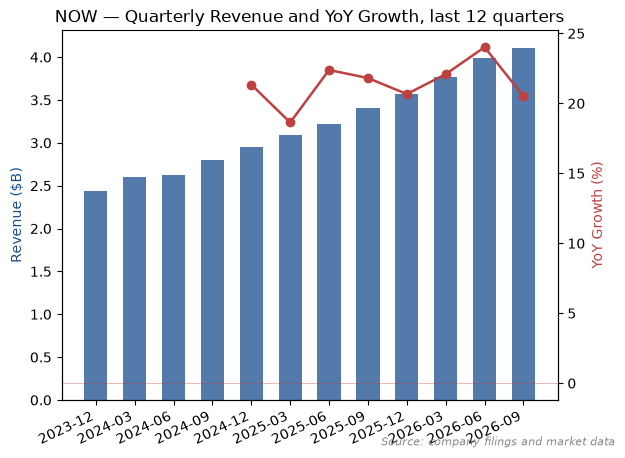
The quarter ServiceNow reported after the close on 28 October was clean. Subscription revenue rose 21% to $3.99B, above the top of guidance, and the adjusted operating margin of 32.5% beat as well.
The trouble was one forward number. Chief financial officer Gina Mastantuono guided fourth-quarter cRPO growth to 18.5% in constant currency. cRPO, or current remaining performance obligations, is the contracted revenue a company expects to recognise over the next twelve months. TradingView and Yahoo Finance put consensus at about 19.5%, and the third quarter itself had grown 21%.
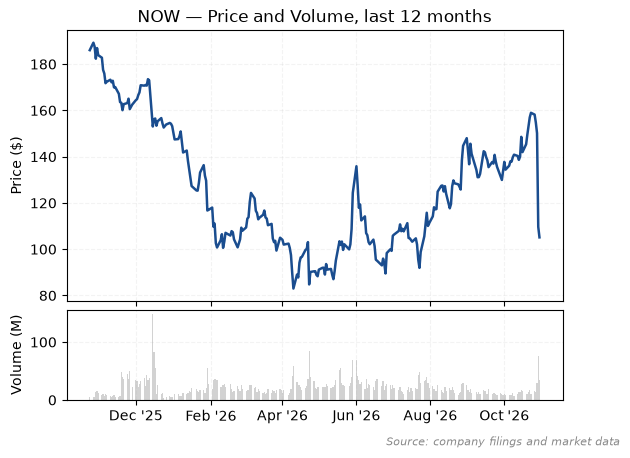
The reaction began on the call. Wolfe Research's Alex Zukin opened his question by noting that "the stock is down pretty meaningfully after market on some of the, I think, the 4Q guide." Bloomberg's headline read "ServiceNow falls after quarterly sales outlook revives AI fears." The next day the shares fell 27%, which Benzinga called the largest one-day drop since the company listed in 2012, and by 30 October they had reached $105.12.
The selling stayed specific to ServiceNow. The stock lost a third of its value in five trading days while the S&P 500 fell 0.6%, though 24/7 Wall St. reported Salesforce and Workday falling in sympathy on 29 October. Eight brokers cut their price targets within two days, and I found no rating downgrade among them.
My argument is that the market repriced the whole company on a guide that management mostly explained, while 2028 forecasts still sit below the company's own backlog growth rate.
A Help-Desk Platform That Wants to Run Corporate AI
ServiceNow is a Santa Clara, California company whose cloud platform runs the internal workflows of large organisations. A broken laptop, a new hire's onboarding, a customer complaint or a security alert becomes a ticket that moves through ServiceNow software. The annual report now describes the goal as becoming "the defining AI enterprise software company of the 21st century."
The core is IT service management, or ITSM, the software an IT department uses to log and resolve requests. IDC, as The Register reported in April, puts ServiceNow's share of that market at about 40%. Around that core the company sells IT operations, asset management, security, customer service, HR and legal workflows on what it calls a "one platform architecture." Bill McDermott, formerly chief executive of SAP, is chairman and chief executive.
About 97% of revenue is subscription, sold mostly through the company's own sales force, and the business is worth about $109B at today's price. Per-share figures here reflect the 5-for-1 split of December 2025.
Where the Money Comes From
ServiceNow reports no business segments. It sells four product groups (Technology, CRM and Industry, Core Business, and Creator) but discloses no revenue by group, so the only split the annual report gives is subscription against professional services.
| Line | FY2025 | FY2024 | Change | Gross margin, 2025 vs 2024 |
|---|---|---|---|---|
| Subscription | $12.88B | $10.65B | +21% | 80% vs 82% |
| Professional services and other | $0.40B | $0.34B | +17% | (5%) vs (2%) |
| Total | $13.28B | $10.98B | +21% | 78% vs 79% |
Subscription is the business. The annual report credits its growth to "increased purchases by new and existing customers." Subscription gross margin slipped two points because of extra staff serving customers in regulated markets and the rising cost of third-party cloud hosting.
Professional services is the help ServiceNow sells to get its software running, and it loses money. The report says partner spend is "increasing at a faster rate than revenue," and third-party partner costs rose from 10% of services revenue in 2023 to 35% in 2025. The line is small, but it shows where the business is strained, and I come back to it under the constraint.
The third-quarter call gave deal counts by product but no revenue, and the clearest signal was scale. Asset Management crossed $1B of annual contract value, or ACV, and McDermott said six businesses have now passed a $1B run rate.
How a Subscription Platform Is Measured
Investors judge ServiceNow on a handful of contract and cash numbers. The table shows how each has moved.
| Metric | 2023 | 2024 | 2025 | 2026 |
|---|---|---|---|---|
| cRPO growth | 25% | 21% (Q3); 18.5% (Q4 guide) | ||
| Renewal rate | 98% | 98% | 98% | 98% (Q3) |
| Customers above $5M ACV | 420 | 502 | 603 | 680 (Q3) |
| Free cash flow margin | 34.9% | 36% (guide) |
cRPO is the number that moved the stock, and growth has slowed from 25% at end-2025 to 21% in Q3, with 18.5% guided for Q4. The renewal rate explains why that matters so much: customers almost never leave, so growth depends on selling them more, and the large-customer count is that expansion engine in one series.
Cash is the strongest line. Add revenue growth to the free cash flow margin and you get the "Rule of 40," a software shorthand for balancing growth against profit. ServiceNow scored about 56 in 2025 and says it will reach 57 this year.
That score hides stock-based compensation, which ran at 15% of revenue in 2025. Subtract it and the 2025 score falls to about 41, which still clears the bar. At its May analyst day the company said it aims to bring stock pay below 10% of revenue by 2029.
What Changed: Agents Threaten the Seat
Three years ago ServiceNow was an IT workflow company selling seats, and it generated $2.73B of free cash flow in 2023. The 2026 guide implies about $5.9B.
The bigger change is the bet itself. Stocktwits counts more than $11B of acquisitions since 2025. Moveworks, an AI assistant for employees, closed in December 2025. Veza, an identity-security firm, closed in March. Armis, which tracks devices on corporate networks, closed in April for $7.75B in cash.
Those deals answer a threat to the seat. If an AI agent resolves a ticket, the customer may need fewer human agents with ServiceNow licences. McDermott's answer is a hybrid price. "The customer likes the predictability of the seat-based pricing model for their budgeting purposes," he said. Once customers are live, "the token economics take off, whereby we have a chance to improve our revenue per user by a factor of 5x." That is his aspiration, and no disclosed metric measures it yet.
The macro is mixed. The annual report says "interest rates, global inflation and tariffs, have led to economic uncertainty," while Gartner forecast on 21 October that software spending grows about 14.6% in 2027.
The Demand Story: Bigger Deals, and AI on Top
Large customers are buying more, and buying more products at once. ServiceNow signed 19 deals worth more than $5M of net new ACV in the third quarter, up 135% from a year earlier, and 19 of its top 20 deals included six or more products.
Accenture is the showcase. McDermott said "every single corporate function now is running on ServiceNow," and that Accenture uses AI Control Tower "to govern nearly 900 ServiceNow native AI assets." Control Tower tracks and polices every AI agent a company runs, including agents built by other vendors.
The named deals cross industries. Aramco Digital agreed to standardise workflows across affiliates in more than 50 countries, InterContinental Hotels Group is rolling out Veza across its hotels, and Nestlé is running Control Tower and agentic marketing operations.
The US government is buying too. Nextgov reported that the General Services Administration's OneGov deal offers agencies up to 70% off upgrades to ITSM Pro tiers. Federal deals above $1M grew more than 30% in the quarter, and management expects federal net new ACV to "accelerate further in Q4."
AI sits on top of all this. ServiceNow raised its AI ACV target for the second time this year, to "$1.7 billion plus by year-end," and net new AI ACV grew 65% in the quarter. EmployeeWorks, the product built on Moveworks, reached $100M of ACV in under three quarters.
ServiceNow also runs on its own AI. Mastantuono said internal use generates "more than $1 billion in annualized value." McDermott said headcount "has actually slightly declined," even as Mastantuono reported double-digit growth in quota-carrying sellers.
The Constraint: Customers Cannot Deploy Fast Enough
Servers and money are not the limit. "We're not compute constrained. We don't have capital constraints," McDermott said on the call, and the free cash flow guide went up a point "driven by lower CapEx spend."
The limit is how fast customers get AI from contract to production. Software that is licensed but not running earns no consumption revenue, and a customer that never goes live does not expand. The annual report's fifth risk factor warns that ServiceNow relies on partners "for an increasing portion of our revenues." The partner cost line shows the strain, rising from a tenth to more than a third of services revenue in two years.
So ServiceNow started paying to close the gap. In the third quarter it began bundling what it calls "delivery expertise," its own engineers, into select large AI deals. Mastantuono said customers given that help "saw AI adoption progress twice as fast during just the first five weeks," and added that the company does not "expect to include this delivery expertise over the long term."
That decision shows up in reported subscription revenue. Part of each bundled contract moves from subscription into services, worth about 25 basis points of subscription revenue growth in the third quarter and 50 in the fourth. The effect on the backlog is smaller, and Mastantuono gave no figure, calling it only "a small modest RPO headwind." "Upon renewal of those contracts, the value of those services return to subscription revenue," Mastantuono said.
The other fixes take longer. Zavery described AI agents that do implementation work, and McDermott said the Sweep acquisition aims to cut CRM deployments to "30 days, 60 days." ServiceNow says time to value has improved 80% this year, though it publishes no method for that figure. None of this reaches cRPO until the next renewal cycle, which is why the constraint is hard to see from outside.
Why the Guide Fell by a Point
Mastantuono gave four reasons for the 18.5% guide, and I credit each only as far as she quantified it.
| Reason | Effect on Q4 cRPO growth |
|---|---|
| Early renewals "pulled... out of Q4 and into Q3" | Not quantified; about half of Q3's cRPO beat |
| Higher on-premises mix from public-sector buyers | 25bp |
| Termination-for-convenience clauses in government contracts | 50bp |
| Delivery-expertise carve-out | Small, not quantified (its 50bp falls on subscription revenue) |
The two quantified items total 0.75 points of the roughly one-point miss against consensus, and the renewal pull-forward accounts for part of the rest. Her summary was blunt: "cRPO is a very nuanced accounting metric, and it doesn't necessarily capture all of the momentum in the business."
Acquisitions are the honest caveat. A secondary summary of the second-quarter release credits Armis with roughly 125 basis points of growth, a figure I could not verify against the release itself. If it holds, the organic fourth-quarter guide is nearer 17.25%, or about 18% with the disclosed accounting effects added back. Morgan Stanley's Sanjit Singh described cRPO on the call as "stable, maybe on an organic basis, modestly decelerating."
What It Is Worth: On Consensus for 2028
I built 2028 revenue from the 2026 guide and four growth rates, each with a public source. The full arithmetic is in the research brief.
I start from the $15.79B subscription guide for 2026, which implies about $16.27B of total revenue. Much of 2027 is already signed, because September's cRPO covers about 80% of the next four quarters' subscription revenue at the fourth-quarter run rate.
| 2028 case | Growth a year | Where the rate comes from | 2028 revenue |
|---|---|---|---|
| Market floor | 14.6% | Gartner 2027 software growth | $21.37B |
| Company target path | 17.4% | ServiceNow's $30B+ 2030 subscription target | $22.43B |
| Base | 18.5% | Fourth-quarter cRPO guide | $22.85B |
| High | 22% | Bank of America's 18–22% range through 2028 | $24.22B |
| Consensus | 18.1% | Analyst consensus | $22.71B |
My base case sits 0.6% above consensus, so I have no quarrel with the revenue forecast. The street assumes 18.1% a year, which is below the backlog growth management just guided.
The company's own target is the conservative anchor. Its $30B-plus goal for 2030 subscription revenue implies 17.4% a year, which leaves 2028 subscription revenue 1.8% below my base path. The street is forecasting roughly what management has promised for the long run, and the stock is priced as though that promise is now in doubt.
Earnings land a little below the street. I take the 31.5% adjusted operating margin guided for 2026, add the roughly one point of 2027 expansion that secondary summaries of the May analyst day attribute to the CFO, and hold it flat. On consensus revenue that gives about $5.53 a share in 2028, against a $5.87 consensus.
Two sourced levers close that 6% gap. One is margin beyond 2027, which the company's "Rule of 60+" target for 2030 and its stock-pay goal both imply. The other is the share count: ServiceNow authorised another $5B of buybacks in January, and a share count about 6% smaller would close the gap alone.
Cash flow is the cleaner measure. At the 36% margin guided for 2026, 2028 free cash flow would be about $8.18B, and stock pay decides how much of that is real, as the next section shows.
What the Market Is Paying: Lowest Multiple It Has Had
Analyst consensus for 2028 still showed $22.71B of revenue and $5.87 of adjusted EPS on 31 October, and I could not verify any post-print revisions. Before the report the stock traded at 25.6 times 2028 consensus adjusted earnings. At $105.12 it trades at 17.9 times.
Even the trailing multiple sits at the bottom of its range. On trailing GAAP earnings ServiceNow costs 75.1 times, which sounds high but is below every year-end reading since the company turned profitable, the lowest of which was 83 times. Stock pay and acquisition amortisation separate GAAP from adjusted earnings, which is why I use the forward adjusted multiple.
For peers I chose Workday, a competitor the annual report names; Pegasystems, a workflow-automation rival; and Atlassian, whose negative earnings leave only sales to compare.
| Company | Trailing P/E | Price/sales |
|---|---|---|
| ServiceNow | 75.1x | 7.1x |
| Workday | 40.0x | 4.7x |
| Pegasystems | 19.5x | 3.2x |
| Atlassian | negative | 7.4x |
On sales, ServiceNow sits beside Atlassian and well above the other two, which is what 21% subscription growth should earn.
Cash flow makes the case more plainly, because even the strictest treatment of stock pay leaves a modest multiple.
| 2028 free cash flow | Multiple of $109B market value | |
|---|---|---|
| Headline, at 36% margin | $8.18B | 13.4x |
| After stock pay at 10% of revenue | $5.90B | 18.5x |
| After stock pay at 15% of revenue | $4.77B | 22.9x |
Citi's $170 target was reported as about 21 times its 2028 enterprise value to free cash flow. The same basis at today's price is about 13 times.
My call, on 2028 consensus adjusted earnings, is that 17.9 times is cheap. That multiple assumes growth falls below the 18% consensus, and probably below the company's own 17.4% path, and nothing in the third-quarter report shows that yet. The brokers agree on direction if not on size: every post-print target I found sits between UBS's $140 and Wells Fargo's $175.
Why ServiceNow Keeps Its Core Against Salesforce and Microsoft
ServiceNow's moat is the record it keeps of how a company runs. Its configuration management database, or CMDB, maps every system, device and dependency a customer owns, and an AI agent needs that map before it can fix anything. McDermott calls it "20-plus years of embedded operational intelligence." Zavery put it more simply: "That work is not able to be done anywhere else because we have the context."
Salesforce is the loudest challenger. In February its chief executive said five customers had moved off ServiceNow ITSM to Agentforce IT Service, naming CoolSys and Cornerstone. ServiceNow replied, as The Register reported in April, that four of the five were still customers. ServiceNow is attacking back in CRM, where McDermott said customers now "rip and replace not just add alongside," though he named no accounts.
Microsoft is the harder threat, because it bundles Copilot into Microsoft 365. If employees start their requests in Copilot or ChatGPT, ServiceNow's screens lose users even when the work still runs on its platform. ServiceNow's answer is to govern those agents. Control Tower can tell Okta, Microsoft Azure AI Foundry and Google Gemini to cut an agent's access, and a ServiceNow plug-in for ChatGPT routes work into the platform.
The AI labs have joined that effort. The Control Tower Alliance counts Anthropic, AWS, Cisco, Okta and OpenAI among its founding partners, which turns the model makers into a distribution channel for ServiceNow's governance layer.
Smaller rivals are pressing too. Atlassian, which sells Jira Service Management, reported its "largest ever quarter for competitive displacements" in May without naming ServiceNow accounts. AI-native service desks such as Decagon and Sierra are the newest entrants, and ServiceNow's response is Flow, a self-serve, consumption-billed service desk that McDermott said makes the "stand-alone autonomous service desk type of provider" unnecessary. Zavery said on 13 October that ServiceNow had "no interest or intention of purchasing Decagon."
I found no named customer win or loss involving ServiceNow from August through October. The 98% renewal rate is the best evidence that the core is holding.
What Could Go Wrong: The Company Named Its Own Biggest Risk
The annual report anticipated this week. Its second risk factor warns of "Cloud-based and AI native vendors" and of "altering pricing models, such as incorporating more consumption-based pricing components." It goes on: "customers may not be satisfied with these changes, and, as a result, we may not recover the cost." That is the seat-cannibalisation fear in the company's own words.
The other disclosed risks are specific too. The sixth notes that federal sales run through "a small number of third-party distributors," and discloses a Department of Justice investigation tied to public-sector business. The eighth warns that customer deals are "becoming more complex," with longer sales cycles. The ninth warns that acquisitions may not deliver, which matters after more than $11B of them.
Three risks matter more to my thesis than the filing suggests. The first is organic growth. On the unverified Armis figure, the organic fourth-quarter guide is about 17.25%, and if that fades a point or two a year, 2028 revenue lands near my $21.37B floor. William Blair's Arjun Bhatia framed the question on the call as "whether AI is cannibalistic or accretive," and said "some of the other metrics are sort of not yet inflecting."
The second is the cost of growth. Services margins are negative and the company is now funding deployment itself. With stock pay at 15% of revenue, free cash flow after stock pay is about 20% of revenue against the 36% headline.
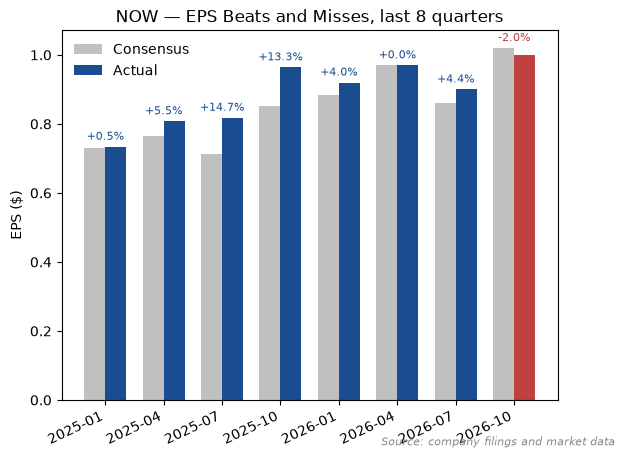
The third is debt. ServiceNow carries about $5.5B, including notes in the annual report and borrowing for Armis. Adjusted EPS of $1.00 missed the $1.02 consensus, the first miss in eight quarters, and Zacks ran the headline "ServiceNow's Debt and Interest Costs Jump."
The assumption most likely to be wrong is my 18.5% growth rate held for two years. If organic growth is really nearer 17% and slipping, the street is a few percent too high. My answer is the price, because the bear needs growth below 15% to make today's multiple fair, and neither the renewal rate nor the large-customer count points that way.
What I Am Watching
The test is the fourth-quarter report, listed for 27 January 2027, though ServiceNow has not confirmed the date. If cRPO growth comes in below the 18.5% guide, the pull-forward explanation fails and my case is wrong.
I will also read the first 2027 subscription guide against the roughly 18% growth consensus implies, and check whether AI contract value clears $1.7B. Armis anniversaries in April 2027, and from then growth is fully organic.
Takeaway
ServiceNow beat on subscription revenue and margin, raised its AI target and its cash flow guide, and still lost a third of its value over one guided number. Management attributed most of that number to timing and accounting, and the 2028 consensus already assumes slower growth than the backlog shows. My model agrees with that consensus and finds the stock at 17.9 times 2028 consensus earnings, while even its trailing multiple sits at the bottom of its profitable history. If January's cRPO clears 18.5%, I expect the multiple to recover before the forecasts have to rise.
Sources
- ServiceNow Q3 FY2026 earnings release (Form 8-K, Exhibit 99.1), 28 October 2026
- ServiceNow Q3 FY2026 earnings call, 28 October 2026 (Bill McDermott, Gina Mastantuono, Amit Zavery; analysts Alex Zukin of Wolfe Research, Sanjit Singh of Morgan Stanley, Arjun Bhatia of William Blair)
- ServiceNow Form 10-K for fiscal 2025, Items 1, 1A and 7, filed 29 January 2026
- ServiceNow Form 10-Q for Q1 FY2026; Form 8-K on the stock split, 5 December 2025
- ServiceNow Financial Analyst Day, 4 May 2026, as reported by MarketBeat
- Bloomberg headline, 28 October 2026
- Benzinga and EBC on the 29 October 2026 session; MarketBeat and CNN on 30 October 2026
- 24/7 Wall St. on Salesforce and Workday, 29 October 2026
- TradingView, GuruFocus and Yahoo Finance on cRPO consensus and Citi's target basis, 29 October 2026
- MarketBeat and Investing.com on price-target changes, 29–30 October 2026
- Zacks, "ServiceNow's Debt and Interest Costs Jump," 29 October 2026
- Bank of America reinitiation, as reported by Yahoo Finance and GuruFocus
- Stocktwits on the Decagon denial and acquisition total, 13 October 2026
- Gartner IT spending forecast, 21 October 2026
- IDC ITSM share and ServiceNow's rebuttal to Salesforce, via The Register, 11 April 2026
- Salesforce investor relations on Agentforce IT Service, February 2026
- Nextgov on the GSA OneGov agreement, 3 September 2025
- IT Brief on the Armis acquisition, April 2026
- Company filings, reported results, analyst consensus and market price data
- Full working, including the four growth paths, the anchors and the valuation bridge:
research/2026-10-31_NOW.md
Research, not a recommendation. Figures are sourced as cited and were current at publication; nothing here is personalized investment advice.