Pentair's CEO Says 80/20 Was 'Probably Misused.' The Repair Is Already in the Numbers
October 31, 2026 · Pentair plc (PNR)
profitmonk
Summary
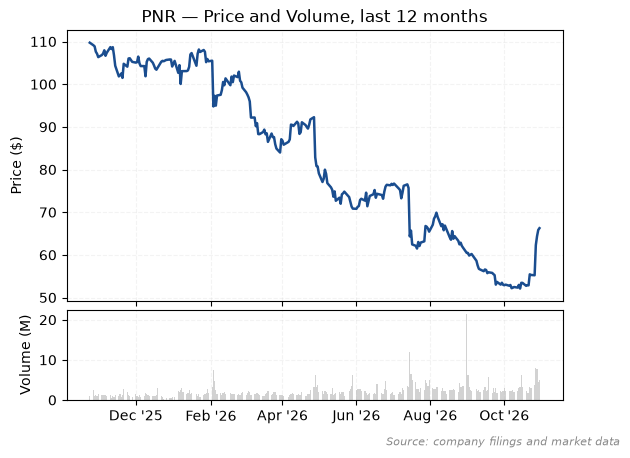
- Pentair said on 27 October that its pool destock is finished. Distributors cut about $280M of its equipment from their shelves over two quarters. The stock rose 19.8% that week.
- Pool is 37% of Pentair's sales and about 46% of its segment profit. That is why a pool inventory glut left the stock 40% below its 52-week high.
- My 2027 build lands on consensus: $5.18 to $5.26 of adjusted earnings a share, against an analyst mean of $5.30. It uses only items management has already sized and assumes no growth at all in Flow or Water Solutions.
- At $66.27 the stock trades at 12.5 times 2027 consensus adjusted earnings. That is cheap if the pool recovery holds. On trailing reported earnings, the only basis that compares cleanly with peers, it sits 16% below the peer average.
- The risk is lost share. Pentair's pool sell-through grew 2% to 3% in 2026 while Hayward's North American sales rose 9% in the third quarter. The 2 February results will show whether dealers are coming back.
The Day Pentair Said the Glut Was Over
Pentair went into its third-quarter call on 27 October with the stock near its 52-week low of $51.13 and its third chief financial officer of the year about to start. Chief executive John Stauch opened with the line the market had waited two quarters to hear. "We estimate full year sell through in 2026 will be $1.45 billion," he said, adding that "our growth expectations for next year do not anticipate market recovery."
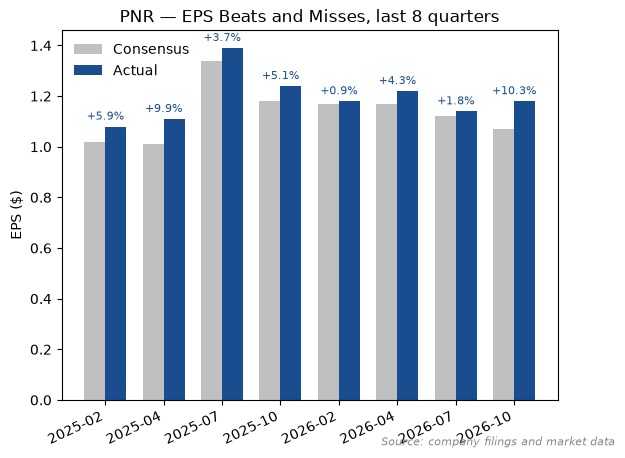
Interim CFO Robert Fishman said the channel destock "has now been completed," and the quarter backed him up. Adjusted earnings of $1.18 a share beat guidance of $1.05 to $1.08. Guidance, consensus and Pentair's beat history are all on an adjusted basis, so I use that basis throughout.
24/7 Wall St. called it the stock's best session since March 2020. By the close on 30 October the shares were at $66.27, up 19.8% in five trading days, and still about 40% below their 52-week high.
The beat was smaller than it looks. Adjusted operating income included about $8M of tariff refunds, which at Pentair's adjusted tax rate accounts for roughly $0.04 of the $0.11 by which it beat consensus. Brokers moved anyway. Citi raised its target to $74 and kept a Buy, RBC went to $69, and BNP Paribas Exane's Andrew Buscaglia upgraded to Neutral with a $65 target.
A Balloon Company That Became a Water Company
Pentair makes the equipment that moves and cleans water. On a backyard pool pad that means the pump, filter, heater and automation. Beyond pools it sells softeners and filters for homes and restaurants, ice machines, and the industrial pumps behind municipal and food plants. The company describes itself as "an S&P 500 company focused on smart, sustainable water solutions."
The business began in Minnesota in 1966. Its own history says the five founders started out building high-altitude research balloons, and the name joins "penta" and "air." Acquisitions turned it into a water company, including the 2012 merger with Tyco Flow Control, and in 2018 it spun off its electrical business as nVent.
Today Pentair is an Irish plc, tax-resident in the UK and run from Golden Valley, Minnesota. It employs about 9,000 people and has raised its dividend for 50 consecutive years.
Almost everything it sells goes through distribution, and one distributor matters far more than the rest. The annual report says a single unnamed pool customer took about 18% of consolidated sales in 2025, which is close to half of the pool segment.
Three Segments, and Pool Earns Almost Half the Profit
The third quarter shows two segments doing well while the third absorbed the destock. The figures use the 2026 structure, which moved residential and irrigation pumps from Flow into Water Solutions.
| Segment | Q3 2026 sales | Change | Q3 2026 segment income | Change | Return on sales |
|---|---|---|---|---|---|
| Flow | $263M | +4% | $69M | +15% | 26.2% (+250bp) |
| Water Solutions | $422M | +1% | $121M | +16% | 28.7% (+370bp) |
| Pool | $292M | −18% | $72M | −38% | 24.6% (−820bp) |
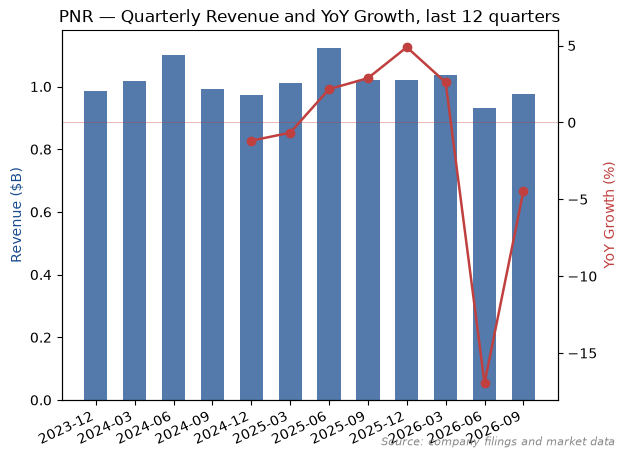
| Total (adjusted operating income) | $976M | −4% | $242M | −8% | 24.8% (−90bp) |
Flow sells pumps for fire suppression, water supply and flood control, along with industrial filtration and the Hydra-Stop valve business it bought in 2025. Management credited Hydra-Stop and "double digit" growth outside food and beverage, where brewers held back spending.
Water Solutions sells commercial filtration under Everpure and Pentek, Manitowoc ice machines, and residential softeners under Fleck and RainSoft. Commercial sales grew on large strategic accounts and convenience stores while residential fell with housing. Management credited "disciplined pricing and productivity" for the margin gain, although $6M of the quarter's tariff refund landed in this segment.
Pool sells pumps, filters, heaters, lights, automation and cleaners under the Pentair, Sta-Rite and Kreepy Krauly names. Its sales fell because about $90M of the final destock still ran through the quarter, and volume deleverage, inflation and growth spending cut more than eight points off its return on sales.
In 2025 Pool earned $527M of segment income at a 33.8% return on sales, about 46% of the three segments combined. A pool inventory problem moved the whole stock because pool carries that much of the profit.
How a Pool Equipment Maker Is Measured
Pool equipment is mostly a replacement business, and that decides which numbers matter. Pool Corp's 2025 annual report puts about 64% of US pool spending on maintenance. There are about 5.5 million in-ground pools in the US, against just under 60,000 new builds in 2025.
The first number to watch is sell-through against sell-in. Sell-in is what Pentair ships to distributors, and sell-through is what they sell on to builders and service dealers. When distributors run their stock down, sell-in falls below sell-through, and that gap was Pentair's whole problem in 2026. Backlog is a weak guide here because at year-end 2025 it covered only about seven weeks of sales. Channel inventory is the better tool, and Pentair now discloses it.
The second is pool return on sales. It was about 34% in 2025 and fell to 27.8% over the first nine months of 2026, and management's 2027 framework assumes about 30%. When RBC's Deane Dray asked whether 30% is the long-term floor, Stauch said "having a healthy 3 in front of it is the right answer."
The third is share against Hayward, Pentair's most direct rival. Hayward's North American sales rose 9% in its third quarter, while Pentair's own sell-through grew "mid single digit."
The fourth is leverage. The Taco acquisition takes net debt to about 2.5 times earnings before interest, tax, depreciation and amortisation (EBITDA). Pentair is targeting 1.5 to 2 times "over the next 24 months."
What Changed: An Efficiency Drive That Cost Customers
In 2025 and 2026 Pentair hurt itself in ways its competitors avoided. In 2025 it adopted 80/20, a method that focuses a company on the 20% of customers and products that earn most of its profit. The annual report warned that "our revenues could be reduced by exiting certain customers and products," and in pool that is what happened.
Stauch was unusually direct about it on the call. "80/20 is a very good tool… I am being honest in this case. It was probably misused." He went further: "You do not fire customers ever. Customers choose to be with you or leave you."
The guidance path shows the damage.
| Date | 2026 adjusted EPS guidance |
|---|---|
| February | $5.25 to $5.40 |
| 14 July pre-announcement | $4.60 to $4.80 |
| 27 October | about $4.70 |
The July cut came after about $170M of pool destock hit the second quarter, and the stock fell 15% the next day. A week before that, Wolfe Research's Nigel Coe had downgraded the shares, blaming pool share losses partly on aggressive 80/20 initiatives.
The annual report's discussion of business conditions covers inflation, tariffs and the global minimum tax, and it never mentions housing. Housing is weak all the same: September single-family starts fell 4.6% on the month, and the 30-year mortgage rate sits near 7%.
The Demand Story: $1.45 Billion of Sell-Through and Dealers to Win Back
The most useful thing in the third-quarter release is that the pool numbers reconcile. Management puts 2026 sell-through at about $1.45B, and nine months of reported pool sales plus the fourth-quarter guide imply sell-in of about $1.27B. The gap of about $184M matches a separate estimate from incoming CFO Robert Hau, who expects year-end channel inventory to be about $180M below a year earlier.
Hau, who was Fiserv's CFO from 2016 to 2025 and formally takes over on 1 November, sized the destock on the call at "roughly $280 million of destock over Q2 and Q3."
For 2027 Stauch framed sell-through as flat at about $1.45 billion, "with more modest price increases offsetting anticipated continued soft market conditions." With sell-in matching sell-through, pool sales would grow about 14%. Pentair has already sent dealers 2027 price increases of 3% to 4%, so flat sell-through dollars means the framework already assumes unit volume falls by about the same amount.
The open question is the dealers. Pentair asked some independent dealers to buy through distribution instead of directly, and Stauch admitted that "some of them are smarting on our desire to ask them to go to distribution and their choice not to. They might be a little bit longer coming back." Josh Cowley, who previously worked at Latham Group and Stanley Black & Decker, starts as chief executive of Pentair Pool on 9 November.
Taco is the other demand line. Pentair closed the $1.425B purchase of the Cranston, Rhode Island hydronics maker on 1 October. Taco makes the pumps, valves and controls that circulate hot and chilled water through buildings, and Stauch expects it to do more than $620M of sales and more than $105M of EBITDA in 2027.
The deal also produced the week's other headline. 24/7 Wall St. called Pentair "Suddenly an AI Stock," then argued against its own title. A summary of Pentair's July Taco deck reportedly put data centres at about 15% of Taco's commercial and industrial sales, and Taco will be only about 13% of 2027 revenue. The story that moves this stock is pool.
Flow and Water Solutions supply steadier demand. Stauch said commercial water "continues to grow mid single digits," and that Flow is seeing "pretty good infrastructure wins… pretty good municipal wins… really building backlog as we head into 2027." He does not expect food and beverage to recover much next year.
The Constraint Is Dealer Loyalty, and It Rebuilds One Season at a Time
Pentair has no factory bottleneck. The annual report says raw materials "are available from multiple sources," and nothing in the 10-K, the 10-Q or the call describes a shortage of capacity or labour. Revenue is limited by how much stock distributors hold and by which brand a dealer chooses to install.
Stauch described share loss in exactly those terms, pad by pad. In some cases, he said, "a onesie and twosie product on an existing pad" has migrated "to a more competitive offering or a dealer who has switched alliances."
Winning those dealers back takes time because buying is seasonal. Pool sales peak from April to August, and winter early-buy programmes lock in dealer orders with discounts and extended payment terms. The 2027 early-buy season is the first real test.
Stauch summarised the plan as "outsell, out-support, deliver quality, product excellence." In practice that means more inside-sales staff and more service and technical support across seven regions. His example was regional: a variable-speed pump pays back differently in Arizona than in the Northeast, and Florida runs on heat pumps because much of it has no natural gas.
Cost is the other constraint. The 10-K names tariffs on steel, aluminium and copper and on goods from Mexico, China and the EU. Fishman said price offset inflation in the third quarter, and Hau called the 2027 increases "more moderate versus last year."
What It Is Worth: Consensus Is Built From Items Management Has Already Sized
I built 2027 from the bottom up, using only numbers Pentair has given, to see how much of consensus depends on hope. Very little does. The full arithmetic is in the research brief that publishes with this article.
| Step | 2027 adjusted operating income |
|---|---|
| 2026 base, from guidance of about −6% | about $991M |
| Pool sell-in returns to $1.45B at a 30% return on sales | +$94M |
| Taco's first full year (EBITDA, so an upper bound) | +$83M |
| 2026 tariff refunds do not repeat | −$43M |
| Flow and Water Solutions core | held flat |
| 2027 floor | about $1,125M |
Interest rises because Taco was paid for with $1.4B of term loans at about 5.25%. Hau said Pentair will prioritise paying down debt. If all the free cash flow left after dividends goes to that, interest is lower, so I show both cases. The tax rate is the one implied by Pentair's adjusted third quarter.
| From operating income to EPS | With debt paydown | Without paydown |
|---|---|---|
| 2027 interest | about $145M | about $160M |
| Adjusted tax rate | 14% | 14% |
| Diluted shares | 160.3M | 160.3M |
| 2027 adjusted EPS | $5.26 | $5.18 |
That gives a floor of $5.18 to $5.26, against an analyst mean of $5.30 and Zacks Research's $5.12. In other words, the model agrees with consensus.
What makes the exercise useful is what it leaves out. The floor holds Flow and Water Solutions flat for a whole year. Closing the gap to $5.30 takes about 1% to 3% growth in their combined segment income, and those two segments grew segment income almost 16% in the third quarter. That does not let me claim a 2027 beat. What it does show is that 2027 consensus rests on announced items, so the real debate is about the multiple and about 2028.
For 2028 consensus is $5.73. A second year of debt repayment adds about $0.24 a share, and the rest needs roughly 2.5% growth on the 2027 profit base, which also looks reachable.
There is a bigger gap I will flag but not lean on. Quartr's summary of the March 2026 Investor Day says Pentair targeted low-double-digit earnings growth through 2028. Applied to the 2025 base, that path would put 2028 earnings about 14% to 21% above today's consensus. I could not check that framework against Pentair's own slides, and my model assumes none of it comes back.
The floor rests on four assumptions, and pool margin is the one that swings it most.
| Assumption | EPS effect |
|---|---|
| Pool return on sales of 30% | about $0.08 a share per point |
| Pool sell-through flat at $1.45B | about $0.12 for every 5% drop |
| Taco depreciation (undisclosed) | about $0.05 per $10M |
| Flow and Water Solutions margins hold without refunds | Stauch says they did |
What the Market Is Paying: 12.5 Times Next Year
My valuation basis is forward adjusted earnings. On that basis Pentair trades at 12.5 times 2027 consensus and 11.6 times 2028. Those are low multiples for a business that earned a 25% adjusted return on sales in 2025.
Comparing with peers takes a different basis, because the peer figures are on trailing reported earnings. On that basis Pentair trades at a 16% discount to the average of eight water and flow peers.
| Trailing reported P/E | Multiple |
|---|---|
| Pentair | 17.5x |
| Hayward (direct pool rival) | 20.4x |
| A. O. Smith (residential water) | 17.6x |
| Xylem | 20.4x |
| Eight-peer average | 23.8x |
On the same trailing basis, Pentair sits in the 30th percentile of its last ten profitable years, in a range that runs from 13 to 27 times.
I think the stock is cheap on my own numbers. At 12.5 times next year's earnings, the market is pricing a pool recovery that either fails or fades. In September Morningstar put fair value at $91 and listed Pentair among its best ideas, though I have not confirmed whether that figure has changed since.
The market's caution has a visible cause. The average analyst target is $66.89, almost exactly the share price. The share of analysts rating the stock a buy fell from 59% in July to 47% in October, though that count predates the post-results upgrades.
Why Hayward Is Winning Pads, and Why Pentair Can Win Them Back
The honest version of the competitive story starts with Hayward. Stifel's Andrew Carter estimates it holds about 30% of North American residential pool equipment. On 28 October Hayward raised its full-year guidance and credited dealer conversion. Every major peer grew faster than Pentair's sell-through.
| Company | Growth | Period |
|---|---|---|
| Hayward, North America | +9% | Q3 |
| Pool Corp | +4% | Q3 |
| Fluidra, North America | about +3.5% | nine months |
| Pentair pool sell-through | +2% to 3% | 2026 estimate |
In July KeyBanc called Pentair's destock somewhat isolated, and these numbers bear that out, because only Pentair's channel was cutting stock. Fluidra, which owns Jandy and Polaris, reports a group adjusted EBITDA margin of 24.1%. The two measures are calculated differently, but Pentair's 33.8% pool return on sales in 2025 still points to stronger pricing.
Pool Corp, the largest US pool distributor, told investors its October sales to date were up only about 2%. A soft distributor hurts every supplier, which is also why Pentair's 2027 framework assumes no market recovery.
Pentair's advantage is its installed base. "We have the most amount of existing pool pads… in the country… just because of our strong positioning from decades," Stauch said. A pad replaced like for like stays Pentair, so the job is to stop dealers switching brands at replacement. The retreat from 80/20, the new pool chief and the support build-out all aim at that.
In water treatment and flow, Pentair competes with A. O. Smith and Xylem, and both trade above it on trailing earnings. Its own Flow and Water Solutions segments widened margins by 250 and 370 basis points in the third quarter, which is not what a business losing ground looks like.
What Could Go Wrong: Pentair Wrote the Warning Itself
Pentair's own risk factors described 2026 better than most outside critics did. The second risk in the 10-K warns about margin pressure from "customer inventory levels and shifts in distribution channels." The fifth warns that 80/20 could mean "exiting certain customers and products." Both were filed in February, before either happened.
Customer concentration is the thirteenth. Because one pool customer took 18% of 2025 sales, one distributor's inventory policy can swing a quarter, and that is roughly what happened when about $280M of sales disappeared to destocking in two quarters.
Leverage and goodwill come next. Goodwill and intangibles made up about 67% of total assets even before Taco, and leverage rises to about 2.5 times just as housing stalls. On my numbers Pentair paid about 15.8 times Taco's 2026 EBITDA, before synergies and tax benefits.
The risks Pentair does not list are about trust. Guidance was cut in July, the company has had three CFOs this year, and a securities class action, Walters v. Pentair plc, was filed in New York in August. Stauch also called the 2027 pool figure a framework: "we do not yet have the market dialed in for 2027."
The strongest case against the stock is that share loss has not stopped. Pentair's sell-through grew 2% to 3% this year while every major peer grew faster, so flat sell-through in a growing market in 2027 would itself mean more lost share. If sell-through falls 5% instead, my floor drops by about $0.12.
My answer is that the framework already assumes falling volume, and at 12.5 times 2027 consensus the price already assumes worse. A $0.12 shortfall would barely move that multiple. The assumption most likely to be wrong is the 30% pool margin, because it depends on winning dealers back while paying for growth investment, and third-quarter pool return on sales was 24.6%.
What I Am Watching
The test comes on 2 February 2027, when Pentair reports the fourth quarter and gives 2027 guidance. If the pool guide falls short of $1.45B, or year-end channel inventory is not about $180M lower, my bull case is wrong. I will also look for Taco's segment income and depreciation, and for an EPS range that excludes tariff refunds and how it compares with consensus.
Takeaway
Pentair spent 2026 paying for an efficiency programme its chief executive now says was misused. The destock that followed is over. The 2027 earnings the market expects come almost entirely from pool recovery and Taco, and management has already sized both. At 12.5 times those earnings, the stock is priced as if the repair might fail. The early-buy season and the 2 February guide will show whether dealers are coming back, and I think the price leaves room for them to be slow.
Sources
- Pentair Q3 2026 earnings release (Form 8-K, Exhibit 99.1), 27 October 2026
- Pentair Q3 2026 earnings call, 27 October 2026 (John Stauch, Robert Fishman, Robert Hau; analysts Deane Dray of RBC and Bryan Blair of Oppenheimer)
- Pentair Form 10-Q for the quarter ended 30 September 2026
- Pentair Form 10-K for fiscal 2025, Items 1, 1A and 7, filed 24 February 2026
- Pentair Q4 2025 earnings release, 3 February 2026
- Pentair pre-announcement 8-K, 14 July 2026; Taco financing 8-K, 2 September 2026; CFO appointment 8-K, 22 September 2026
- Pentair, "Acquisition of Taco" presentation, 28 July 2026
- Pentair release on Josh Cowley's appointment, 19 October 2026
- Hayward Q3 fiscal 2026 results, 28 October 2026; Pool Corp Q3 2026 results and call, 22 October 2026; Fluidra nine-month 2026 results, 29 October 2026
- Pool Corp Form 10-K for fiscal 2025
- 24/7 Wall St., "This Pool Pump Company Is Suddenly an AI Stock," 28 October 2026
- Investing.com and Benzinga on BNP Paribas Exane, 28 October 2026; GuruFocus on RBC, 28 October 2026; Yahoo Finance on Citi, 28 October 2026
- Investing.com on Wolfe Research, 9 July 2026, and on KeyBanc and Stifel, July 2026
- MarketBeat on Zacks Research estimates, 27 October 2026
- Quartr summary of Pentair's Investor Day, 4 March 2026
- Morningstar on Pentair, September 2026
- US Census Bureau and HUD new residential construction, 20 October 2026
- Company filings, reported results, analyst consensus and market price data
- Full working, including the 2027 floor build, the anchor and the 2028 walk:
research/2026-10-31_PNR.md
Research, not a recommendation. Figures are sourced as cited and were current at publication; nothing here is personalized investment advice.