Twilio Raised Its 2027 Floor, Then Lost 22% of Its Value in Five Days
October 31, 2026 · Twilio Inc. (TWLO)
profitmonk
Summary
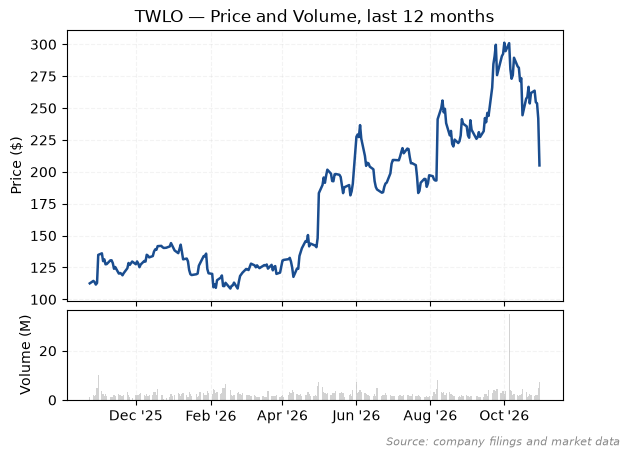
- Twilio beat on revenue and earnings on 29 October and raised its 2027 floor to at least 10% organic growth, yet the stock fell 21.7% in five trading days.
- The selling was about one product. Messaging is about 60% of revenue, and its organic growth slipped from 18% to 17%.
- The 2027 floor only breaks if Messaging roughly halves its growth rate, on my assumption that the rest of the business keeps growing at 12% to 15%.
- My model lands on consensus: $7.36B to $7.90B of 2028 revenue against a $7.48B average, and $7.30 to $8.00 a share of non-GAAP earnings against $7.73.
- The case is the price. At $205.03 the stock trades at 23 times management's 2027 free cash flow floor. That is fair to modestly cheap on headline cash, and full once stock pay is deducted.
A Record Quarter, a Softer Guide and a 15% Drop
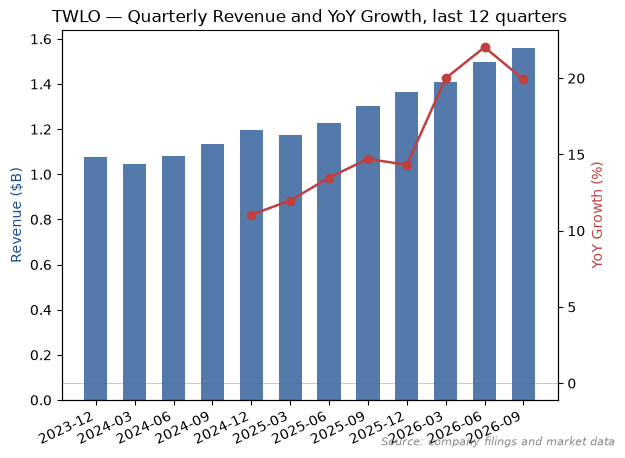
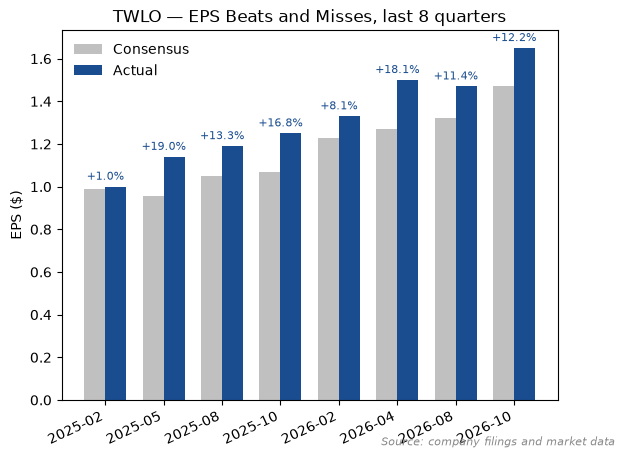
Twilio's third quarter was the best in its history, and it still wasn't enough. After the close on 29 October, chief financial officer Aidan Viggiano reported record revenue and record free cash flow. Revenue grew 16% organically, a measure that strips out acquisitions and the extra fees US carriers now charge, which Twilio passes straight through to customers. Non-GAAP earnings of $1.65 a share beat the $1.47 analysts expected.
The fourth-quarter guide is what the market sold. Organic growth is set to fall by about a third from the quarter just reported, and both operating income and earnings are guided below what Twilio had just delivered:
| Q3 2026 actual | Q4 2026 guide | |
|---|---|---|
| Organic revenue growth | 16% | 11% to 12% |
| Non-GAAP operating income | $325.7M | $300M to $310M |
| Non-GAAP EPS | $1.65 | $1.48 to $1.53 (consensus $1.54) |
Investing.com's headline read "Twilio tumbles 15% as fourth quarter growth outlook disappoints."
Morgan Stanley's Elizabeth Porter opened the questions by asking why the beat had shrunk. Viggiano said "we didn't and still don't expect 5%-plus beats that we saw in both the first and second quarter to kind of be the new normal." The smaller beat "was primarily driven by Messaging," he said, which "is our biggest product at about 60% of our revenue." Its organic growth had eased from 18% in the second quarter to 17% in the third.
Investors sold harder than the analysts did. The shares closed at $205.03 on 30 October, down 21.7% over five sessions while the S&P 500 barely moved. MarketBeat's tally shows Needham, UBS and Stifel all cutting targets, with Needham going furthest, to $240. No rating downgrade was confirmed among the brokers that cut or reiterated targets.
The headlines skipped the rest of the call. Management raised its 2027 floor to at least 10% organic growth, "well above our 2025 Investor Day framework of 7% to 8%," and set floors of $1.35B for both non-GAAP operating income and free cash flow. My argument is that the market sold a one-quarter guide on the same evening the multi-year numbers went up.
A San Francisco Company That Rents Out the Plumbing for Texts and Calls
Twilio sells the plumbing that lets software send a text, place a phone call or deliver an email. A developer writes a few lines of code against Twilio's APIs, the hooks one program uses to call another, and pays per message or per minute. The traffic then runs across what Twilio calls the Super Network, a software layer that, in the annual report's words, "interconnects communications networks and inbox services providers around the world."
The company is based at 101 Spear Street in San Francisco and was incorporated in Delaware in March 2008. CNBC named Jeff Lawson, Evan Cooke and John Wolthuis as its founders. Lawson ran it until January 2024, when Khozema Shipchandler took over as chief executive.
No single customer can sink it. The 2025 annual report counts more than 402,000 active customer accounts, and the ten largest made up only 9% of revenue.
Its products are Messaging, Voice, SendGrid email, the Verify authentication service and Segment, a customer-data platform. Revenue in 2025 rose 14% to $5.07B, and at $205.03 a share Twilio is worth about $31.5B.
One Reportable Segment, and Six Dollars in Every Ten Come From Messaging
Twilio has reported a single segment since Q3 2025, after it realigned into a functional support model at the start of 2025, so there is no divisional revenue or profit to compare. What management does give on the call is growth by product and by sales channel, and that split is what investors are trading.
| Q3 2026 line | Growth | Management's explanation |
|---|---|---|
| Messaging (about 60% of revenue) | +24% reported, +17% organic | carrier fees added about 7 points |
| Voice | 20%+ | "balance of volume growth and software add-ons" |
| Software add-ons | 25%+ | Branded Calling and Conversation Intelligence growing triple digits |
| below company average | not given | |
| Self-serve channel (about 15% of revenue) | 30%+ | self-serve Voice up about 55% |
| ISV channel | 20%+ | lapping a strong Q3 2025 |
| Company | +20% reported, +16% organic |
Messaging covers SMS, MMS, RCS (the richer successor to the plain text) and WhatsApp. Its reported growth flatters it, because carrier fees added about seven points. Viggiano blamed the slowdown on ISVs, the independent software vendors that build on Twilio and resell it, which were "lapping tougher comparisons back in the third quarter of '25."
Voice is where the AI story shows up first. Management credited its 20%-plus growth to volume and to add-ons, the features sold on top of a call or message, such as a verified caller name or live transcription. Email grew "a little bit lower than our kind of company average," and Segment's growth was not disclosed. Self-serve customers, who sign up online without a salesperson, are the fastest-growing channel in the table.
For 2025 as a whole, the annual report credited growth mainly to "increased usage of our products by our existing customers." The non-GAAP operating margin widened to 18% from 16%.
Twilio Looks Like Software but Is Measured on Gross Profit Dollars
Anyone who knows subscription software has to reset some expectations here. About 74% of Twilio's 2025 revenue was usage-based, and its biggest cost is the fee each carrier charges to deliver a message. That holds gross margin near 50%, far below a typical software company, and Viggiano said plainly that Messaging "carries low gross profit for every dollar of revenue."
So management steers by gross profit dollars. "The thing that we focus on day-to-day is predominantly gross profit growth," Shipchandler told analysts. Non-GAAP gross profit grew 18% in the third quarter, the third straight quarter above 15%.
The second number to watch is dollar-based net expansion, or DBNE, which measures how much more last year's customers spend this year. It has risen every year since 2023 and reached 114% in the third quarter. Carrier fees supplied about four points of that, so the underlying rate is nearer 110%.
Gross margin also has to be read through the fees. The non-GAAP figure fell 90 basis points on the year, but Viggiano said it would have risen 80 basis points without the incremental carrier fees. Fees pass through at cost, so they swell revenue without adding a dollar of gross profit.
Cash is the fourth measure, and it is improving fastest. Free cash flow reached 24% of revenue in the third quarter, up from 19% in 2025. Add 16% organic growth and Twilio scores exactly 40 on the Rule of 40, the software shorthand that sums growth and cash margin.
Three Years From an Activist Target to $1.35 Billion of Cash
Twilio is worth writing about because its finances have turned around. In 2023 it lost $1.0B. Legion Partners and then Anson Funds pushed for board changes and a sale, with CNBC reporting Anson's campaign in November 2023, and Lawson stepped down on 8 January 2024.
The Twilio of 2026 makes money and dilutes less. It earned $33.8M of GAAP net income in 2025, and stock-based compensation fell to $600.4M from $675.9M in 2023. It has been buying back shares, with about $700M left on its authorisation. It has also beaten the 7% to 8% growth framework from its 2025 Investor Day every year.
Management names two outside forces. The first is the economy, because usage revenue "is also more immediately impacted by changes in consumer spending and macroeconomic conditions than our subscription-based revenue." The second is the carriers: one major US carrier raised its fees on business texts in June 2025, and the others followed in January and April 2026.
Voice AI Is Being Built on Twilio's Rails
This quarter's demand story belongs to voice agents, software that answers and places phone calls for a company. Twilio signed its first eight-figure Conversations deal, with an unnamed health insurer whose voice agent is "powered by Conversation Relay and Conversation Intelligence's real-time transcription." ConversationRelay connects a phone call to whichever AI model the customer chooses.
Named seven-figure deals stack up behind it. Ushur, which sells AI customer service to healthcare and insurance, expanded across Voice, Messaging and WhatsApp, and says its health-plan customers "achieved 3x higher Medicaid re-enrollment completion rates compared with human led outreach." Gong signed for voice and add-ons. Chapter is moving its contact centre onto Flex, Twilio's contact-centre software, with "a fully live deployment in a matter of weeks."
Eltropy, which serves credit unions, says its voice agents "resolve up to 70% of routine member calls on their own." These outcomes are customer claims relayed by management, and I found no independent source to confirm them.
Viggiano's best example shows how a small account grows. A conversational-AI company that "in Q1 of '25" was "generating kind of low 6 figures quarterly spend" is now at "over $6 million annual run rate, growing like 65% with us." Since then its quarterly connectivity spend has tripled, and its software add-ons went from essentially nothing to nearly $0.5M in the latest quarter.
Shipchandler's case is that this has barely started. He put voice AI at "about 1% of what the voice interactions are so far," and said financial services, healthcare and insurance are "still experimenting." His pitch is neutrality: "virtually every player in the space who are predominantly participating at the application layer, they are running off of Twilio's rails." Chief operating officer Thomas Wyatt called self-serve voice growth of "over 50%" "a good leading indicator of the adoption of the channel itself."
Published market forecasts are no help. Grand View Research puts the communications-platform market at $86.26B by 2030 and Knowledge Sourcing Intelligence at $34.49B, so I built the model on Twilio's own numbers.
The Limit Is Carrier Fees and Slow Buyers
Twilio has no factory and no capacity shortage, because it buys delivery from carriers and hosting from Amazon Web Services. The annual report says AWS carries "a substantial majority of our cloud infrastructure." What limits Twilio is what those suppliers charge and how fast large customers buy.
Carrier fees are the main constraint, and they hit the margin rate. They will put about $245M of revenue into 2026 that carries no gross profit, which cuts the non-GAAP gross margin by about two points. Viggiano said the fees have "no impact on our gross profit, income from operations or free cash flow dollars." But Twilio cannot set them, and the annual report warns that "such fees may increase further over time."
Hosting is the second limit. Viggiano said fourth-quarter gross profit will only keep pace with organic revenue, citing "higher hosting costs for the holiday shopping season" and "our e-mail cloud migration now behind us." The margin gain from moving email to the cloud has been lapped.
The third limit is the pace of big buyers. The regulated industries with the most call volume are still in pilots, Shipchandler said, and Twilio is adding research and sales staff ahead of them, which helps explain the softer operating income guide.
What It Is Worth: Consensus Already Assumes Twilio Keeps Beating
I built the model from management's own floors, and the full arithmetic is in the research brief published alongside this article.
| Year | Basis | Revenue |
|---|---|---|
| 2026 | 20% reported growth guide | about $6.08B (about $5.84B organic, +15%) |
| 2027 floor | at least 10% growth | at least $6.69B |
| 2027 consensus | 11.3% growth | $6.77B |
The 2026 line matches the company's raised 15% organic guide. For 2027 the street already sits about 1.3 points above the floor, which fits the "2% to 4%" Viggiano gave as Twilio's normal beat against guidance.
How weak Messaging can get decides whether the floor holds. The other 40% of revenue does a lot of work: if it grows 12% to 15%, Messaging needs only about 7% to 9% for the company to reach 10%. Messaging grew 17% last quarter, so the floor breaks only if it roughly halves while the rest of the business slows too.
| 2028 case | Assumption | 2028 revenue | 2028 non-GAAP EPS |
|---|---|---|---|
| 2025 Investor Day framework | 10% in 2027, then 7% to 8% in 2028 | $7.16B to $7.22B | n/a |
| Floor held | 10% in 2027 and 2028 | $7.36B | $7.30 |
| Beat cadence | 12% to 14% in both years | $7.63B to $7.90B | $7.57 to $7.84 |
| Beat cadence plus buyback | remaining $700M retires about 2% of shares | $7.63B to $7.90B | $7.73 to $8.00 |
| Analyst consensus | $7.48B ($7.15B to $7.89B) | $7.73 |
The earnings column holds the operating margin at the roughly 20% implied by the 2027 floor, converts to net income at the ratio in the fourth-quarter guide and uses 163M shares. On those terms the 2027 floor works out to $6.63 a share, 2.6% below the $6.81 consensus.
So I agree with consensus. Its $7.73 of earnings sits inside my beat-cadence range, and its $7.48B of 2028 revenue sits just below that range's $7.63B low end. That range needs Twilio to beat its floor by about two points a year, the low end of the pattern Viggiano described. Even the 2025 Investor Day framework lands at the bottom of the analyst range. I have no bigger 2028 number than the street.
My anchors are the analyst consensus for 2028 and management's 2027 floors. I found no named broker's 2028 revenue model to test against. And 2028 is the year analysts disagree about most: their estimates span 10% of the average, against 4% to 5% for nearer years.
What the Market Is Paying: 23 Times a Cash Flow Floor
If the earnings outlook holds, the 21.7% fall has simply made those earnings cheaper. I value Twilio on free cash flow, because that is the profit line management guides to and the basis UBS cited when it cut its target for a "lower EV/FCF multiple."
| At $205.03 | Basis | Multiple |
|---|---|---|
| Market value / free cash flow | 2027 floor of $1.35B | 23.3x |
| Market value / free cash flow after stock pay | Q3 2026 annualised, about $0.86B | 36.6x |
| Non-GAAP P/E | 2027 consensus, $6.81 | 30.1x |
| Non-GAAP P/E | 2028 consensus, $7.73 | 26.5x |
| Price / sales | trailing | 5.4x |
Peers are cheaper on sales. RingCentral and Five9, which sell the contact-centre software Flex competes with, both trade at 2.3 times trailing sales. Twilio's own history offers no range, because 2025 was its only profitable year after nine years of losses.
Stock-based compensation is the honest adjustment. In 2025, free cash flow left after stock pay was $345.0M, only 36% of the headline figure. By the third quarter of 2026 that share had risen to about 58%, which is how the annualised $0.86B in the table is built.
On my numbers, the price is fair to modestly cheap on headline cash flow for a company guiding to double-digit growth, and full on cash flow after stock pay. The multiple therefore rests on two things: growth near 10%, and stock pay that keeps shrinking as a share of revenue. It fell 2.3 points in a year to 9.9%, and that is the part of the bull case the market is paying least for.
Bandwidth and Sinch Are Growing Slower on the Same Fees
Twilio's first edge is its self-serve funnel. Shipchandler said "60% plus of our enterprise customers started in self-service." A startup building a voice agent signs up online and can grow into a large account from there, which is how the conversational-AI customer grew from low six figures a quarter to a $6M run rate.
The second edge is what Twilio sells on top of each call. Add-ons grew more than 25%, and Shipchandler said a coming identity product for AI agents has "software margin like characteristics." It entered private beta this quarter, with general availability "next year."
The listed peers are growing more slowly. Bandwidth owns its own US network, yet a search excerpt of its quarterly filing shows cloud communications revenue up 12% in the third quarter, against Twilio's 16% organic. I could not check that figure against the filing itself. Its reported growth is padded by the same carrier surcharges. Sinch, the European roll-up, grew 6% organically in its second quarter.
Vonage, now owned by Ericsson, sells competing communications APIs. Amazon bundles SNS and Amazon Connect with its cloud, and Microsoft does the same with Azure Communication Services. I found no 2026 evidence of either winning a named Twilio account.
The risk worth taking seriously comes from the AI model companies. Mizuho's Siti Panigrahi told management on the call that frontier labs and agent builders "are all moving into voice." Shipchandler answered, "We're the neutral party." ElevenLabs, a leading voice-model company, is a Twilio customer, which supports that answer for now.
What Could Go Wrong, Starting With Twilio's Own List
Twilio's risk factors open with the economy. The second warns that "our quarterly and annual results of operations have fluctuated in the past and may continue to do so," which this year describes the third quarter exactly. The third is usage: "Most of our usage-based customers do not have long-term contractual financial commitments to us."
On competition, the filing concedes that "some of our competitors have lower list prices than us," and that carriers and intermediaries "at times have offerings that compete directly with our products." It also flags a specific technology threat: if "user authentication practices evolve to reduce or eliminate the use of one-time passwords, our revenue could be adversely affected." Passkeys, which log users in without a texted code, are that threat.
The risk I think matters most, the filing leaves implicit: Messaging decelerating hard. Suppose ISV churn, passkeys and price competition pushed its growth to 3% or less. Even with the rest growing 15%, total growth would fall to about 6% to 8%, and 2028 revenue would land around $6.9B to $7.1B, below the lowest analyst estimate.
The beat cadence is the second weak assumption, because consensus needs about two points a year and Viggiano has just told investors not to expect the bigger beats of early 2026. Margin is the third. With the email gain lapped, Oppenheimer's Ittai Kidron asked "why should gross profit grow in line with revenue? Why should it not grow faster?" Management gave no commitment. The third quarter also included about $11M of platform credits, which Viggiano said "creates a slightly larger optical gap in our Q4 guidance."
Then there is the legal noise. On 30 October Levi & Korsinsky announced an investigation into whether Twilio adequately disclosed Messaging trends, quoting Viggiano on the May 2025 call: "No, we're not seeing a slowdown, Mark." This is a law firm soliciting clients, and I found no filed class action as of 31 October. Barron's headline the same day read "Slowing Growth Throws 'Cold Water' on Benefits From AI."
My answer to the bear case is the arithmetic of the floor. Messaging slipped one point in a quarter, and the floor survives a fall to 7% to 9%. Viggiano also called the fourth-quarter guide "our strongest quarterly revenue guidance in several years." The bear needs Messaging to collapse, and so far the evidence shows it easing.
What I Am Watching
Sinch reports on 5 November, an early read on whether Twilio's Messaging growth is its own or the market's. The real test is Twilio's fourth-quarter report, expected around 11 February 2027. If organic Messaging growth drops into single digits, or the full 2027 guide comes in below 10% organic, this thesis is wrong. The Investor Day on 13 and 14 April 2027 should replace the 7% to 8% framework, and it is the largest scheduled re-rating event before 2028.
Takeaway
Twilio gave the market no reason to cut its 2028 numbers, and my model does not cut them either. It gave a softer quarter and a smaller beat, and the stock lost a fifth of its value. The business now trades at 23 times a cash flow floor that only breaks if its largest product halves its growth. I agree with the street on what Twilio will earn, and on headline cash flow I think the market is now paying too little for it.
Sources
- Twilio Inc., Form 8-K and Exhibit 99.1, third-quarter 2026 results, 29 October 2026.
- Twilio Inc., third-quarter 2026 earnings call, 29 October 2026 (Khozema Shipchandler, Aidan Viggiano, Thomas Wyatt; questions from Elizabeth Porter of Morgan Stanley, Ittai Kidron of Oppenheimer, Siti Panigrahi of Mizuho).
- Twilio Inc., Form 10-K for fiscal 2025, filed 24 February 2026 (Items 1, 1A and 7).
- Investing.com, "Twilio tumbles 15% as fourth quarter growth outlook disappoints," 29 October 2026.
- The Motley Fool, "Twilio Sees Slower Q4 Growth and Lower Profit," 29 October 2026.
- Barron's, "Slowing Growth Throws 'Cold Water' on Benefits From AI," 30 October 2026 (headline only).
- MarketBeat, analyst target changes for Twilio, 30 October 2026.
- PR Newswire, Levi & Korsinsky announcement of investigation into Twilio Inc., 30 October 2026.
- CNBC, coverage of Twilio's listing, 6 June 2016; Anson Funds campaign, 28 November 2023; chief executive change, 8 January 2024.
- Bandwidth Inc., Form 10-Q for the quarter ended 30 September 2026.
- Sinch AB, second-quarter 2026 report, 22 July 2026.
- Grand View Research and Knowledge Sourcing Intelligence, communications-platform market forecasts.
- Analyst consensus estimates and market price data as of 31 October 2026.
- Full working, including the model walk and every derivation: the research brief,
research/2026-10-31_TWLO.md.
Research, not a recommendation. Figures are sourced as cited and were current at publication; nothing here is personalized investment advice.