Vertiv Will Stop Reporting Its Orders. Customers Have Already Prepaid $4.1B
October 31, 2026 · Vertiv Holdings Co (VRT)
profitmonk
Summary
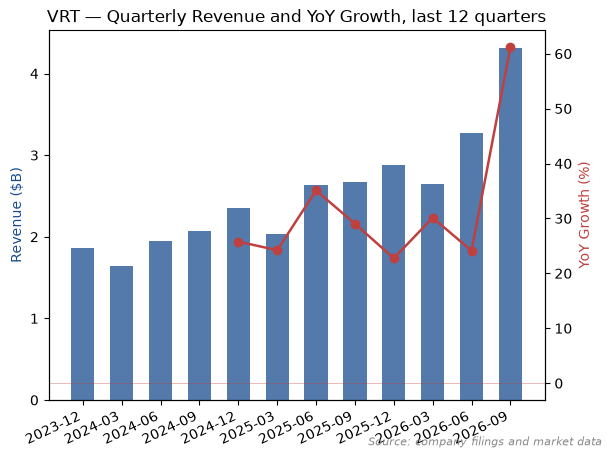
- Vertiv's third-quarter sales rose 61% and organic orders more than doubled. That ended a five-month slide that had taken the stock about 49% below its May high.
- Management will stop disclosing orders. Customer prepayments, the best signal left, have climbed 127% this year to $4.12B.
- Consensus has quarterly sales growth slowing by two thirds in 2027. My base case assumes it only halves, which puts 2028 sales at about $25.2B, 7% above the $23.52B consensus.
- On that path, and if management's 30% to 35% incremental margin holds, 2028 adjusted EPS lands at $13.59 to $14.66, which is 9% to 18% above the $12.44 consensus.
- At $232.50 the stock trades at 18.7 times 2028 consensus EPS. The main risk is that Vertiv's own long-term growth framework sits below the Street.
The Rumors of Its Demise
Vertiv reported its third quarter on 28 October, and executive chairman David Cote opened the call by paraphrasing Mark Twain: "the rumors of our demise have been greatly exaggerated." The numbers backed him up. Sales rose 61%, adjusted EPS beat consensus by 21%, and full-year guidance went up on every line.
The number that mattered came from chief executive Giordano Albertazzi. "Our Q3 orders were more than 100% up year on year. Organically," he said. Cote also delivered the other news of the morning: "we are not planning to share orders data going forward." So the quarter in which orders doubled is the last one investors will see measured that way.
The stock gained 19.6% in the five sessions to 30 October. Even so, at $232.50 it still sits 38.8% below its record high.
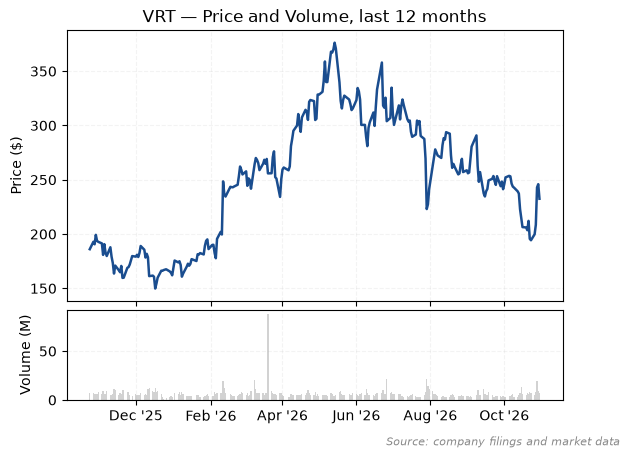
The slide started with a delivery problem. StockScan dates the record to 14 May. Then on 29 July Vertiv missed second-quarter revenue expectations, and CNBC and MarketBeat reported a one-day fall of 14% to 17%. Management blamed "supply chain congestion, multi-phased project execution," and Albertazzi called it "a temporary issue."
The market did not believe him for months. In September an acquisition with an undisclosed revenue base met scepticism. In October the stock fell for eleven straight sessions, a run Benzinga tied to a hot inflation print and a spike in CoreWeave bond yields. MarketBeat put the trough near $193, about 49% below the high.
The third quarter answers July directly. Chief financial officer Craig Chamberlin said $100M to $150M of revenue delayed from the second quarter landed in the third. July's miss came from late deliveries, and some of that delayed revenue landed in the third quarter.
The Company That Built the First Computer-Room Air Conditioner
Vertiv makes the electrical and thermal plumbing between the utility line and the server rack. Its annual report calls it "a global leader in critical digital infrastructure for applications in data centers, communication networks, and commercial and industrial environments." It is based in Westerville, Ohio.
The business goes back to Ralph Liebert, who founded it in 1946. In 1965 Liebert Corporation became, in the 10-K's words, "the industry's first manufacturer of computer room air conditioning." Emerson owned it from 1987 until it sold the unit to Platinum Equity in 2016. Vertiv then listed through a Goldman Sachs-sponsored SPAC in February 2020.
What it sells today is the whole chain, plus the people to maintain it. Products run from uninterruptible power supplies (UPS, the battery systems that bridge a power cut) and switchgear to chillers, liquid-cooling units and racks, under brands including Liebert, Geist and Avocent. About 5,000 service engineers look after what it installs. The 10-K names Microsoft, AWS, Google Cloud, Digital Realty, Equinix and CoreWeave among its customers.
Where Vertiv Earns: The Americas, and a Recovery in EMEA
Vertiv reports three regional segments, and the third quarter shows where the growth and the margin sit.
| Q3 2026 | Sales | Q3 2025 | Change | Organic | Adj. op. margin | Q3 2025 margin |
|---|---|---|---|---|---|---|
| Americas | $2.99B | $1.71B | +74.5% | +66.2% | 29.4% | 29.3% |
| Asia Pacific | $779M | $520M | +49.9% | +48.3% | 17.0% | 13.2% |
| EMEA | $545M | $444M | +22.8% | +19.3% | 28.0% | 18.8% |
| Total | $4.31B | $2.68B | +61.2% | about 55% | 25.2% | 22.3% |
The Americas is the business. It earned 69% of third-quarter sales, though Vertiv does not disclose an end-market split. Margin held flat while sales rose 75%, and Chamberlin explained why: "America's had a large ramp in capacity, which drives some inefficiency there."
Asia Pacific grew on Australia and India, and Albertazzi described "encouraging green shoots" in China. Its margin is still the lowest of the three, though it rose almost four points.
EMEA is the turnaround. In 2025 its sales rose 1.7%, less than currency alone added, and its operating profit fell 14%. The 10-K blamed "operational inefficiencies" and "increased capacity to support future global demand." This year that capacity is filling up. Margin jumped more than nine points, and Albertazzi said the EMEA pipeline "approximately doubled year on year, and organic orders grew even more."
How an Equipment Maker Like Vertiv Is Measured
Vertiv sells projects, so investors judge it on how much it wins, how fast it ships and how much of each sale it keeps. Four measures do most of the work.
The first is organic growth, which strips out acquisitions. It was 55% in the third quarter, and acquisitions added roughly another 6 points on top.
The second was orders, and that measure is now gone. The last backlog Vertiv will publish was $15.0B at the end of 2025, double the year before. The best proxy left is customer advances, which is cash paid before delivery and is booked as deferred revenue. Advances rose 127% in nine months to $4.12B, almost as much as the whole third quarter's sales.
The third is margin. Adjusted operating margin rose to 25.2% from 22.3% a year earlier. Chamberlin's rule of thumb is an incremental margin of 30% to 35%, meaning that share of each extra dollar of sales reaches operating profit.
The fourth is cash. Guidance calls for $2.6B to $2.8B of adjusted free cash flow this year, close to all of adjusted net income. Inventory is the drag. It has more than doubled as Vertiv builds for growth and holds what Chamberlin calls "resiliency" stock.
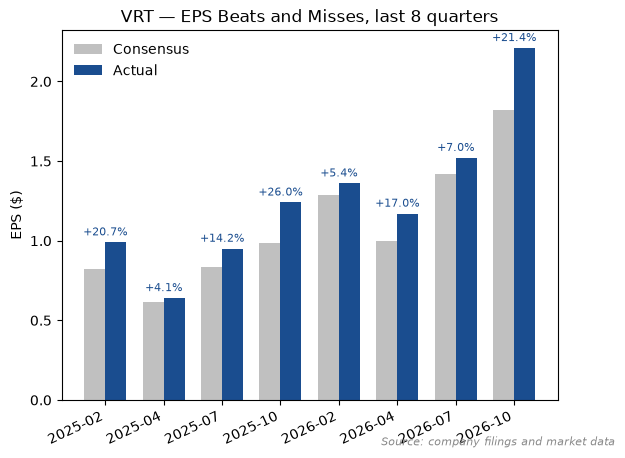
Vertiv has now beaten adjusted EPS consensus eight quarters in a row. Guidance has climbed just as steadily: the full-year adjusted EPS guide is up 19% since February, to $7.15.
What Changed: Heat Became the Limit on AI
Three years ago Vertiv was an industrial still recovering from the 2021 to 2022 supply-chain squeeze. Cote came over from Honeywell as executive chairman and brought its operating system with him. The 10-K says that since late 2021 Vertiv has "more than doubled its manufacturing capacity for switchgear, busbar and integrated power solutions."
What changed is the chip. AI accelerators pack far more power into each rack, so cooling and power delivery now set how fast a data center can open. The 10-K says "the complexity of hybrid air and liquid cooling created by AI workloads presents significant opportunities." On the call, Albertazzi said liquid is "taking a much bigger share of the … first level heat extraction," while air is "not going away."
Power is changing as well. Nvidia's 2027 Rubin Ultra systems will use 800 VDC power, which means 800 volts of direct current. Vertiv announced in October 2025 that its 800 VDC portfolio had reached "engineering readiness" and would ship in the second half of 2026. Both shifts favour a supplier that designs the power train and the cooling chain together. "The more technology changes, the better it is for us," Cote said.
Management's named headwinds are tariffs and metal costs. The 10-K admits Vertiv once "did not accurately anticipate the magnitude of inflationary cost increases and customs duties and tariffs." This year it expects price increases to outrun costs, "including the current impact of tariffs and countermeasures."
The Demand Story: Gigawatt Campuses and Prepaying Customers
The demand comes from hyperscale, colocation and neocloud builders, and Vertiv does not quantify concentration. The four largest hyperscalers' capex is the best proxy for the end market. Amazon, Alphabet, Microsoft and Meta guided to about $732.5B of combined capital spending for 2026. Even the lowest 2027 estimate in circulation is 28% higher, and in September Goldman Sachs put the figure near $1.14T.
Vertiv is growing about twice as fast as its market. Dell'Oro Group's July forecast has data-center physical infrastructure reaching $120B by 2030, growing 22% a year. That is up from a mid-teens rate in its January forecast, and Dell'Oro now says delivery, more than demand, is the industry's constraint. Vertiv is guiding to 43% sales growth this year.
Evercore analyst Amit Daryanani raised this on the call. Orders of 100% or more are "well in excess of underlying gigawatts of capacity addition," he said, which "would almost imply that Vertiv is actually picking up market share." Albertazzi answered: "we strongly believe that this growth is above the market growth."
The named projects are large, although Vertiv discloses no contract values. Albertazzi said EdgeConneX, working with Vantage Construction Europe, uses Vertiv as its "preferred end to end powertrain thermal chain and services partner" for "gigawatt scale facilities across multiple locations." He also named SGC Energy and KT Cloud's Gunsan AI data center in South Korea, and the first 41 MW phase of Polar's Herøya campus in Norway.
The pipeline is still widening. Albertazzi said Americas "pipeline sequential quarter to quarter growth is the fastest we have seen ever," and that project slippage was "nothing out of the ordinary." He called power availability, permitting and skilled site labour "pacing items. But not slowing down growth."
The prepayments are the hardest evidence. Customers do not hand over $2.3B of extra cash in nine months for equipment they expect to cancel.
The Constraint Is Vertiv's Own Factories
What limits Vertiv is how fast it can build, test and deliver whole systems on schedule. On the Q3 call Chamberlin described the factories as still building resiliency toward delivering projects "like a product level business".
The fix is capacity, and Vertiv is building it. In March it announced two South Carolina plants for integrated power modules and SmartRun prefabricated busway, which it says will raise regional capacity about sevenfold once ramped. On the call management said the Johor, Malaysia plant is "now operational" and that chiller capacity will double by year-end. Capital spending in the first nine months was $425M, against $127M a year earlier.
Execution is the hard part. Vertiv hired more than 2,500 salaried staff in 2025 and has a new head of manufacturing, Mike Risher. A ramp this fast costs margin first, which explains the flat Americas margin. The 10-K lists steel, copper, aluminium and electronic components as inputs, some from a single supplier. Management says it keeps "proactively securing and expanding long term capacity agreements with key suppliers," and it has more than doubled inventory, to $3.29B, as a buffer.
What Vertiv Can Earn: The Street Has Growth Slowing by Two Thirds
Orders and backlog are no longer published, so I built 2028 from the exit rate. The full walk is in the research brief that publishes alongside this article.
Vertiv guided to about $4.41B of fourth-quarter sales, 53% above a year earlier. That means sales grew about 11% a quarter through 2026. The question is how fast that pace fades.
| Path from Q4 2026 | Quarterly growth | 2027 sales | 2028 sales |
|---|---|---|---|
| Consensus pace | about 3.8% | $19.37B (consensus) | about $22.5B |
| 2028 consensus | $23.52B | ||
| My base case | about 5.6% | $20.3B | $25.2B |
Consensus needs a two-thirds slowdown to reach its 2027 figure. That would come in a year that opens with orders up more than 100% and a 12- to 18-month delivery cycle. My base case only halves the pace, which puts 2028 at $25.2B. That is 7% above consensus and still below the highest estimate of $27.55B.
Dell'Oro's market forecast supports the case. Vertiv's sales will be about 27% of that market this year, four points higher than in 2025. My case needs about 31% by 2028, the same gain again. Consensus already needs 29%, so the Street is assuming share gains too.
For earnings, I apply Chamberlin's 30% to 35% incremental margin to this year's $3.5B of guided adjusted operating profit. I hold the tax and interest burden and the share count at this year's levels.
| 2028 revenue | Adj. operating margin | Adj. EPS |
|---|---|---|
| $22.5B (consensus pace) | 26.1% to 27.8% | $11.95 to $12.75 |
| $23.52B (2028 consensus) | 26.3% to 28.1% | $12.56 to $13.47 |
| $25.2B (base case) | 26.5% to 28.6% | $13.59 to $14.66 |
The middle row is the surprise. At consensus revenue, management's own drop-through rule puts 2028 EPS 1% to 8% above the $12.44 consensus. So even with no revenue upside, the Street's earnings look low.
My base case adds revenue on top, for EPS 9% to 18% above consensus. I agree with the Street on demand and on margins. Where I differ is pace: I think quarterly growth halves, and consensus has it falling by two thirds.
What the Market Is Paying: 18.7 Times 2028 Consensus
My valuation call rests on one multiple: 18.7 times 2028 consensus EPS. That is fair for the consensus path and cheap for mine. The table puts every basis side by side, so each multiple is read against earnings for the same year.
| Earnings basis | Vertiv P/E at $232.50 |
|---|---|
| Trailing | 42.5x |
| 2026 guidance | 32.5x |
| 2027 consensus | 23.7x |
| 2028 consensus | 18.7x |
| 2028 base case | 15.9x to 17.1x |
Peers only line up on trailing earnings, and on that basis the premium is small. Vertiv trades at 42.5 times against 37.5 times for Eaton and 30.0 times for nVent. That is about 13% above Eaton for a company growing sales 43% this year. Enterprise value to EBITDA ranks the three the same way.
Against its own history the stock is cheap. Its trailing P/E sits at the 20th percentile of its five profitable years, which ranged from 40 to 168 times.
Analysts are more generous than the price. Their average target is $340, about 46% above today. Every target change after the print was a raise, with Bernstein going to $376.
Why Vertiv Wins, and Why Schneider and Eaton Bought Their Way In
Vertiv's edge is that it designs the power train and the cooling chain as one system and ships them prefabricated. Its OneCore and SmartRun products arrive as factory-built modules, so the site assembles blocks instead of doing custom work. Albertazzi claimed the approach "cuts deployment time by up to half." That is the company's own claim, but it is the right pitch to a customer whose constraint is time to first revenue.
Its second edge is Nvidia alignment and service depth. Vertiv publishes reference designs for Nvidia's GB300 and Rubin platforms, and it says its 800 VDC reference architecture is the "basis of design" in several large AI-factory projects. It has added liquid-cooling fluid services through PurgeRite in the US and King Environmental Services in Dublin and Frankfurt.
Schneider Electric is the strongest rival. Dell'Oro has ranked it first in data-center physical infrastructure, with Vertiv within half a point. Schneider bought 75% of Motivair to get liquid cooling, and its data-center orders more than doubled this year. Where it trails is speed. Sharecast and Utility Dive put its third-quarter organic growth at 16.9%, against Vertiv's 55%, though Schneider's figure covers the whole group.
Eaton is the electrical incumbent, and the move to 800 VDC plays to its strength. It paid $9.5B for Boyd Thermal to add cold plates and liquid loops, and its electrical backlog rose 103% in the second quarter. Both rivals had to buy their way into liquid cooling, while Vertiv's thermal business dates to 1965.
What Could Go Wrong: Vertiv's First Risk Is an AI Air Pocket
The first risk factor in Vertiv's 10-K is its dependence on data-center growth. It names "shifts in the level or focus of spending on artificial intelligence" and customers "building capacity in excess of demand." The third risk factor addresses the backlog head-on: "We may not realize all of the sales expected from our backlog of orders and contracts." Firm orders can be cut or delayed, "usually with penalties."
The 10-K also flags fixed-price contracts, including "long-term, turnkey projects." It warns that larger customers demand terms "more favorable to the customer," such as late-delivery penalties. It identifies no customer above 10% of sales and gives no figure for concentration.
I would add three more. The first is disclosure. Dropping orders data right after a quarter of 100% growth invites the reading that later comparisons will be worse. Customer advances are the substitute, and I will watch them every quarter.
The second is quality. On the call, Melius analyst Scott Davis cited "compressors that have been burning out" and "UPS systems that are overheating." Albertazzi conceded a higher early failure rate on new products: "We are not perfect. Absolutely. We are not perfect." The warranty reserve rose 32% this year to $57.2M, slower than sales, so there is no blow-out in the reserve yet.
The third is that Vertiv's own long-term target sits below the Street. TD Cowen and TIKR summaries say Vertiv framed organic growth of 20% to 22% a year from 2025 to 2030 at its May investor conference. That implies about $19.7B of 2028 sales, below both consensus and my case. The bull reading is that the framework is stale, because this year's guided organic growth has since risen from about 28% to about 38%. The bear reading is that management expects growth to fade toward the market. I lean to the first because management has beaten every guide this year, but the objection is real.
Chip architecture is a quieter risk. At CES in January, Jensen Huang said Vera Rubin runs on 45°C water without chillers. Vertiv is doubling chiller capacity anyway, betting that the change shifts the mix of equipment without shrinking it.
The assumption most likely to be wrong is mine. Strip out the second-quarter catch-up and fourth-quarter guidance is roughly flat on the third. That makes the first quarter of the new run rate look closer to the consensus pace than to mine. If quarterly growth runs at 4.5%, 2028 sales land on consensus and my edge disappears. If incremental margin falls to 24%, base-case EPS drops to about $12.30, below consensus. Either way, the downside is roughly the consensus path the stock already trades on at 18.7 times.
What I Am Watching
Vertiv reports its fourth quarter and gives 2027 guidance on 10 February 2027. A 2027 sales guide above about $20B supports my case. A guide at or below $19B would mean the consensus slowdown is right, and I would drop my case. Between now and then, customer advances need to keep rising if orders are still growing.
Takeaway
Vertiv just shipped the quarter its critics said it could not deliver, and then stopped showing investors its orders. The prepayments say customers are still committing cash: advances rose 127% in nine months. Consensus already assumes share gains, so my case only needs sales growth to halve where the Street has it falling by two thirds. If the February guide clears $20B, 2028 earnings look too low by up to 18%, at a price below 19 times consensus.
Sources
- Vertiv Q3 2026 earnings release (Form 8-K, Exhibit 99.1), 28 October 2026
- Vertiv Q3 2026 earnings call, 28 October 2026 (David Cote, Giordano Albertazzi, Craig Chamberlin; analysts Amit Daryanani of Evercore and Scott Davis of Melius)
- Vertiv Form 10-Q for the quarter ended 30 September 2026
- Vertiv Form 10-K for fiscal 2025, Items 1, 1A and 7, filed 13 February 2026
- Vertiv Forms 8-K, 24 September, 26 October and 27 October 2026 (King Environmental Services and UIG acquisitions)
- Vertiv press release on the 800 VDC portfolio, 13 October 2025
- Dell'Oro Group data-center physical infrastructure forecast, July 2026, as summarised by PR Newswire, August 2026
- CNBC and MarketBeat on the Q2 2026 results, 29 July 2026
- MarketBeat, 9 September, 22 October and 30 October 2026; KeyBanc estimate via MarketBeat, 30 July 2026
- Benzinga and Trefis on the October losing streak, 21 October 2026
- DCD on the Q3 share-price reaction, 28 October 2026
- TipRanks, Investing.com and MarketBeat on post-earnings price-target changes, 29 October 2026
- StockScan on the 14 May 2026 record price
- Sharecast and Utility Dive on Schneider Electric's Q3 2026 results, October 2026
- TD Cowen and TIKR summaries of Vertiv's 2026 Investor Conference, May 2026
- Company filings, reported results, analyst consensus and market price data
- Full working, including the exit-rate model, the anchors and the 2028 walk:
research/2026-10-31_VRT.md
Research, not a recommendation. Figures are sourced as cited and were current at publication; nothing here is personalized investment advice.