Genmab Won Three Phase 3 Trials in 23 Days. Its US Royalty Still Ends in 2029.
November 1, 2026 · Genmab A/S (GMAB)
profitmonk
Summary
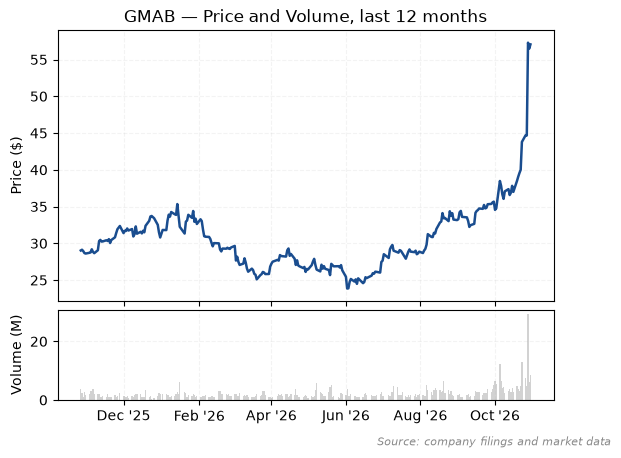
- Genmab reported phase 3 wins for all three of its late-stage drugs between 5 and 28 October, and the shares rose 65% in a month while the S&P 500 fell 1%.
- Two thirds of Genmab's revenue is a royalty on Johnson & Johnson's DARZALEX, and by contract the US part of it ends in 2029, however well the drug sells.
- My 2028 model lands on consensus. The existing business gets to about $5.6B, so the $6.92B sell-side average needs about $1.3B from two drugs that have not yet been filed.
- The bull case is 2029 and after, and it rests on an assumption of mine. Genmab's $1B petosemtamab target plus Rina-S matching ELAHERE's roughly $0.9B run-rate adds up to about $1.9B. That is roughly 94% of the US royalty it has to replace, though only in revenue, since owned drugs earn a lower margin.
- At $57.06 the ADS trades at 20.4 times 2028 consensus earnings, which I think is a fair price for that year. The test is whether Genmab puts filing dates on Rina-S and petosemtamab at its third-quarter results.
Three Trials, Twenty-Three Days
On 28 October Genmab told the market that its head and neck cancer drug had cut the risk of death in half. The trial, LiGeR-HN1, added petosemtamab to Keytruda (pembrolizumab) in patients whose cancer had come back or spread and whose tumours expressed PD-L1, the marker used to select patients for Keytruda.
An independent committee looked at the first interim analysis, an early read the trial plan allows. It found a hazard ratio for overall survival of 0.50, which means patients on the combination were dying at half the rate of those on Keytruda alone. Genmab's announcement puts typical survival in this disease at 10 to 12 months. Everett Vokes of the University of Chicago called it "the first positive Phase 3 study in this patient population in several years."
It was the third win in 23 days.
| Date | Trial | Drug and setting | Result |
|---|---|---|---|
| 5 Oct | EPCORE DLBCL-2 | EPKINLY plus chemotherapy, newly diagnosed lymphoma | 51% lower risk of progression or death |
| 23 Oct | RAINFOL-02 | Rina-S against chemotherapy, platinum-resistant ovarian cancer | 71% lower risk of progression, 57% lower risk of death |
| 28 Oct | LiGeR-HN1 | Petosemtamab plus Keytruda, head and neck cancer | Risk of death halved |
The ADS rose 30% in the last five trading days of October while the S&P 500 slipped. It closed at $57.06, valuing Genmab at $35.09B.
Fierce Biotech and European Biotechnology Magazine both headlined the week as Genmab's $8B Merus bet paying off. My argument is about timing. Genmab's largest source of income has a fixed end date in the United States, and the October results are what let it put its own drugs on the market with about two years to spare.
An Antibody Inventor That Wants to Sell Its Own Drugs
Genmab A/S is a Danish biotechnology company based in Valby, Copenhagen, and it began operating in 1999. Its shares trade on Nasdaq Copenhagen and its American depositary shares, or ADSs, trade on Nasdaq in the US, both as GMAB. One ADS is a tenth of an ordinary share, and every per-share figure here is per ADS.
For most of its life Genmab invented antibodies and let larger companies sell them. Its biggest invention, daratumumab, is sold by J&J as DARZALEX for multiple myeloma, a blood cancer, and it pays Genmab a tiered royalty of 12% to 20%. Novartis pays royalties on Kesimpta and Amgen on TEPEZZA.
The company builds drugs on three in-house platforms. DuoBody makes bispecific antibodies, which bind two targets at once, and HexaBody is a second antibody-engineering platform. The third came with ProfoundBio in 2024 and makes antibody-drug conjugates, or ADCs, which carry a chemotherapy payload into the tumour cell.
Genmab had 3,029 employees at the end of 2025, up from 548 in 2019. Its annual report on Form 20-F says it is building its own sales teams, "initially in the US and Japan, and more recently the EU."
Where the Money Comes From
Genmab's revenue note splits income by drug and by type. That split shows how much of the company still runs on other people's sales forces.
| Revenue line ($M) | FY2025 | FY2024 | Change |
|---|---|---|---|
| DARZALEX royalty (J&J) | 2,443 | 2,019 | +21% |
| Kesimpta royalty (Novartis) | 443 | 323 | +37% |
| TEPEZZA royalty (Amgen) | 105 | 106 | −1% |
| Other royalties | 111 | 69 | +61% |
| Royalties | 3,102 | 2,517 | +23% |
| Net product sales (EPKINLY US and Japan, Tivdak) | 398 | 253 | +57% |
| Reimbursement, milestones and collaboration | 220 | 351 | −37% |
| Total revenue | 3,720 | 3,121 | +19% |
Royalties were 83% of revenue, and they arrive with no cost of goods and no sales force. Operating profit rose 10% to $1.07B in 2025, while net profit fell 15% to $963M; acquisition charges were $185M.
DARZALEX alone supplied 66% of revenue. Management explained why the royalty grows more slowly than J&J's sales: "the tiered royalty rates, Genmab's Halozyme royalty reductions in connection with the increase in SC product net sales." SC means subcutaneous, the under-the-skin version of the drug. Kesimpta pays Genmab 10% of Novartis's non-cancer sales, and the "other" line is mostly J&J again, including an 8% to 10% royalty on RYBREVANT.
Net product sales are where the new company starts. Genmab books EPKINLY, a lymphoma bispecific, as "the principal for net sales in the US and Japan" and splits the profit 50:50 with AbbVie. Tivdak it co-promotes with Pfizer in the US. Management credited EPKINLY's growth to later-line use in two lymphoma types, DLBCL and follicular lymphoma.
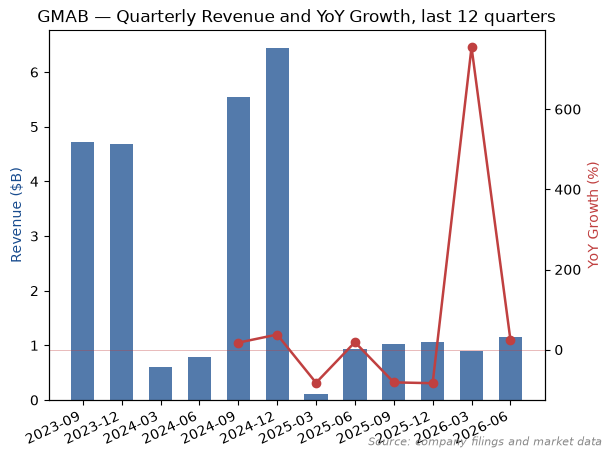
The growth has carried into 2026. Second-quarter revenue rose 25%, and in August Genmab raised its 2026 guidance to $4.3 to $4.5 billion, a midpoint 19% above 2025. Chief financial officer Anthony Pagano said about half the growth came from DARZALEX and the rest from EPKINLY and the wider portfolio, so "our business is becoming more diversified and more durable."
How a Royalty Company Is Measured
Genmab trades on a handful of numbers, and its partners report most of them.
| Latest | Why it matters | |
|---|---|---|
| J&J's DARZALEX sales | $4.24B in Q3, up 0.8% on Q2 | The base for the royalty |
| Effective royalty rate | 16.0% in H1 2026, 17.7% in Q2 | Climbs through the year as sales cross each tier |
| EPKINLY global sales | $312M in H1 2026, up 48% | The drug Genmab already sells |
| Kesimpta royalty | $259M in H1 2026, up 31% | The fastest-growing large royalty |
| AbbVie's ELAHERE sales | $224M in Q3, up 31% | The benchmark Rina-S would compete with |
The line I watch most is DARZALEX. J&J's third quarter was barely above its second, and annualised it already sits slightly above the top of the range Genmab's guidance assumes for 2026. The royalty rate rises through the year because the tiers reset annually.
EPKINLY looks like real demand. Chief commercial officer Brad Bailey said "over 90% of our key customers are ordering for 2 or more sites," and that there was "no stocking at this point in time," so the sales are not distributors filling shelves.
The cost of this model is concentration. J&J accounted for 69% of Genmab's 2025 revenue, up from 67% a year earlier.
What Changed: The Royalty Has a Date on It
Three years ago Genmab was a royalty business with two co-owned products and no debt. Since then it has bought two companies: ProfoundBio in 2024, which brought Rina-S, and Merus, which brought petosemtamab for $8.0B and closed on 12 December 2025.
Genmab paid for Merus with cash and $5.5B of new borrowing in four tranches. By my arithmetic that costs about $356M a year in cash interest, and first-half 2026 interest expense of $174M is running at that pace.
Separately, the J&J licence sets the royalty's term. The royalty runs country by country until the later of 13 years after the first sale or the expiry of the last relevant Genmab patent. In the US, where DARZALEX first sold in 2015, Genmab's patents expire in 2029, and Japan and Europe follow from 2030 and in 2031.
Genmab tried to extend that clock by arguing in arbitration that it was owed royalties under J&J's own patents on the subcutaneous formulation. It lost, and the 20-F says the dismissal of the second arbitration "is now final." The company now writes that the royalty will "decline materially in 2029."
This is the fact I think the October coverage left out. Under the contract, Genmab's US royalty runs out in 2029 whether or not a biosimilar launches and however much DARZALEX FASPRO sells. The US was about 60% of DARZALEX sales in the third quarter.
Management also names two pricing pressures in its risk factors: the most-favoured-nation pricing order of 12 May 2025, and the White House letters of 31 July 2025 to drugmakers including Genmab's partners AbbVie, J&J, Novartis and Pfizer. DARZALEX was not among the first ten drugs negotiated under the IRA.
The Demand Story: Patients With Few Options
All three new drugs aim at cancers where current treatment runs out quickly. Petosemtamab is the clearest case. It is a bispecific that binds EGFR, a growth receptor on tumour cells, and a second target called LGR5.
Genmab says the LiGeR-HN1 benefit held "regardless of HPV status," which matters because head and neck cancer splits into virus-driven and non-viral forms. The phase 2 study behind the trial, updated in a Business Wire release two days earlier, reported median survival of 28.2 months, against the 10 to 12 months typical of the disease. A second-line trial, LiGeR-HN2, reads out in the first quarter of 2027.
Petosemtamab is also moving into colorectal cancer, where Genmab reported a 75% response rate in first-line patients at the ESMO congress on 25 October. That trial had a single arm and short follow-up. Even so, two phase 3 colorectal trials are already running, and Genmab has added a combination with Incyte's KRAS G12D inhibitor.
Rina-S targets platinum-resistant ovarian cancer, where chemotherapy has stopped working. It is an ADC aimed at the folate receptor alpha, or FRα, a protein on the surface of ovarian tumour cells. PMLive puts US ovarian cancer incidence at about 20,000 women a year.
The detail that matters is who can be treated. ELAHERE is approved only for FRα-high tumours, which PMLive says covers roughly a third to 40% of patients. RAINFOL-02 enrolled women at every FRα level, and its primary analysis group, which left out FRα-high patients who had not had ELAHERE, still showed a 56% cut in the risk of death.
That breadth is the demand case. ELAHERE earns $224M a quarter in the FRα-high slice alone, and Rina-S was tested across the whole market. Three more ovarian phase 3s are running, and one of Genmab's endometrial cancer trials has breakthrough designation.
EPKINLY already sells, and October widened its market. EPCORE DLBCL-2 tested it in newly diagnosed diffuse large B-cell lymphoma against R-CHOP, which chief executive Jan van de Winkel called "for over 20 years the gold standard." Chief medical officer Tahamtan Ahmadi had called the trial "the most important study ... within the epcoritamab franchise."
Brokers moved fast. JPMorgan upgraded the stock to Overweight on 27 October, and BioPharma Dive reported that it doubled its petosemtamab peak sales estimate to $5B. BioSpace reported that Truist called the head and neck data "potentially practice-changing" and moved its modelled approval from 2028 to 2027.
The Constraint: No Filing Dates Yet
Genmab has no factory problem, because J&J makes daratumumab and AbbVie makes epcoritamab. The binding limit is regulatory time.
None of the three drugs has a date for its BLA, the biologics license application the FDA needs before it can approve an antibody. Van de Winkel guides only to "potential approvals and launches in 2027."
The data are early in places. LiGeR-HN1 read out at its first interim, and neither its medians nor its enrolment have been released. RAINFOL-02 left out its response rate, though that is a key secondary endpoint. A regulator can ask for more mature data, and every month of delay comes out of the two-year window.
The second constraint is a named supplier. The 20-F says "the CMO we use for the manufacturing of Rina-S is based in China," and warns that the BIOSECURE Act "could delay the Rina-S launch." The filing calls the law enacted in one section and proposed in another, and the manufacturer is not named in the sections I read.
What It Is Worth: On Consensus for 2028, Ahead of It After
I built 2028 from Genmab's own 2026 guidance, one revenue line at a time. Backing the other royalties out of the guided total leaves a 2026 DARZALEX royalty of about $2.79B. I then ran each line two ways, flat or growing at its first-half 2026 rate for two more years, with the mid case halfway between.
| 2028 revenue ($B) | Flat | Mid | Trend growth |
|---|---|---|---|
| DARZALEX royalty | 2.79 | 3.41 | 4.02 |
| Other royalties | 0.90 | 1.20 | 1.51 |
| Products, collaboration, milestones | 0.74 | 1.02 | 1.30 |
| Existing business | 4.43 | 5.62 | 6.82 |
The sell-side average for 2028 is $6.92B. My mid case gets the existing business to about $5.6B, so the other $1.3B has to come from Rina-S and petosemtamab in what would be, at best, their first full year.
That explains the oddest thing in the forecasts. The 2028 estimates span 42% of the average, far wider than the years on either side. The lowest, $5.57B, is roughly my mid case with nothing from the launches, while the highest needs about $2.9B from them. The analysts are really disagreeing about when two drugs reach the market.
My average agrees with consensus, but for a reason the coverage does not give. If DARZALEX kept growing 20% a year, consensus would barely need the launches. It is not on that path. Third-quarter sales rose 0.8% on the second, and both Evaluate and Bloomberg Intelligence forecast 2030 sales at or below today's run-rate. That puts the existing business in the lower half of my range and makes the launches load-bearing.
The bull case sits a year later. In my mid case the US share of the 2028 DARZALEX royalty is about $2.03B, and that is the part that steps down in 2029. Genmab has said petosemtamab has "at least one-billion-dollar annual sales potential by 2029." My own assumption is that Rina-S matches ELAHERE's current run-rate of roughly $0.9B. Together that adds up to about $1.9B, or about 94% of the US royalty in revenue terms.
The margin does not transfer with the revenue. Royalty dollars carry no cost of goods and no sales force, whereas wholly owned drugs carry both, and Genmab's selling costs are already rising "for Rina-S and petosemtamab" before either is approved. The Merus interest sits on top.
Consensus already leans this way. The 2029 average of $7.78B is above 2028 even though Genmab says its royalty begins to decline materially that year, and October's three trials are what give that forecast evidence behind it.
Three assumptions carry the conclusion. Each $1B of DARZALEX sales moves Genmab's royalty by about $0.17B. A one-year launch slip moves about $1.3B of 2028 revenue into 2029, the year the US royalty steps down. And Genmab has not disclosed how fast that step-down happens. The full working is in the research brief.
What the Market Is Paying: About 20 Times 2028
I value Genmab on 2028 earnings, because that is the year my model tests. On the sell-side average of $2.80 a share, the ADS trades at 20.4 times. The trailing figure of 45.6 times GAAP earnings looks higher because it carries the Merus interest and acquisition charges.
On a like-for-like trailing basis, Genmab sits between two peers I chose by hand. Incyte, which also mixes royalties with its own products and is now a Genmab collaborator, trades at 57.3 times. Exelixis, a single-franchise cancer drugmaker, trades at 20.1 times. Genmab's trailing multiple also sits near the middle of its own ten profitable years, at the 60th percentile.
On my numbers the stock is fairly priced for 2028. Twenty times is what the market pays if 2027 launches happen on schedule, and it leaves no room for a slip because consensus already needs the launch revenue. The upside is in 2029, where consensus earnings keep rising as the US royalty starts to fall. I think the October data make that the likelier outcome.
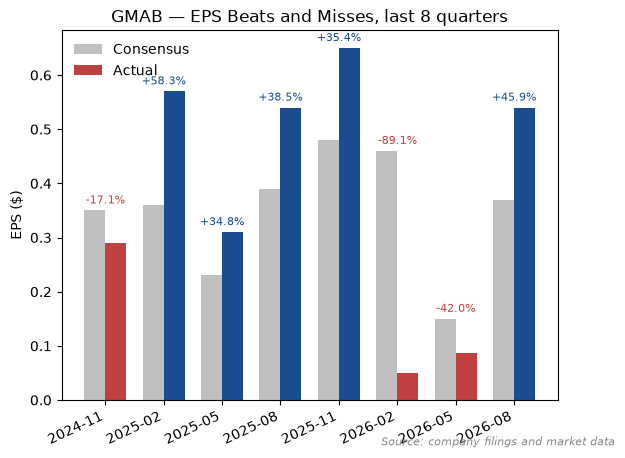
The earnings record is noisy for a reason. Adjusted earnings, which exclude acquisition and integration charges, beat consensus by 46% in the second quarter. The two misses before that came after the Merus deal closed and brought its debt and charges, so revenue did not cause them.
Reported price targets after the readouts run from Morgan Stanley's $57 at Equal-weight to Guggenheim's $80 at Buy.
The Competition: Genmab's Head and Neck Rival Is Its Own Partner
Genmab leads in head and neck because it reached a survival result first. Its closest rival is J&J's amivantamab, an EGFR and MET bispecific sold as RYBREVANT. J&J reported a 56% response rate when it was given with Keytruda in the OrigAMI-4 study. Ahmadi said on the August call that J&J is pursuing accelerated approval in head and neck on response data, and J&J's phase 3 has no results yet.
J&J pays Genmab a royalty on RYBREVANT, so Genmab partly wins either way. Kempen's Suzanne van Voorthuizen called J&J "competitor or partner" on that call. Ahmadi said "cross-study comparisons are difficult," then argued that petosemtamab outperforms amivantamab "in all 4 of these datasets" and "does not have the same challenges ... with skin toxicities."
Bicara's ficerafusp alfa is further behind. Its phase 3, FORTIFI-HN01, covers only HPV-negative patients and guides to an interim response readout in mid-2027, while petosemtamab already has survival data across HPV status.
Ovarian cancer is more crowded. ELAHERE holds the FRα-high patients, and Daiichi Sankyo reports that raludotatug deruxtecan, its drug with Merck aimed at a different target called CDH6, has breakthrough designation and a response rate of about 50%. Ahmadi described "multiple folate receptor ADCs from very large competitors that are coming left and right." Van de Winkel puts Rina-S "a year, 1.5 years ahead of some of the potential competitors," a lead that rests on a phase 3 survival result and a trial open to every FRα level.
Lymphoma is Roche's ground, where it sells two bispecifics of its own, Columvi and Lunsumio. Genmab also has a weak point here. Pharmacy Times reported that EPCORE DLBCL-1, the EPKINLY monotherapy trial in relapsed patients, missed on survival with a hazard ratio of 0.96, and that grade 3 and 4 infections ran at 30% against 12%. October's frontline result is the answer to that, and its full data have not been published.
What Could Go Wrong: Genmab Lists Its Own Biggest Risk First
Genmab's first risk factor in the 20-F is the thesis of this article. It reads: "The substantial majority of our revenue comes from royalties on sales of DARZALEX, and our patents underlying these royalties … will start to expire in the late 2020s." The second warns that a launch "may not be successful."
The debt sections are blunt. They describe "substantial indebtedness" secured by a first-priority lien on almost all of Genmab's assets, with maintenance covenants tested every quarter. Meanwhile operating cash flow fell to $54M in the first half of 2026 from $349M a year earlier, and net debt stood at $3.6B at the end of June.
There is litigation too. AbbVie has sued Genmab over trade secrets in federal court in Washington state and filed a complaint at the US International Trade Commission. Genmab "categorically refutes these allegations," and the filing I read does not say which product is at issue. In Tokyo, Chugai has three suits over EPKINLY patents.
My own worry is DARZALEX, because J&J's third quarter grew less than 1%. If sales go flat, the existing business reaches only about $4.4B in 2028, and consensus would need about $2.5B from launches in their first full year. That is the assumption most likely to be wrong.
The most damaging risk is timing. A slip to 2028 approvals puts the launches in their first year just as the US royalty starts to fall, and both the Chinese manufacturer and the interim data make that slip possible.
My answer is the quality of the evidence. Both solid-tumour drugs read out on overall survival, with hazard ratios of 0.43 and 0.50, while their nearest rivals have response-rate data. And Genmab collects a royalty on its main head and neck rival, so part of the downside is hedged.
What I Am Watching
Calendar listings put Genmab's third-quarter results on 5 November, though the company has not confirmed the date. The first thing I want is BLA timing for Rina-S and petosemtamab. The second is the DARZALEX royalty, which at the second quarter's 17.7% rate should come in near $750M. Later, the full RAINFOL-02 data must show benefit at low FRα levels. If nothing is filed by mid-2027, the 2028 consensus no longer holds without DARZALEX growth that J&J is not reporting.
Takeaway
Genmab spent $8B to stop depending on a royalty whose US term ends by contract in 2029, and October showed that the drugs it bought work. The 2028 consensus already counts on them, so the stock is fairly priced for that year. The value lies in the years after, when about $2B of US royalty steps down and two wholly owned drugs, if launched in 2027, are in their second and third years. That bull case holds only if the filing dates arrive on time.
Sources
- Genmab Form 20-F for fiscal 2025 (Items 3.D and 4, revenue, collaborations, borrowings and acquisition notes), filed 17 February 2026
- Genmab H1 2026 interim report (Form 6-K), 6 August 2026
- Genmab Q2 FY2026 earnings call, 6 August 2026 (Jan van de Winkel, Anthony Pagano, Tahamtan Ahmadi, Brad Bailey; analyst Suzanne van Voorthuizen of Kempen)
- Genmab Form 6-K on Q3 2026 DARZALEX net sales, 13 October 2026
- Genmab Company Announcement no. 43 (RAINFOL-02), Form 6-K, 23 October 2026
- Genmab Company Announcement no. 44 (LiGeR-HN1), Form 6-K, 28 October 2026
- AbbVie and Genmab release on EPCORE DLBCL-2, 5 October 2026
- Genmab releases on the Incyte collaboration (24 October 2026), the colorectal phase 2 at ESMO (25 October 2026) and the head and neck phase 2 update (26 October 2026), via GlobeNewswire and Business Wire
- Genmab release on the Merus acquisition, September 2025
- Fierce Biotech, BioSpace, Scrip, BioPharma Dive, European Biotechnology Magazine and IBTimes, 27 to 29 October 2026
- OncLive on RAINFOL-02 and LiGeR-HN1, 26 and 28 October 2026
- AbbVie Q3 2026 results (ELAHERE sales)
- PMLive on ovarian cancer incidence and FRα expression
- Evaluate Orphan Drug Report 2025; Bloomberg Intelligence DARZALEX forecast
- J&J on OrigAMI-4; Bicara Q4 2025 release; Daiichi Sankyo on raludotatug deruxtecan; Pharmacy Times on EPCORE DLBCL-1
- Broker actions from JPMorgan, Truist, H.C. Wainwright, Morgan Stanley and Guggenheim, as reported 27 to 31 October 2026
- Company filings, reported results, analyst consensus and market price data
- Full working, including the three-case revenue build, the royalty clock and the valuation:
research/2026-11-01_GMAB.md
Research, not a recommendation. Figures are sourced as cited and were current at publication; nothing here is personalized investment advice.