Moderna's Cancer Vaccine Did Nothing for Six Months. The Doses Were Still Being Made.
November 1, 2026 · Moderna, Inc. (MRNA)
profitmonk
Summary
- The Phase 3 headline of 0.58 blends two different periods. OncLive reported a hazard ratio of 0.99 for the first six months, while each patient's doses were still being made, and 0.42 after that.
- Management described this shape in July, three months before the data, when David Berman said Phase 2b took "about 12 months" for strong separation.
- Bancel told the Boston Globe that 17% of screened patients cannot be given the vaccine because their tumour sample is too small. That cuts the US high-risk melanoma pool I can count to about 31,000 a year.
- At William Blair's assumed $475,000 a course, US melanoma is worth $2.96B to $10.34B of gross sales a year. Only the top of that range roughly covers the $87.7B enterprise value at BioNTech's sales multiple, and Moderna keeps only half the profit.
- The test is Analyst Day on 12 November, the first chance for company figures on courses per year, time to first dose and screen failures.
A Leak, a 17% Drop and a Recovery
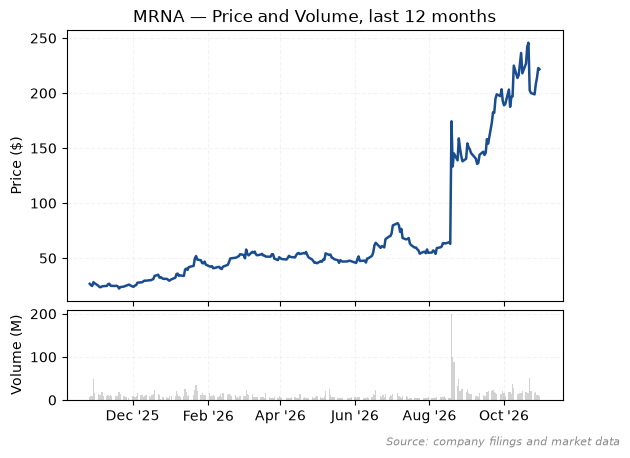
The full results of Moderna's most important trial appeared on the wrong website. On Thursday 22 October, two days before their scheduled presentation in Madrid, the INTerpath-001 numbers showed up on the OncologyCentral site, Fierce Biotech and Endpoints reported. They were taken down, the European Society for Medical Oncology lifted its embargo, and Merck confirmed the key figures that afternoon. The stock, which had just set a 52-week high of about $254, closed the day down 17.3%.
The headline was a hazard ratio of 0.58 for recurrence-free survival. A hazard ratio compares the rate of bad events in the two arms, so lower is better. BioPharma Dive had reported that management's own pre-trial bar was about 0.80, which this cleared comfortably, but it trailed the 0.51 from the Phase 2b study.
In the week to 30 October the stock recovered about 11% to roughly $222, in the same week that MarketWatch's headline read "The excitement around Moderna's cancer vaccine is cooling." The week's coverage compared 0.58 with 0.51 and stopped there.
I think 0.58 averages six months in which the vaccine could not yet work with eighteen months in which it clearly did. The real limit on this drug is the share of patients it can be made for.
The Company That Made the COVID Vaccine
Moderna, based in Cambridge, Massachusetts, and dating its founding to 2010, makes medicines from messenger RNA. Messenger RNA is a set of instructions that tells a patient's own cells to build a protein, such as a piece of a virus or a marker found on a tumour.
It sells three vaccines: Spikevax and mNEXSPIKE against COVID, and mRESVIA against RSV. The annual report says that "in 2025, we achieved total revenue of $1.9 billion, largely from sales of our COVID vaccines." A flu vaccine, mFLUSIVA, won FDA approval on 5 August for adults aged 50 and over.
Behind those products sit 35 programmes, six of them in late-stage trials. Besides its Norwood plant and sites in the UK, Canada and Australia, Moderna owns a Marlborough, Massachusetts, site that the annual report calls "purpose-built for intismeran." The market values the whole company at $88.52B.
Where the Money Comes From
Moderna reports a single business segment, so the useful split is product sales by region, and that split has changed sharply this year.
| Net product sales | H1 2026 | H1 2025 | FY2025 | FY2024 |
|---|---|---|---|---|
| United States | $143M | $119M | $1,165M | $1,726M |
| Europe | $255M | $0M | $50M | $573M |
| Rest of world | $48M | $81M | $603M | $810M |
| Total | $446M | $200M | $1,818M | $3,109M |
| Total revenue (incl. other) | $1,944M | $3,236M |
Over a full year the United States is still the biggest market and the most uncertain one. Chief financial officer Jamey Mock told analysts in July that "across the globe, we've basically contracted … I think the biggest variable comes down to the U.S." US sales fell by a third in 2025, which the annual report puts down to a market moving to "a more competitive and commercially driven environment."
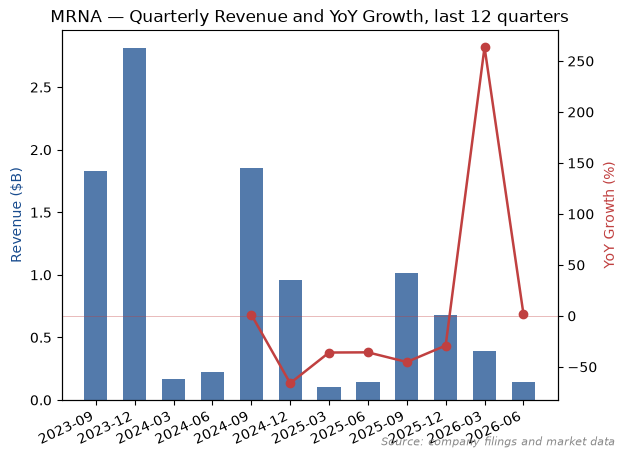
Europe is the surprise. Moderna sold $255M there in the first half of 2026, more than half of all product sales, and nearly all of it came in the first quarter. My own September article on Moderna said it "re-enters Europe from $50M", when the quarterly filing already showed five times that.
The rest of the world shrank, and RSV barely registers. The annual report says plainly that "our RSV sales have been minimal," and COVID is still about 98% of product revenue.
How a Biotech Like This Is Measured
A company like Moderna earns approved products times patients times net price for as long as its patents hold, and its latest granted US product patents run to 2041. Three numbers decide how the market prices it today.
| Measure | Latest reading |
|---|---|
| Intismeran hazard ratio, recurrence | 0.51 in Phase 2b at five years; 0.58 in Phase 3 |
| Cash and investments | $8.1B end-2025; $6.9B end-June; guided $4.7B to $5.2B at end-2026, before September's convertible |
| Cash costs, second quarter | down 10% from a year earlier |
The hazard ratio leads because the oncology programme carries most of the value. The Phase 2b figure comes from the five-year update at ASCO 2026 and the Phase 3 figure from the ESMO coverage. The cash figures come from the annual and quarterly filings, and the guidance and cost trend from Moderna's July deck.
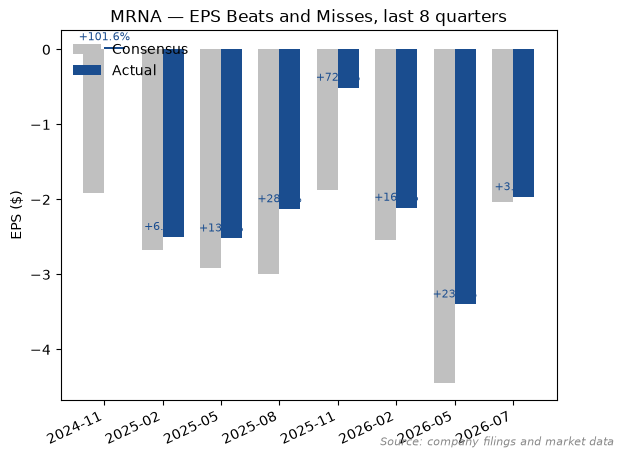
Cheaper operations explain the earnings record. Moderna has beaten consensus eight quarters running, most recently with a second-quarter loss of $1.97 a share. Today's revenue still depends on COVID, and IQVIA data in the same deck shows mNEXSPIKE took about 24% of the US retail COVID market in its first season, so Moderna can still win share in a shrinking market.
Pricing is the hidden variable. In 2025 Moderna kept about $1.8B of its $3.3B in gross product sales, giving up 45% in gross-to-net provisions, including $1,037M of chargebacks, discounts and fees. That gap between list price and cash will matter when a cancer vaccine arrives with a six-figure price.
What Changed: A Hazard Ratio and a Manufacturing Hire
Three years ago Moderna was a pandemic company in decline, and revenue fell from $6.8B in 2023 to $1.9B in 2025 as COVID demand collapsed.
Two things are new. The first is a Phase 3 result in cancer for intismeran autogene, which Moderna developed with Merck. Merck paid $200M upfront in 2016 and a $250M option fee in 2022, and costs and profits are "generally shared equally worldwide." Moderna makes the vaccine and Merck generally runs the trials.
The second is a hire. On 30 September Moderna named Juan Andres to a newly created chief operating officer role, reporting to chief executive Stéphane Bancel, "to support the increasing scale and diversification of the Company," the filing says. Andres ran technical operations and quality from 2018 to 2022, through the COVID scale-up. So a company preparing to make a different batch for every patient has hired the person who last scaled its plants.
The Demand Story: A Drug That Needs Time and Tissue
How intismeran is made sets its demand, and the making shows up in the data. After surgery the patient's tumour is sequenced, and Moderna designs an mRNA vaccine carrying up to 34 neoantigens, the mutations that make that tumour look foreign to the immune system. It is given with Merck's KEYTRUDA, a checkpoint drug that takes the brakes off the immune system.
That process explains the shape of the Phase 3 curve. INTerpath-001 randomised 1,137 patients with resected high-risk melanoma two to one, and each patient's doses were manufactured from their own tumour after randomisation. So for the first weeks, both arms were effectively on KEYTRUDA alone.
| INTerpath-001 analysis | Recurrence-free survival HR | Distant metastasis HR |
|---|---|---|
| First six months | 0.99 | 1.01 |
| After six months (landmark) | 0.42 | 0.50 |
| Intention-to-treat (primary result) | 0.58 | 0.62 |
| Modified intention-to-treat | 0.51 |
OncLive's figures show the split. For the first six months the two arms did equally well, and after that the vaccine cut the rate of recurrence or death by more than half. The companies attributed the early flat period to the staggered start of dosing.
Management had warned of exactly this. On the July call UBS's Michael Yee asked whether expectations were too high given "a nonproportional hazard ratio where the effect size gets better over time due to the way the drug works." Berman, the chief development officer, answered that Phase 2b had shown "somewhat of a nonproportional hazard with about 12 months for really strong separation to occur." President Stephen Hoge added that "there's a commercially valuable product that could emerge maybe only in the final analysis."
A second analysis supports this reading. On a modified intention-to-treat (mITT) sensitivity analysis, OncLive reported 0.51, the same figure Phase 2b produced.
I should be careful with the post-six-month figure. It is a landmark analysis, counting only patients still free of disease at six months, so regulators will label the drug on the primary result. What it does is give Bancel's claim in the Wall Street Journal, that the data will get better with time, a number the next analysis can test.
A payer cares more about absolute numbers. OncLive put two-year recurrence-free survival at 82% with the vaccine against 70% without, a 12-point gap, so roughly eight patients must be treated to prevent one recurrence or death within two years.
Now the pool of patients. GlobalData puts about 37,000 US melanoma patients a year in the high-risk group, a third of all adult diagnoses. Bancel told the Boston Globe on 27 October that 17% of screened patients had a tumour sample too small to make the vaccine, which leaves about 31,000 who can be treated.
GlobalData's figures also show that about 20% of stage II and 70% of stage III patients receive adjuvant therapy today, the treatment given after surgery to stop a recurrence. If intismeran reaches those rates across the treatable pool, that is about 6,200 to 21,800 courses a year.
The rest of the business has contracted demand too. Moderna has a European Commission joint procurement for up to 24 million mRESVIA doses, partnerships with the UK, Canada and Australia, and a multi-year supply deal with Brazil. Hoge expects some contribution from mCOMBRIAX, a combined flu and COVID shot, "beginning in 2027, but the full effect really probably not felt until 2028."
The Constraint: Time, Yield and a Partner
Moderna's plant looks large enough for launch. Hoge said in July that Marlborough "can support our commercial profile that ourselves and our partner, Merck have articulated for several years to come," and that "we'd be ready to go next year if all went perfectly to plan." The site has made clinical batches since September 2025.
The limit has three parts, and this month's data measured two of them. The first is yield: the 17% of patients whose tumour cannot be made into a vaccine, a number no hazard ratio changes.
The second is time to first dose. The six flat months are, in effect, the turnaround from tumour sample to vaccine showing up in a clinical result, so faster manufacturing means earlier protection. Andres's appointment points at the same problem.
The third is the partner. Every course needs KEYTRUDA, and Merck's third-quarter remarks listed an "anticipated regulatory filing" with no date. Bancel told the Boston Globe that filing work began in mid-August, and STAT and the Globe reported that approval is expected in 2027.
Capacity is the missing piece. Moderna has never published how many courses Marlborough can make in a year, the largest gap in the bull case, and Analyst Day is the first place it could appear.
What It Is Worth: Melanoma Covers the Price at the Top of the Range
I built the value from patients, because $145M of second-quarter revenue cannot support an $88.52B company on any ordinary multiple. The chain is short.
| Step | Value |
|---|---|
| US high-risk melanoma patients a year | 37,477 |
| Treatable after 17% screen failures | 31,106 |
| Courses a year at today's adjuvant rates (20% to 70%) | 6,221 to 21,774 |
| Gross US sales at $475,000 a course | $2.96B to $10.34B |
William Blair's analysts assume a course costs about $475,000, by analogy with cell therapies, and that price produces the range in the last row. Blair's $5.4B peak melanoma forecast falls inside the range, but reports are ambiguous on whether it is a total or Moderna's share.
The curve shape decides where in that range intismeran lands. If the effect after six months holds, physicians have reason to treat stage II patients, where only a fifth get adjuvant therapy today, and adoption moves toward the top. If the hazard ratio drifts back toward 0.58, it moves toward the bottom.
The same arithmetic caps the bullish forecasts. Morningstar's $16.8B forecast for 2035 would require selling to every treatable high-risk US melanoma patient and then some, so the high forecasts already assume a second tumour type or sales outside the United States.
Even on generous assumptions, 2028 sales top out near $5B, well above consensus of about $3.4B, so the launch year won't settle the stock. To get there I took every revenue line at its highest sourced level. For intismeran I counted half of GlobalData's forecast, because Moderna shares the profit with Merck, and pulled it forward three years to count the drug as early as possible.
The data did move the forecasts at the top. The highest 2028 estimate fell 12.3% after ESMO while the average barely moved, so the bulls moved toward what can be sourced.
Funding is not the risk over this horizon. On consensus losses, Moderna would end 2028 with about $5.7B to $6.2B of cash, before $0.9B of undrawn term loan.
What the Market Is Paying: Melanoma at the Top, Plus a Second Tumour
The stock trades above the $210.58 conversion price of September's convertible bond, so I count the conversion shares, which gives a fully diluted value of $91.68B. Net of about $4.0B of pro forma year-end net cash, the enterprise value is $87.7B.
Earnings multiples say nothing while Moderna loses money, so I compare sales. My main peer is BioNTech, the other mRNA company and also loss-making, with two profitable vaccine makers for scale.
| Company | Price to trailing sales |
|---|---|
| Moderna | 39.7x |
| BioNTech | 7.4x |
| Pfizer | 2.7x |
| GSK | 2.2x |
The current price requires roughly the best-case melanoma outcome. Dividing the $87.7B enterprise value by BioNTech's 7.4 times sales gives about $12B of revenue the price needs, close to the roughly $10B top of my US melanoma range.
The catch is that those are sales. Moderna earns half the profit, while Merck keeps all the KEYTRUDA revenue given alongside, and today the collaboration costs Moderna money: $407M in 2025 and $198M in the first half of 2026.
My call is that the price is fair if adoption reaches the top of the band and expensive if it does not. Because Moderna books half the profit, the price in practice assumes melanoma near full stage III penetration plus a second tumour type. The street leans the same way. Only two analysts set price targets last month, and they average about $184, 17% below the price.
Investing.com reported that William Blair's Myles Minter made the same point when he downgraded the stock on valuation on 27 October. His sum of the parts already assumes a 70% to 75% chance of success in tumours beyond melanoma, and he warned that "development in these additional tumors is not without meaningful clinical and biological risk."
Why No Rival Is Close in Neoantigen Vaccines
In personalised cancer vaccines Moderna has no Phase 3 competitor. The closest analogue, BioNTech and Genentech's autogene cevumeran, failed in first-line melanoma, and in August BioNTech ended its adjuvant colorectal Phase 2. No other individualised neoantigen therapy has Phase 3 data.
The moat is design and manufacturing. Berman said in July that about 29% of the neoantigens Moderna picks provoke an immune response, and "you only need 1 neoantigen reactive T cell." Add a plant built for this product and a chief operating officer from the COVID scale-up, and a rival starting now would need its own Phase 3 and its own per-patient supply chain.
Safety helps adoption. Moderna's recap and OncLive reported serious treatment-related side effects in 14.2% of vaccinated patients against 13.4% of controls. Fever and injection-site pain each hit about half the vaccine arm, so patients get many more fevers and sore arms and almost no added severe harm.
Vaccines are a tougher fight. Pfizer and BioNTech's Comirnaty and Novavax's Nuvaxovid compete in COVID, and BioNTech sued Moderna over mNEXSPIKE in February. Pfizer's Abrysvo and GSK's Arexvy compete in RSV, where Moderna sold $10M in the first half. In enhanced flu, mFLUSIVA faces Sanofi's Fluzone High-Dose and Flublok and CSL Seqirus's Fluad, and Hoge said mFLUSIVA "really is in the enhanced category from our perspective."
The counter-moat is Merck. It owns KEYTRUDA and half the cancer economics, and the combination only works where checkpoint drugs work. Berman named the limit himself: "the big question comes out in tumors where checkpoints don't work, and that's pancreatic cancer and to a lesser degree, gastric."
What Could Go Wrong: The Company Already Named It
Moderna's annual report lists its own risks, and four of the first eight headings bear directly on this thesis. The first reads: "Regulatory and market uncertainty have and may continue to impact our business and the markets for our products." US policy has already cut COVID demand.
Two headings bear on the price of a cancer vaccine. The sixth warns that sales "depend on the availability and extent of reimbursement from third-party payors," and the seventh that "reference pricing or most-favored-nation pricing models … could impact our product revenues and materially harm our business." At $475,000 a course and roughly eight patients treated per recurrence prevented, a payer spends about $3.9M of drug for each recurrence avoided, and payers will do that sum.
The eighth heading reads: "The market opportunities for our products and product candidates may be smaller than we believe." Bancel's 17% figure has now put a number on it. A separate heading says intismeran products "are uniquely manufactured for each patient using a novel, complex manufacturing process and we may encounter difficulties in production," and the six flat months are that risk showing up in a clinical result.
Beyond the filing, the strongest case against me is that the landmark cut is a choice. Payers will price on the intention-to-treat result, which counts every randomised patient. Distant metastasis, the endpoint closer to death, weakened from 0.411 in Phase 2b to 0.62. CancerNetwork reported an overall survival result whose confidence interval spans 1, so the honest description is a favourable trend.
The second tumour type the price needs is also still a trial. Kidney cancer looks like the next readout, and Merck lists April 2027 as that trial's primary completion date.
The assumption most likely to be wrong is the $475,000 price, since it is one bank's analogy. Cut it by a fifth and the top of my range falls to about $8B. A lower price shrinks the whole range, but it leaves the adoption argument intact: the curve shape still decides where in the range the drug lands, and the curve is what the market has misread.
What I Am Watching
Third-quarter results arrive before the open on 6 November, and a small revenue miss would tell me nothing new. Management's own guidance implies at most about $880M, against consensus near $890M.
The real test is Analyst Day in Cambridge on 12 November. If Moderna does not publish courses per year for Marlborough, a time to first dose and a plan to cut the 17% screen-failure rate, the top of my range has no support. The next INTerpath-001 analysis is undated, and if its hazard ratio drifts back toward 0.58, the case is wrong.
Takeaway
The market read 0.58 as a disappointment. I read it as a vaccine that could not work until it was made, because among patients still free of disease at six months it cut recurrence risk by more than half, the shape Berman described in July. On William Blair's assumed price, US melanoma at stage III adoption rates is worth about what the stock already charges at BioNTech's sales multiple. Moderna keeps half the profit, so every case above that needs a second tumour type. Faster doses and fewer screen failures would lift the case from fair to good, and Moderna's first chance to show both is 12 November.
Sources
- Moderna Form 10-K for fiscal 2025, Items 1, 1A and 7, filed 20 February 2026
- Moderna Form 10-Q for Q2 FY2026, filed 31 July 2026
- Moderna Q2 FY2026 earnings call and investor presentation, 31 July 2026 (Stéphane Bancel, Stephen Hoge, David Berman, Jamie Mock; analyst Michael Yee of UBS)
- Moderna Form 8-K on the chief operating officer appointment, 30 September 2026
- Moderna Form 8-K on the convertible notes, 1 September 2026
- Merck press release on INTerpath-001 topline results, 19 August 2026
- BioPharma Dive on the pre-trial efficacy bar, 19 August 2026
- KEYNOTE-942 five-year results, ASCO 2026
- Fierce Biotech and Endpoints News on the data leak, 22 October 2026
- BioSpace on investor expectations and the RBC note, 22 October 2026
- OncLive, CancerNetwork and Fierce Biotech on the ESMO presentation, 24 October 2026
- Moderna investor relations recap of the INTerpath-001 results, October 2026
- STAT interview with Stéphane Bancel, 26 October 2026
- MarketWatch, "The excitement around Moderna's cancer vaccine is cooling," 26 October 2026
- Boston Globe interview with Stéphane Bancel, 27 October 2026
- Investing.com on the William Blair downgrade, 27 October 2026
- Wall Street Journal on Bancel's response to the sell-off, 28 October 2026
- Merck third-quarter 2026 remarks, 29 October 2026
- Zacks and MarketBeat on third-quarter consensus, 30 October 2026
- GlobalData on US melanoma incidence and adjuvant penetration, 25 August 2026
- IQVIA prescription data, as shown in the Moderna Q2 FY2026 investor presentation
- Morningstar, Goldman Sachs and William Blair intismeran sales forecasts, 2026
- Company filings, reported results, analyst consensus and market price data
- Full working, including the patient build, the 2028 ceiling and the valuation bridge:
research/2026-11-01_MRNA.md
Research, not a recommendation. Figures are sourced as cited and were current at publication; nothing here is personalized investment advice.