SharkNinja Sold 2% More to Its Biggest Retailer and 29% More to Everyone Else
November 8, 2026 · SharkNinja, Inc. (SN)
profitmonk
Summary
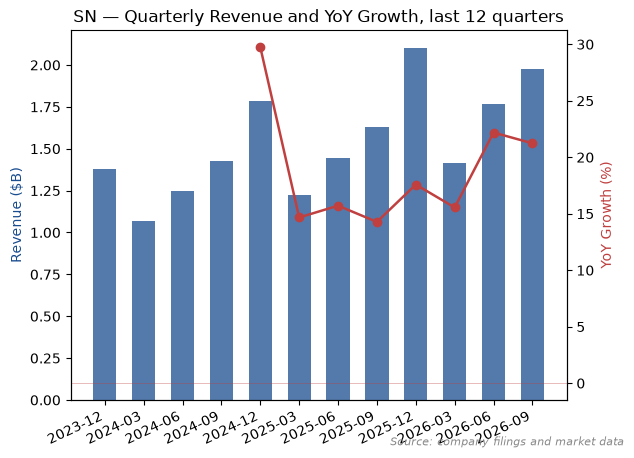
- SharkNinja grew third-quarter sales 21% and raised its 2026 sales guide for the third time, to 18% to 19%. The shares closed at their highest level in the window on 6 November, about 1.2% below the 52-week high, while the S&P 500 fell.
- Its largest retailer bought only about 2% more than a year earlier, while every other channel bought about 29% more. The 10-Q's customer note shows growth leaning less on one buyer, and the nine-month figures show the same shift.
- My call is on revenue. If 2025's segment growth rates simply repeat, 2028 net sales reach $10.3B against a $9.7B consensus. Consensus sits below even my floor case, which takes US and Canada growth down to 10%.
- On earnings the stock is fairly valued. My build gives about $8.80 to $9.03 a share for 2028 against an $8.87 consensus, and at $222.95 the shares trade at 25 times that consensus. Any earnings upside needs gross margin to hold without the tariff refund.
- The stock is cheap only if revenue growth outlasts consensus. The 10 February results and first 2027 guide will be the first test.
A Window High in a Falling Market
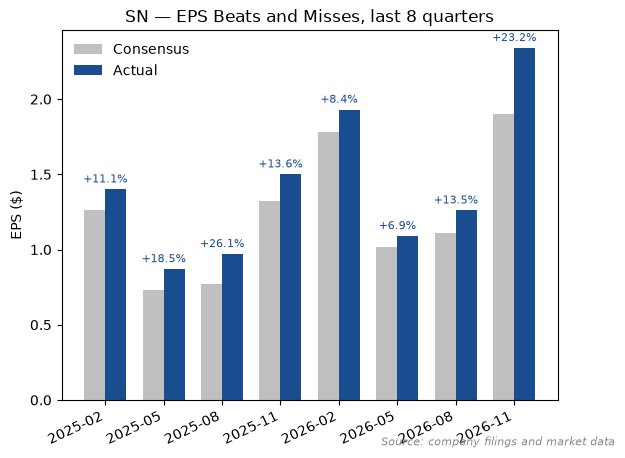
SharkNinja's 4 November report beat on both lines and marked its fourteenth straight quarter of double-digit sales growth. Net sales rose 21%, and adjusted earnings of $2.34 a share beat the $1.90 consensus, its eighth beat in a row. Guidance, consensus and the beat history are all adjusted figures, so I use that basis throughout.
The company also raised its 2026 sales guide for the third time this year. It started at 10% to 11% growth and now sits at 18% to 19%, so the growth management expects has nearly doubled inside a year.
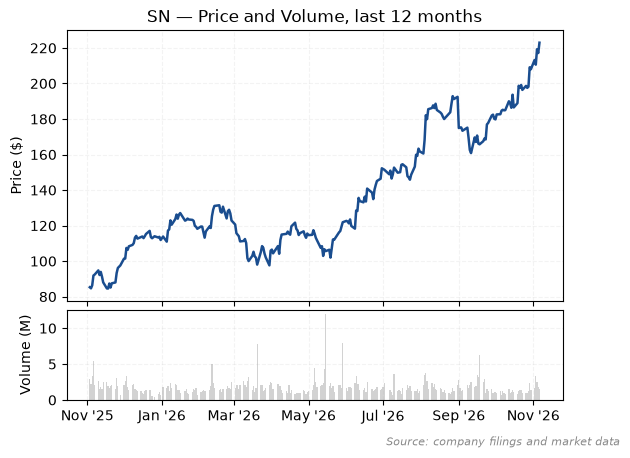
The market rewarded it. In the five trading days to 6 November the shares rose 7.2% while the S&P 500 fell about 2.7%, and Investing.com reported that Jefferies raised its target to $300.
Most of the coverage read the quarter as a margin story and an artificial intelligence (AI) rebrand, and Investing.com's headline on the Jefferies note called it a "tech pivot." The more useful line sits in a note to the 10-Q, and it is why I am writing this week. The company's biggest retailer barely grew, and the rest of the business grew 29%.
The Company Behind Shark and Ninja
SharkNinja designs small household appliances and sells them under two brands. Shark makes vacuums and hair tools; fans and air purifiers sit in the Beauty & Home Environment category. Ninja makes air fryers, blenders, espresso machines and, since August, a $199 water filter.
The listed company is young. It was incorporated in the Cayman Islands in May 2023 as a subsidiary of JS Global, a Hong Kong-listed group controlled by SharkNinja's chairman, and listed on the New York Stock Exchange that July.
It is bigger than its age suggests. It sold $6.40B of appliances in 2025 across 38 markets, and the annual report, citing the research firm Circana, ranks Shark as the top US vacuum brand and Ninja as the best-selling US small kitchen appliance brand.
SharkNinja makes none of its products itself. "We do not manufacture any of our own products," the 10-K says, and its contract factories are "primarily based in China," with others across Southeast Asia. Its money goes into demand, and advertising took almost 10% of 2025 sales. At $222.95 a share the company is worth about $31.4B.
Four Categories, and Vacuums Are Now Under a Third
SharkNinja reports two operating segments, Domestic (the US and Canada) and International, and four product categories. It does not disclose gross profit by category or region, so the only profit lines below are for the whole company.
| Q3 | 2026 | 2025 | Change | Share of sales 2026 (2025) |
|---|---|---|---|---|
| Cleaning | $617M | $593M | +4% | 31% (36%) |
| Cooking & Beverage | $598M | $437M | +37% | 30% (27%) |
| Food Preparation | $486M | $411M | +18% | 25% (25%) |
| Beauty & Home Environment | $276M | $189M | +46% | 14% (12%) |
| Domestic (US and Canada) | $1,314M | $1,101M | +19% | 66% (68%) |
| International | $663M | $530M | +25% | 34% (32%) |
| Net sales | $1,976M | $1,630M | +21% | |
| Adjusted gross margin | 55.9% | 50.3% | +560bp | |
| Adjusted operating income | $426M | $289M | +47% |
The table shows growth moving away from the original business. Cleaning, the Shark vacuums and mops, is now the slowest category, and its share of sales fell five points in a year. Cooking & Beverage, where management credited the Ninja Luxe Café and the Ninja Crispi, is now almost as large.
The other two categories are growing faster than the company. Food Preparation grew on blenders, led by the CrushBOSS, while Beauty & Home Environment, which covers hair stylers, skincare, fans and air purifiers, grew fastest of all.
Management credited Domestic growth to what it called the base business and a Walmart rebound, and International growth to Spain, Italy, Mexico and Latin America. The UK, SharkNinja's largest foreign market, grew a slower 13%.
Growing in a Shrinking Category: The Measures That Matter
SharkNinja is growing against a shrinking category, and gross margin and retailer concentration are the things to watch. Circana data, cited in the housewares trade association's MarketScope report, put US small appliance and housewares sales down about 0.5% in 2025, while SharkNinja's Domestic segment grew 13.5%.
Adjusted gross margin held near 49% in 2024 and 2025, then rose to 51.6% in the first nine months of 2026, a figure flattered by tariff refunds. Chief financial officer Adam Quigley said that excluding the refund, third-quarter gross margin "would have been down around 100 basis points," or one percentage point (a basis point is a hundredth of one). The 10-K credits 2025's small gain to cost savings and a lower sourcing fee to JS Global, and it expects operating expenses to keep rising in dollars, so I think further margin gains must come from pricing.
Concentration peaked in 2025, when the largest customer, which the filings do not name, took 23.8% of sales. Amazon, Costco and Walmart each took more than 10%. In 2026 that trend reversed.
Sell-through looks healthy as well. Chief executive Mark Barrocas said point-of-sale on major US retailer websites, meaning what shoppers actually buy there, is up more than 30% this year. Inventory has grown roughly in line with sales, so there is no sign of stock piling up.
What Changed: The Biggest Customer Stopped Carrying the Business
One retailer's share of sales rose from 19.9% in 2023 to 23.8% in 2025, which made concentration a risk. One retailer took a rising share of sales, so a single buying decision there could swing a quarter. The third-quarter 10-Q shows that dependence falling quickly.
The largest customer took 23.4% of third-quarter sales, down from 27.8% a year earlier. In dollars its purchases rose about 2%, while sales to everyone else rose about 29%, carried by other retailers, the company's own website, social commerce and international.
There is one caution, and I want to state it plainly. At 30 September that customer accounted for 28.8% of receivables, the money customers owed SharkNinja, which is above its share of sales. That suggests its holiday buying bunched at the end of the quarter, so part of the 2% against 29% gap may be timing.
The nine-month figures are the better test, and they point the same way. Over nine months the largest customer's purchases rose about 12% and the rest grew about 22%. The filings do not say which of the three big retailers it is, and I will not guess.
The Demand Story: Spain, TikTok and a $199 Water Filter
The demand case is that SharkNinja keeps enlarging its own market. On the 4 November call, Jefferies' Randy Konik read from his initiation report of three years earlier, which had put SharkNinja's market at "a $112 billion total addressable market…" Barrocas answered that the figure is now "roughly about $130 billion."
SharkNinja's 2026 sales of about $7.6B are under 6% of that, and the company widens it by adding sub-categories. It competes in 41 today and has committed to two more for 2027.
The newest is water. Ninja HydraSense launched in August at $199, against reverse-osmosis systems that Barrocas said "can often cost $2,000 or more." Management sizes the market at more than $6 billion and says subscribe-and-save attach rates on replacement filters "more than tripled our internal expectations." I could find no outside figure to check either claim.
Europe is the second line. Spain and Italy moved from distributors to a direct model this year. Barrocas recalled the doubters: "I remember people saying to me, 'Mark, continental Europe is so different than anywhere else in the world.' It's not so different than anywhere else in the world." He expects international growth to re-accelerate in the fourth quarter from 25% in the third.
Social commerce is the third. TikTok Shop is on track to be live in 14 countries before the holidays, and Barrocas called social commerce "the biggest change in consumer retail since Amazon." He said each dollar of sales on the platform generates $2 elsewhere, a figure from the company's own analysis with no outside check.
The US core is still growing, which matters because Domestic is two-thirds of sales. "Our North America business is on fire in these markets right now, and it is really being driven by the core," Barrocas said, naming walmart.com, bestbuy.com and target.com among the growers.
The Constraint Is Shelf Space, and It Is Loosening
SharkNinja has no factory bottleneck. Its products are "dual-sourced," and the 10-K says there are "no existing long-term manufacturing contracts on which we are substantially dependent." Three other things limit growth, and the most important is how much new product retailers will take.
Retailers set an open-to-buy, a budget for how much inventory they will order from each supplier. Speaking of Europe and Latin America, Barrocas said "we were somewhat constrained by the pace by which retailers were willing to bring on more product from us." The company's answer is to sell around that gate, so half of the holiday range in Spain and Italy will be sold only through its own site, social channels and Amazon.
Distributor conversions are the second limit, and they take years. The UK went direct in 2014 and reached $964M of sales in 2025. Mexico, Spain and Italy have followed, and Canada's model is being reset for 2027. Quigley said each conversion lets SharkNinja fund advertising that "distributor partners simply cannot afford."
Tariffs are the third. The Supreme Court ruled that the International Emergency Economic Powers Act (IEEPA) does not authorise tariffs, so duties paid under it are being refunded. Section 301 and 232 tariffs on China-origin goods, however, "remain in effect and are unaffected by the Supreme Court's ruling," the company's first-quarter 10-Q says. SharkNinja does not disclose how much it sources from China.
The tariff year also had a cost in loyalty. SharkNinja paid its factory partners $45.2M "in recognition of their extraordinary partnership during the tariff-related headwinds in 2025."
What It Could Earn: Consensus Has 2028 Below My Floor
Consensus 2028 sales sit below even my floor case, built from SharkNinja's own growth rates. I start from about $7.6B for 2026, the top of the guide, split roughly two-thirds Domestic and one-third International. The full arithmetic is in the research brief that publishes alongside this article.
The floor path takes Quigley's description of Domestic as "very firmly a double-digit grower" at its minimum, 10%, and keeps International at its 2025 actual growth of 20.8%. The middle path repeats both 2025 actuals, 13.5% for Domestic and 20.8% for International. The high path repeats this year's nine-month rates. The 2028 sales figures are my model outputs, rounded.
| Path to 2028 | Domestic growth | International growth | 2028 net sales |
|---|---|---|---|
| Floor: Domestic at 10% | 10.0% | 20.8% | $9.9B |
| Repeat of 2025 | 13.5% | 20.8% | $10.3B |
| Repeat of 2026 so far | 14.9% | 30.8% | $11.1B |
| Analyst consensus | $9.7B |
For 2027 the floor path lands almost exactly on the $8.64B consensus, which implies about 13.5% growth. Analysts have already settled on management's floor for next year.
Analysts disagree most about 2028: the range of estimates is 14% of the mean, the widest of any year. On average they have growth slowing again, to about 12%, below even my floor path. That is hard to square with the mix, because International grows faster than Domestic and becomes a larger share of sales each year, which should lift total growth.
That is my variant view, and it is about revenue. Consensus implicitly assumes US and Canada growth falls to about 10% and stays there, or that International slows below its 2025 pace. This year's results run against both, with Domestic up 14.9% and International up 30.8% over nine months, so I read consensus as too low.
Earnings tell a more modest story. If I hold the adjusted EBITDA margin at the 2026 guide and the share count flat, the 2025-repeat path earns about $9.03 a share in 2028, or about $8.80 once I strip out the tariff refund. Consensus is $8.87, so on earnings I agree with the Street. Any upside depends on management's rule to "grow adjusted EBITDA dollars faster than net sales dollars," which Quigley restated for 2027.
The refund inflates gross margin, but management plans to reinvest most of it, so only about $0.17 a share reaches 2026 earnings. Quigley called the margin decline excluding the refund "really a choice," because SharkNinja delayed price increases. The real question is whether it takes them in 2027.
Three assumptions carry the revenue call. Domestic growth has to hold near 13.5%, because closer to management's 10% floor my 2028 figure falls back toward consensus. International has to hold near its 2025 rate as the European conversions and TikTok Shop scale. Gross margin has to hold without the refund, and that matters most for earnings: each percentage point of margin is worth about $0.42 a share, more than the whole gap between my figure and consensus.
What the Market Is Paying: 25 Times 2028 Earnings
On earnings the price looks fair. At $222.95 the stock trades at 25 times 2028 consensus earnings of $8.87, and my own 2025-repeat figure gives about the same multiple. William Blair, reiterating Outperform this month, put the stock "at the high end of its peer group," Investing.com reported.
The premium to appliance makers is large. On trailing earnings, the appliance peers I chose, De'Longhi, Midea and Haier Smart Home, trade at 11 to 14 times against SharkNinja's 37. The gap is as wide on EV/EBITDA, which compares the value of the whole business, debt included, with earnings before interest, tax, depreciation and amortisation.
| Trailing multiples | P/E | EV/EBITDA |
|---|---|---|
| SharkNinja | 37.2x | 25.2x |
| De'Longhi | 14.4x | 8.5x |
| Midea | 14.2x | 12.4x |
| Haier Smart Home | 11.6x | 8.3x |
SharkNinja deserves a premium only for its growth. It grew sales 21% last quarter, while De'Longhi guides to mid-single-digit growth for 2026, so the multiple depends on that growth lasting. The market has already paid up for it: the trailing multiple sits around the 83rd percentile of six profitable years, and was 23 times at the end of 2025.
My judgment is that at 25 times 2028 earnings the market already pays for double-digit growth well past 2027, roughly what my model earns. It does not pay for my extra $0.6B of 2028 sales, because consensus does not contain it. The stock is cheap only if revenue growth outlasts consensus.
The Competition: Why Dyson, iRobot and Helen of Troy Are Not Winning
SharkNinja wins on two things, and both show in the numbers. The first is launch speed: the 10-K lists seven new sub-categories in three years, from outdoor ovens and carbonation to fans and skincare. The second is the scale of its demand machine. Barrocas put media and promotional spend at more than $1.5 billion a year, and SharkNinja is one of fewer than 30 vendors in Amazon's Global Vendor Management program.
The rivals' results show what that buys. Dyson, the premium rival in cordless vacuums and hair tools, saw 2025 revenue fall 6.7%, which it blamed mainly on US tariffs. Its operating profit still rose 15%, so it remains a strong competitor even as sales shrink.
Helen of Troy, which owns Hot Tools and Drybar, saw its Beauty & Wellness segment fall 4.5% in its latest quarter, while SharkNinja's Beauty & Home Environment grew 46%. Breville grew total revenue 6.7% in the year to June, with coffee growing double-digit, against 37% for SharkNinja's Cooking & Beverage in the third quarter.
The one new kind of rival is in robots. iRobot, the Roomba maker, filed for Chapter 11 in December 2025 and was sold to its own contract manufacturer, Shenzhen Picea Robotics, in a deal that closed on 23 January 2026. Picea now owns both the factory and the brand, so it keeps the manufacturing margin that SharkNinja pays away to its contract factories.
What Could Go Wrong: SharkNinja Names Its Retailers as a Risk
SharkNinja's own risk factors describe the thesis's weak points well. One heading reads, in full, "We rely substantially on our retailers and distributors," and Amazon, Costco and Walmart together took 45.7% of 2025 sales. Another warns that "conflicts with our retailers could harm our business and operating results." That risk is live, because half of the Spain and Italy holiday range will skip brick-and-mortar retailers.
The 10-K also flags trade policy, warning that "significant changes to U.S. trade policies that restrict imports or increase import tariffs… may have a material adverse effect on our business." It disclosed that "our disclosure controls and procedures were not effective as of December 31, 2025," with material weaknesses across IT, revenue, inventory and the financial close. Management says none caused a misstatement.
The risks I add are about the quarter itself. The fourth-quarter guide implies sales growth of about 17% but adjusted EBITDA growth of only about 9%. Goldman Sachs' Brooke Roach noted on the call that "it implied a slower rate of growth in the U.S. exiting the year," and the UK, the most mature market, slowed to 13%. All 14 ratings in my consensus data are Buy or Strong Buy, so there is nobody left to upgrade.
The strongest case against the stock is that the margin decline excluding the refund becomes permanent. If retailers refuse price increases in a category Circana measured as shrinking, the 2027 spending fails to pay back and the multiple falls toward its 2025 level. Applying that 23 times to 2027 consensus earnings would put the shares at about $179, roughly 20% below today.
My answer is that SharkNinja has not yet tested its pricing, by its own choice, and that management flagged the fourth-quarter EBITDA slowdown in advance. It called the slowdown "simply the timing" of spending "intentionally designed to benefit 2027 and beyond." The assumption most likely to be wrong is gross margin, because pricing is untested. The second is Domestic growth, given the UK slowdown and the slower US exit.
What I Am Watching
The test comes on 10 February 2027, when SharkNinja reports the fourth quarter and gives its first 2027 guide. If the 2027 sales guide is below the roughly 13.5% that consensus expects, or adjusted gross margin excluding the refund is still falling, my bull case is wrong. In early March the 2026 10-K will show whether the largest customer's share kept falling and whether the control weaknesses were fixed.
Takeaway
SharkNinja's third quarter was carried by the parts of the business that do not depend on its largest retailer, and they grew about 29%. Consensus has already priced next year at management's floor and then has growth slowing further in 2028, below even my floor case. On earnings my model only reaches consensus unless pricing holds, so at 25 times 2028 earnings the stock is fairly priced. The 10 February guide will show whether the revenue growth lasts long enough to make it cheap.
Sources
- SharkNinja Q3 2026 earnings release (Form 8-K, Exhibit 99.1), 4 November 2026
- SharkNinja Q3 2026 earnings call, 4 November 2026 (Mark Barrocas, Adam Quigley; analysts Randy Konik of Jefferies, Brooke Roach of Goldman Sachs and Phillip Blee of William Blair)
- SharkNinja Form 10-Q for the quarter ended 30 September 2026, including Note 2 (customer concentration) and Note 11 (share repurchases)
- SharkNinja Form 10-Q for the quarter ended 31 March 2026, and Q1 2026 earnings release
- SharkNinja Form 10-K for fiscal 2025, Items 1, 1A and 7, filed 2 March 2026
- Helen of Troy Q2 fiscal 2027 results (Form 8-K, Exhibit 99.1), 8 October 2026
- Breville Group FY2026 results, ASX release, 19 August 2026
- De'Longhi Q1 2026 results release
- Dyson financial results 2025, published 26 March 2026
- Boston Globe on the iRobot sale to Shenzhen Picea Robotics, 20 January 2026
- Homepage News on the IHA MarketScope 2026 report and Circana's "Future of Home" forecast
- Investing.com on Jefferies, BTIG and William Blair, November 2026
- Zacks, 5 November 2026; Investor's Business Daily, 4 November 2026; Seeking Alpha, 4 November 2026; MarketBeat, 4 November 2026; FXEmpire, 6 November 2026; Barron's, 2 November 2026
- Company filings, reported results, analyst consensus and market price data
- Full working, including the three growth paths, the anchor and the earnings walk:
research/2026-11-08_SN.md
Research, not a recommendation. Figures are sourced as cited and were current at publication; nothing here is personalized investment advice.