Exxon Fell 11% on Peace Talk, but the War Was Costing It Barrels
November 8, 2026 · ExxonMobil Holdings Corporation (XOM)
profitmonk
Summary
- ExxonMobil raised its dividend for the 44th straight year on 30 October, then fell 11.4% in five sessions as Brent slid on hopes of US–Iran diplomacy.
- The war cut Exxon's output by about 10% between late 2025 and the third quarter. By my estimate, 255,000 to 265,000 barrels a day of that comes back when the Strait of Hormuz reopens.
- Consensus 2028 earnings of $10.15 a share match Exxon's own 2030 plan delivered at $65 Brent. At September's futures price for 2028, about $79, the same plan earns about $12.40.
- That edge holds only if 2028 oil lands near the futures price. The model keeps refining margins at 2024's weak level, so none of this year's refining windfall is in it.
- At $165.87 the stock trades at 16.3 times consensus 2028 earnings and 13.4 times mine, which is fair on the street's number and cheap at the strip. The EIA outlook on 10 November and the 29 January results are the next tests.
A Dividend Raise, Then an 11% Fall
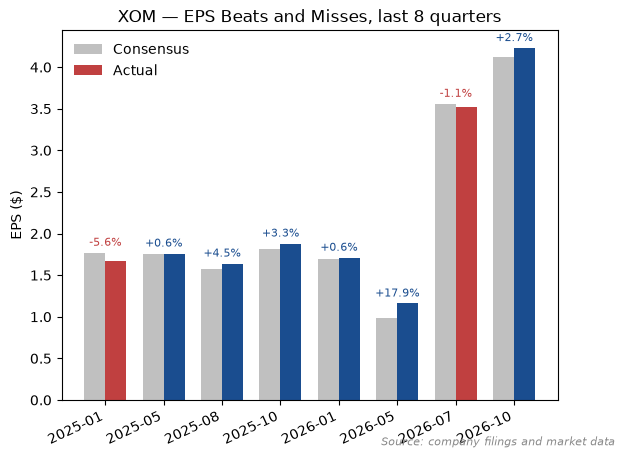
ExxonMobil's third quarter, reported on 30 October, roughly doubled profit, and the company paired it with a bigger dividend and a buyback promise for 2027. GAAP earnings came to $3.72 a share, against $1.76 a year earlier.
| Third quarter 2026 | |
|---|---|
| Revenue | $110.5B |
| GAAP net income | $15.41B |
| EPS, GAAP | $3.72 |
| EPS, adjusted | $4.23 |
| Consensus EPS: market data / Oil & Gas Journal | $4.12 / $3.99 |
| Quarterly dividend | $1.07, from $1.03 |
| 2027 buyback promised | $20B |
The adjusted figure strips out one-off items and the timing of hedge marks. It beat consensus, though the size of the beat depends on whose consensus you use, because the Oil & Gas Journal's estimate sat well below ours. Darren Woods, the chairman and chief executive, called the raise the 44th consecutive year of dividend growth. The release promised "2027 share repurchases of $20 billion", with a footnote: "assuming reasonable market conditions". The same day Exxon agreed two LNG deals that give it operatorship and bigger stakes in Mozambique and Papua New Guinea.
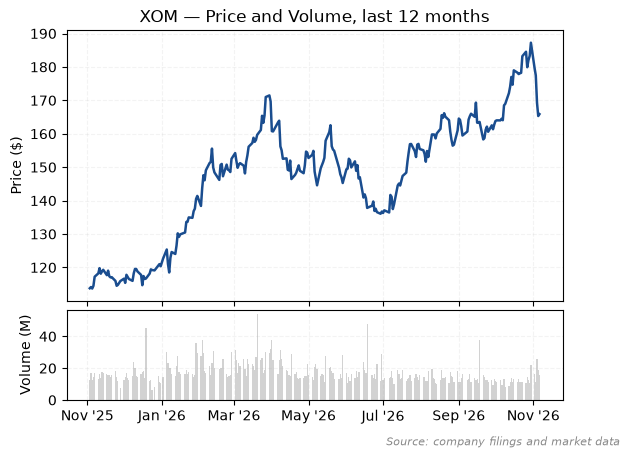
Then the shares fell 11.4% in the five sessions to 6 November, while the S&P 500 lost 2.7%. Brent fell almost 8% on 2 November on hopes of US–Iran diplomacy, and Exxon lost 4% that day. Its biggest drop came on 4 November, when Brent broke below $95. Exxon disclosed nothing new that week, so the whole move came from oil and the Iran headlines.
The coverage that followed, from TIKR to Zacks to Trefis, argued about the multiple and treated peace as plainly bad for Exxon. I think it missed two things in the company's own filings. The war has been taking barrels away from Exxon, and the street's 2028 number already assumes oil well below the futures curve.
The Company Behind the Pump
Exxon finds and produces oil and gas, refines crude into fuels, and turns hydrocarbons into plastics and lubricants. Woods called it "the largest nonstate-owned refiner in the world", and it runs about 3.6 million barrels of crude a day. Exxon Mobil Corporation was incorporated in New Jersey in 1882, and Exxon and Mobil merged in 1999. Since 1 July 2026 the listed parent has been ExxonMobil Holdings Corporation, a Texas company based in Spring. Shareholders swapped one for one, and the 10-Q says the change left the business, assets and financial reporting as they were.
Output is reported in koebd, thousands of barrels of oil equivalent a day. The unit counts gas by its energy content so that oil and gas can be added together, and in the prose I just say barrels a day.
| Scale | |
|---|---|
| Production, 2025 | 4,736 koebd |
| Proved reserves, end-2025 | 19.3B barrels of oil equivalent |
| Employees, end-2025 | 58,000 (61,000 a year earlier) |
| Shares outstanding, 30 September 2026 | 4,079M |
| Market value at $165.87 | about $677B |
Upstream Earns Most of the Money, Except This Year
In a normal year the oil and gas business carries the company. The table shows Exxon's four segments for the last two full years, on earnings excluding identified items, the basis management uses.
| Segment, earnings ex-items | FY2024 | FY2025 | Change |
|---|---|---|---|
| Upstream | $25.18B | $22.25B | −11.6% |
| Energy Products | $3.95B | $6.94B | +75.5% |
| Chemical Products | $2.67B | $1.07B | −59.9% |
| Specialty Products | $3.07B | $2.86B | −6.7% |
| Corporate & Financing | ($1.40B) | ($3.01B) | |
| Total | $33.46B | $30.11B | −10.0% |
Upstream, which covers oil, gas and liquefied natural gas (LNG), earned three quarters of the 2025 total. Its decline was all price, because Exxon's average realized production price fell to about $65 a barrel from $76. Energy Products, the refining and fuel-trading arm, rose 75.5% after a weak 2024 that the company blamed on "new industry capacity" squeezing margins. Chemicals earned less than half its 2024 figure, and lubricants slipped.
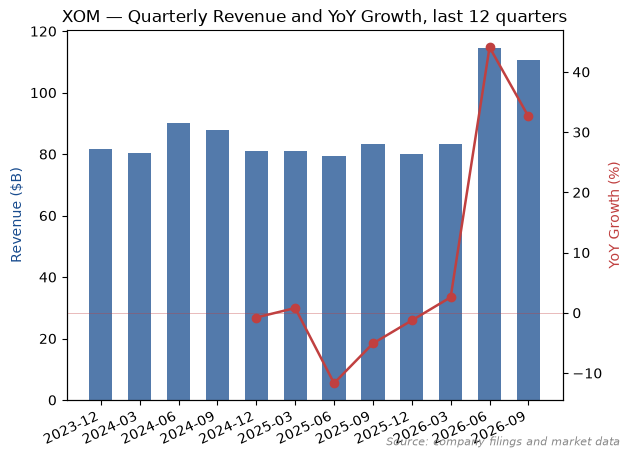
This year refining carried the company. In the third quarter Energy Products earned more than the upstream.
| Segment, adjusted earnings | 2Q26 | 3Q26 |
|---|---|---|
| Upstream | $9.19B | $7.31B |
| Energy Products | $4.10B | $9.05B |
| Chemical Products | $1.21B | $0.73B |
| Specialty Products | $0.97B | $1.28B |
| Corporate & Financing | ($0.79B) | ($0.86B) |
| Total | $14.68B | $17.51B |
The company said refining "improved on higher margins", worth about $4.5B in the quarter. It blamed the upstream decline on "lower prices and accelerated Guyana entitlement impact." The question for 2028 is which of these two years it resembles.
How the Business Works: Price, Margin and the Barrels You Keep
Exxon earns more when Brent and refining margins rise, but the war has cut its volumes, and in Guyana high prices actually cost it barrels. The table tracks the drivers by quarter. Realization is the price Exxon actually receives for its crude.
| 4Q25 | 1Q26 | 2Q26 | 3Q26 | |
|---|---|---|---|---|
| Brent, $/bbl | 63.69 | 80.61 | 104.52 | 97.01 |
| Exxon non-US crude realization, $/bbl | 57.46 | 69.98 | 92.42 | 84.03 |
| Discount to Brent, $/bbl | 6.23 | 10.63 | 12.10 | 12.98 |
| Indicative refining margin, $/bbl | 18.3 | 16.3 | 29.0 | 50.3 |
| Production, koebd | 4,988 | n/a | 4,514 | 4,496 |
Read across the rows and Brent and the refining margin climbed, while the discount widened and production fell.
Brent, the global crude benchmark, matters most, because Exxon's sensitivity table says each $1 move changes annual upstream earnings by about $700M after tax. But Exxon is now receiving about $13 a barrel less than Brent for its non-US crude, against about $6 in the fourth quarter of 2025, so part of the price rise never reaches it. The likeliest reason is the one Woods gave for the UAE, where sales "have been deferred just based on the constraints".
The refining margin, the spread between crude's cost and what the products fetch, roughly tripled between the first and third quarters to about $50 a barrel. Neil Hansen, the chief financial officer, said the refineries ran at "record utilization levels of around 84%", with Gulf Coast crude units "around 100%."
Volume is down about 10% since the end of 2025. Guyana adds a twist, because Exxon works there under a production-sharing contract that repays its costs in oil before the rest is split with the government. When prices rise, those costs are repaid with fewer barrels and Exxon's share shrinks, which took 87,000 barrels a day off the upstream in a single quarter.
What Changed: Bigger Underneath, Smaller on Top
Exxon has grown in the two places that now matter most. The Pioneer acquisition closed in May 2024 and doubled its Permian position, and Hansen said the synergy target has since doubled to $4B a year. Stabroek, the Guyana block, passed one billion barrels produced "just 11 years after discovery," Woods said, after a decade of investing "countercyclically".
The war took about 350,000 barrels a day off the top of that, most of it gas. That is Exxon's guide for the Middle East hit, which Woods accepted when an analyst put it to him on the call. The March strikes on Qatar's Ras Laffan LNG complex took out 17% of the country's export capacity, according to QatarEnergy. By the third quarter Exxon's Asia gas sales had nearly halved, a loss of about 264,000 barrels a day of oil equivalent from gas alone.
So a war that sent Brent past $110 in September cut Exxon's output by about a tenth. Woods said the loss is "concentrated [in] Qatar" and that UAE production is back, with sales held up by logistics. Most of what was lost is waiting on a shipping lane, and only a small part is broken.
Demand: Fuel Is Short Because Supply Was Destroyed
The refining windfall comes from lost supply, since demand has not jumped. Woods said "1/3 of the shortage out there roughly is just the inability to get clean products out of the Middle East." He added that "roughly about half of Russia's refining capacity has been taken offline," turning Russia into a net importer of clean fuels. The EIA's October outlook describes "unusually tight diesel markets."
Woods expects the tightness to last "certainly well through next year… but it could be longer." My case does not need it to, because it explains 2026 and probably 2027, and the 2028 model below assumes it is gone.
The longer-run demand case is Exxon's own. Its Global Outlook projects energy demand growing through 2050, with oil and gas "more than half" of supply. The 10-K now names "increased demand for artificial intelligence (AI), including the construction and expansion of AI data centers" as a demand factor, which matters for the gas and LNG book. Some demand is already contracted: Hansen said the carbon capture and storage business has 11 million tonnes a year under contract, and the 10-K lists oil and gas delivery commitments running through 2028.
Exxon is adding capacity to meet that demand.
| Project | Timing, per the 30 October call |
|---|---|
| Uaru, the fifth Guyana development (about 250,000 barrels a day gross) | Start-up in the fourth quarter |
| Golden Pass LNG | Train 1 first LNG in March; Train 2 "substantially complete by December"; Train 3 mechanical completion mid-2027 |
| Rovuma LNG | Decision expected "as we get through the back end of this year" |
In refining, Gulf Coast reconfigurations will add about 100,000 barrels a day of distillate yield, starting with Baytown, which completes in 2028. Woods said building on existing sites costs "half the cost roughly of grassroot."
The Constraint Is a Strait and Two Trains in Qatar
Geography is what holds Exxon's volumes down, and most of the problem goes away once ships can move. The biggest constraint is the Strait of Hormuz and the export routes out of the UAE. Those barrels can be produced today and will be sold once the cargoes can sail.
A small part of the loss, about 90,000 barrels a day, is gone for years. Ras Laffan's Trains 4 and 6, two of its LNG processing units, were destroyed, and QatarEnergy expects repairs to take three to five years. Exxon owns 34% and 30% of them. Rystad Energy says the parts come from "a limited number of specialist facilities" with long lead times.
| Middle East loss | Barrels of oil equivalent a day |
|---|---|
| Exxon's guide for the hit | about 350,000 |
| Long-dated: Exxon's share of Trains 4 and 6 | 84,000 to 95,000 |
| Returns when the Strait reopens | 255,000 to 265,000 |
The long-dated line is my conversion of Exxon's share of the two trains' LNG capacity into barrels, and the full working is linked under Sources.
Two smaller constraints remain. Guyana's contract terms tighten as prices rise and loosen as they fall. Execution is the other, because the original contractor's bankruptcy has already delayed Golden Pass Train 1 once.
Add the returning barrels to the third-quarter rate and production reaches roughly 4,750 koebd, about 2025's full-year level. That is before Uaru, Golden Pass or Permian growth. The 2030 plan targets 5.5 million barrels a day of oil equivalent, but Exxon has not published a 2028 milestone, so I do not invent one.
What It Is Worth: The Company's Plan at the Futures Price
The cleanest way to value Exxon in 2028 is to take management's own plan and change only the oil price. In December 2025 Exxon promised "$25 billion in earnings growth… by 2030… versus 2024… at constant prices and margins," starting from 2024's $33.5B of earnings excluding identified items.
Spread evenly, that growth puts the plan at about $50.1B in 2028, at 2024's prices and margins. It looks on pace: re-priced to 2024's Brent, 2025 earnings rose about $4.7B in the plan's first year, against a $4.2B annual pace. That check adjusts only for oil, so I treat it as a rough guide.
I then re-price 2028 to three oil cases using the $700M-per-dollar sensitivity. I hold refining and chemical margins at 2024 levels throughout, which is the cautious choice because 2024 was a weak refining year. For the share count, I assume the rest of the 2026 buyback and the $20B for 2027 are done at today's price, with nothing for 2028.
| 2028 case | Brent | 2028 earnings | Shares | EPS |
|---|---|---|---|---|
| Exxon's planning price | $65 | $39.2B | 3,929M | $9.98 |
| Futures strip | $78.66 | $48.8B | 3,929M | $12.42 |
| EIA 2027 forecast | $84 | $52.6B | 3,929M | $13.38 |
At Exxon's own $65 planning price, the plan earns $9.98, within 2% of the $10.15 consensus in our market data. Consensus, in other words, looks like Exxon's plan priced at $65 oil.
At the futures price, the plan earns about $12.40 a share, roughly a fifth above consensus. Commodity Board put the January 2028 Brent future at about $79 on 23 September. Netting out the permanently damaged Qatar trains costs about 15 cents a share, which barely dents the gap.
So consensus is either a low-oil number or a low-growth number. It is Exxon's plan at $65 oil, or it is the plan at about $79 oil with only a third of the earnings growth management has promised for 2025 to 2028. Both readings put the street below management's plan at the September curve, and the whole gap comes from the oil price.
The futures quote is six weeks old, and front-month Brent has fallen from about $110 to the mid-$90s since late October. Here is what each key assumption is worth.
| If this changes | 2028 EPS effect |
|---|---|
| Each $1 off 2028 Brent | about −$0.18 |
| 2028 strip $5 lower, near $74 | about $11.50, still 13% above consensus |
| Only 80% of the plan's growth arrives by 2028 | about −$0.85 |
| 2028 Brent 20% below the strip, near $63 | about −$2.80, below consensus |
| Each $1 a barrel of refining margin below 2024 | about −$0.22 |
The result is most sensitive to oil. A $5 miss on the strip still leaves my number above consensus, and only a 20% miss takes it below. The full working is linked under Sources.
What the Market Is Paying: Fair on Consensus, Cheap at the Strip
The bear coverage quotes trailing earnings, and on that basis Exxon does look expensive, at a 48% premium to the average of eight oil peers. The table adds EV/EBITDA, which compares enterprise value with operating cash earnings.
| Trailing basis | P/E | EV/EBITDA |
|---|---|---|
| ExxonMobil | 17.0x | 8.5x |
| Chevron | 15.5x | 6.8x |
| BP | 13.1x | 3.1x |
| Saudi Aramco | 11.9x | 7.3x |
| TotalEnergies | 8.7x | 4.2x |
| Shell | 8.5x | 4.2x |
| Eight-peer average | 11.1x |
Against its own history the multiple sits in the middle, at the 56th percentile of nine profitable years, and TIKR's forward measure puts it just under its five-year average. Trefis notes that the median S&P 500 company trades at 21.8 times.
The trailing figure includes this year's windfall quarters, so I make the valuation call on 2028 earnings. At $165.87 the stock trades at 16.3 times consensus and 13.4 times my number. That is fair on the street's figure and cheap at the futures strip, and the current price assumes, in effect, that oil settles near Exxon's own $65 planning price.
The cash flow makes it easy to wait. In 2025 dividends and buybacks exceeded free cash flow, but this year free cash flow has covered them and still cut net debt by about a third.
| Cash and balance sheet | |
|---|---|
| Free cash flow, FY2025 | $26.1B |
| Dividends and buybacks, FY2025 | $37.2B |
| Free cash flow, first nine months of 2026 | $39.0B |
| Dividends and buybacks, first nine months of 2026 | $28.0B |
| Net debt, end-2025 | $32.8B |
| Net debt, 30 September 2026 | $22.1B |
| Dividend cost at $1.07 a quarter | about $17.5B a year |
Hansen called Exxon's net debt to capital "the strongest in the industry". Goldman's Neil Mehta asked whether the $20B buyback holds "if oil was not $120 and oil was $60." Woods answered with the dividend: "we're not going to ever cut our dividend. So any increases we had becomes an obligation." That leaves buybacks as the flexible part, and Hansen said they have averaged about $13B a year since the Exxon and Mobil merger.
The Competition: Why Exxon Wins the Projects
Exxon's first edge is that it runs its own large projects, and it is buying operatorship wherever it can. The Rovuma swap gives it the larger onshore operated piece and takes it out of Eni's floating position, a deal one analyst on the call said "makes a lot of sense" for both sides. Woods' thesis is that a single global projects organisation means "we need to be an operator with a significant… share."
Refining is the second edge. Morgan Stanley's Devin McDermott said on the call that Exxon is "one of the only companies that's materially expanded U.S. refining capacity over the last decade." Woods said the $2B Beaumont expansion "paid for itself in about 3 years," and Hansen said Exxon runs twice as many megaprojects as any rival oil major, at 20% lower cost and 20% faster. Both are company claims made on the call, but Beaumont is a finished project with a stated cost and payback, which makes it the more concrete of the two.
Technology lowers cost as well. A lightweight fracking proppant developed by Exxon's refinery engineers is now used across the Permian, and Woods expects about half the Permian drilling fleet to be automated by 2028.
Chevron, the closest rival, is a partner in Guyana through its Hess deal and trades nearest to Exxon's multiple. Shell has the largest LNG portfolio and its own Ras Laffan problem: The National reported that one of two trains at its Pearl GTL plant is offline for at least a year. Shell and TotalEnergies trade at about half Exxon's multiple, so the same windfall is cheaper there. Exxon's claim to the premium rests on its scale, Guyana and its US refining, and I count the premium among the risks below.
What Could Go Wrong
The 10-K's risk factors start with the obvious one: "The oil, gas, and petrochemical businesses are fundamentally commodity businesses." It also lists losses on hedging derivatives, which show up as timing effects and cost $2.54B in the third quarter alone. The company says "in periods of rising prices, the timing effects are typically negative," so they tend to reverse when prices fall. The 10-K was filed in February, before the Qatar strikes, and speaks only of "wars or hostile actions".
The strongest case against is speed, because peace could crush refining margins before the barrels return. In the third quarter Energy Products earned about five times its 2025 quarterly average. That gap of about $7B a quarter dwarfs the roughly $1.7B a year that restored upstream volume would earn, so for 2027 earnings the risk is real.
My answer is that 2028 is a different question. The model holds refining margins at 2024 levels, below 2025's, so none of the windfall is in my $12.40. Peace removes earnings my model never counted, and it returns barrels and Guyana entitlements that consensus may not credit.
The second risk is the curve. Commodity Board describes the strip as steeply backwardated, meaning later contracts trade well below near ones, and it falls below $60 from 2033. If 2028 Brent lands near $65, consensus is right, and 16.3 times 2028 earnings is a full price.
The third risk is Qatar, where the repair could run past five years, and Golden Pass has slipped once already. The fourth is the analysts. TIKR reported that Wells Fargo cut Exxon to Equal Weight on 1 October, and the bullish share of ratings has fallen to 35% from 38%. The assumption in my model most likely to be wrong is the 2028 oil price, followed by an even schedule for the plan's growth.
What I Am Watching
Three dated events will test the thesis.
| When | Event | What it tests |
|---|---|---|
| 10 November | EIA November outlook | Whether the $84 forecast for 2027 Brent survives the sell-off |
| Later this quarter | Press release reaffirming 2027 planning metrics | Whether the $25B plan is trimmed |
| 29 January | Fourth-quarter results, against a $4.07 consensus | Middle East volumes, entitlement barrels, whether timing effects reverse |
The thesis is wrong if the 2028 strip falls toward $65 or the plan is cut.
Takeaway
The market sold Exxon as a war trade that loses when the war ends. Its upstream is smaller because of the war, and most of the 350,000 barrels a day it lost are waiting on a strait. Consensus for 2028 already looks like the company's plan at $65 oil, with no windfall left in it, while at the futures curve the same plan earns about a fifth more. Peace is a smaller loss for Exxon than an 11% fall suggests.
Sources
- ExxonMobil 3Q26 earnings release and supplemental information (Form 8-K, Exhibits 99.1 and 99.2), 30 October 2026
- ExxonMobil 3Q26 earnings call, 30 October 2026 (Darren Woods, Neil Hansen, Jim Chapman and analysts)
- ExxonMobil 3Q26 earnings considerations (Form 8-K, Exhibit 99.1), 16 October 2026
- ExxonMobil Holdings Corporation Form 10-Q for the quarter ended 30 September 2026
- Exxon Mobil Corporation Form 10-K for fiscal 2025, Items 1 and 1A, filed 18 February 2026
- ExxonMobil 4Q25 earnings release (Form 8-K, Exhibit 99.1), 30 January 2026, and 2024 results release
- ExxonMobil 2030 corporate plan release, 9 December 2025, and Sensitivities and Key Assumptions, January 2026
- US Energy Information Administration, Short-Term Energy Outlook, 6 October 2026
- QatarEnergy statements via Anadolu and The Energy Year, March 2026; Rystad Energy via Riviera
- The National on Pearl GTL, 30 July 2026
- Commodity Board (CMB News), 23 September and 5 November 2026
- Kalkine Media, 2 November 2026; TIKR, late October and 2 November 2026; Zacks, 3 and 4 November 2026; 24/7 Wall St., 4 November 2026; Trefis, 7 November 2026; Oil & Gas Journal, 30 October 2026; Stocktwits, October 2026
- Company filings, reported results, analyst consensus and market price data
- Full working, including the Qatar volume conversion, the three oil cases and the share count:
research/2026-11-08_XOM.md
Research, not a recommendation. Figures are sourced as cited and were current at publication; nothing here is personalized investment advice.